
What Is the Sodium to Salt Calculator?
Nutrition labels around the world list either sodium or salt, and the two are not the same thing. Salt (sodium chloride, NaCl) is only about 40% sodium by weight. This calculator converts a sodium figure in milligrams into the equivalent amount of table salt in grams, so you can compare products and track your intake on a consistent basis.
How to Use It
Enter the sodium content shown on a food label or recipe in milligrams (mg). The calculator instantly returns the equivalent salt in grams. For example, a label reading 400 mg sodium per serving converts to 1 gram of salt.
The Formula Explained
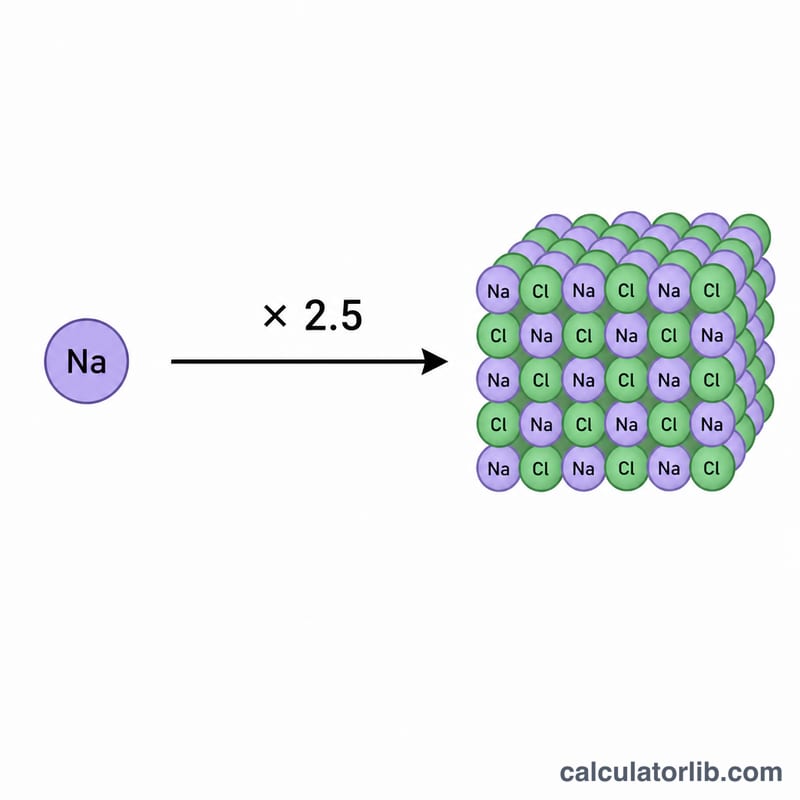
Because sodium makes up roughly 40% of salt's weight, you divide by 0.4 — which is the same as multiplying by 2.5:
$$\text{Salt (g)} = \frac{\text{Sodium (mg)} \times 2.5}{1000}$$
The \(\times 2.5\) step converts sodium to salt in the same unit (mg → mg), and dividing by 1000 converts milligrams to grams.
Worked Example
Suppose a ready meal contains 1,000 mg of sodium. $$\text{Salt} = \frac{1000 \times 2.5}{1000} = 2.5 \text{ g of salt}$$ That is already a large share of the commonly recommended daily limit of around 5–6 g of salt.
FAQ
Why multiply by 2.5? One molecule of NaCl contains one sodium atom (23 g/mol) and one chlorine atom (35.5 g/mol), totalling 58.5 g/mol. Sodium is \(23/58.5 \approx 39.3\%\) of salt, so salt = sodium ÷ 0.393 ≈ sodium × 2.5.
How do I go the other way? To convert salt to sodium, divide the salt amount by 2.5 (or multiply by 0.4).
How much salt is too much? Many health authorities suggest adults keep salt under about 5–6 g (roughly 2,000–2,400 mg sodium) per day, but check local guidance.