
What Is the Sodium in Salt Calculator?
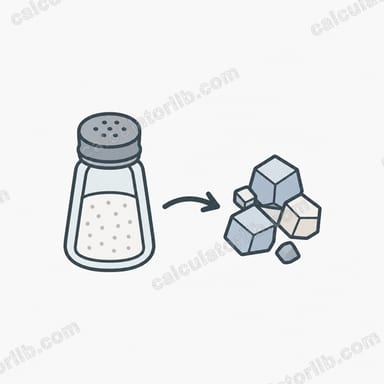
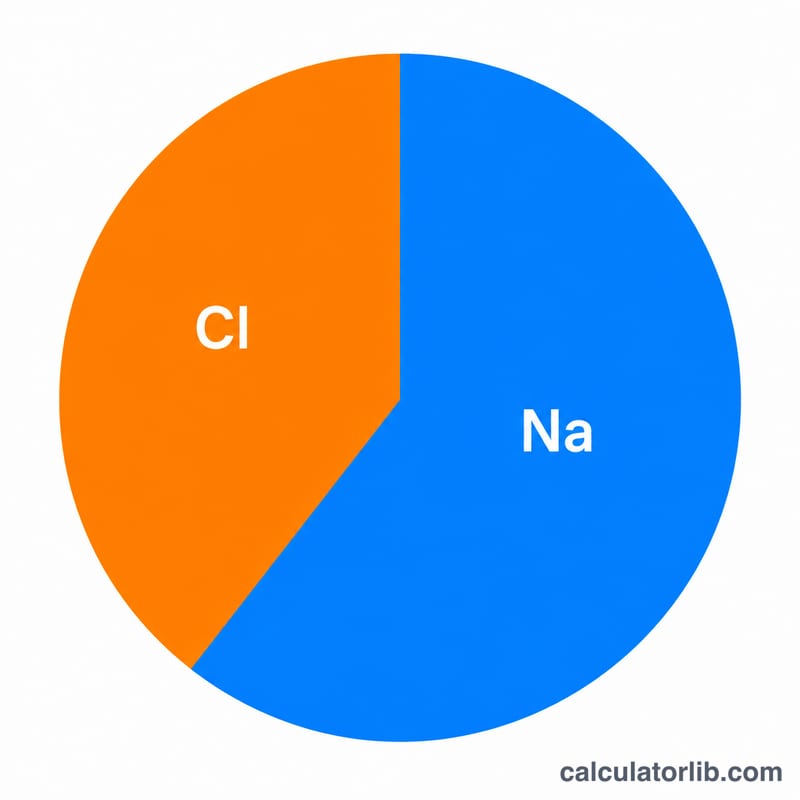
Table salt is chemically sodium chloride (NaCl). Because the sodium atom makes up only part of the molecule, salt is not 100% sodium. By mass, sodium accounts for roughly 39.3% of pure table salt. This calculator converts an amount of salt in grams into the equivalent amount of sodium in milligrams (mg) — the figure that matters most for health and nutrition guidelines.
How to Use It
Enter the amount of salt in grams and the calculator instantly returns the sodium content in milligrams. This is handy for reading food labels, planning low-sodium diets, or converting between the "salt" figures common on European packaging and the "sodium" figures common on US Nutrition Facts labels.
The Formula Explained
The conversion uses the mass fraction of sodium in sodium chloride:
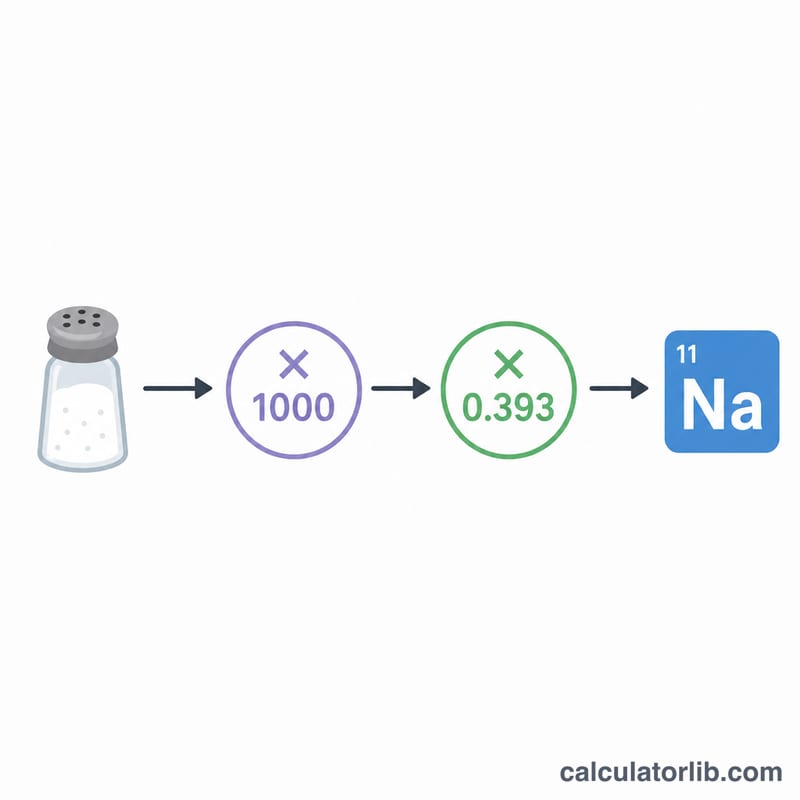
$$\text{Sodium (mg)} = \text{Salt (g)} \times 1000 \times 0.393$$
Multiplying grams by 1000 converts to milligrams, and the 0.393 factor accounts for sodium being about 39.3% of salt by weight. Equivalently, every 1 gram of salt ≈ 393 mg of sodium, and to reverse it, multiply sodium by about 2.5 to estimate salt.
Worked Example
Suppose a serving contains 5 grams of salt. Sodium \(= 5 \times 1000 \times 0.393 = 1{,}965\) mg of sodium. That is close to the World Health Organization's recommended daily limit of about 2,000 mg of sodium (≈ 5 g of salt) per day.
FAQ
Is salt the same as sodium? No. Salt (sodium chloride) contains both sodium and chloride; only about 39.3% of its weight is sodium.
How do I convert sodium back to salt? Multiply sodium (in grams) by about 2.5 to get salt in grams.
Why 39.3% and not 40%? It comes from atomic masses: sodium ≈ 23.0 and chloride ≈ 35.45, so \(23.0 \div 58.45 \approx 0.393\).