
What Is the Geriatric BMI Calculator?
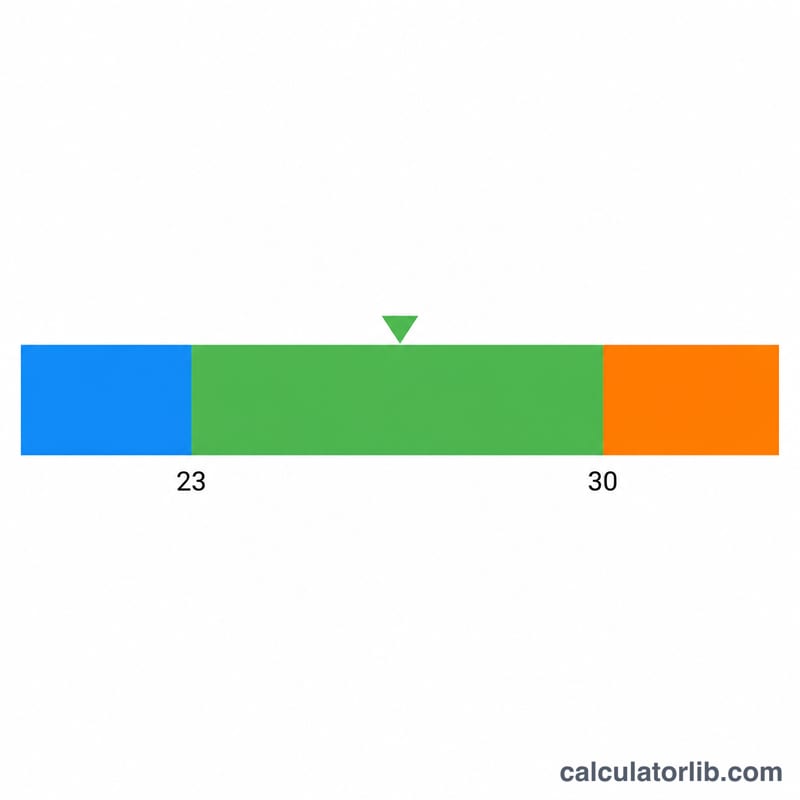
The Geriatric BMI Calculator estimates body mass index for older adults (typically aged 65 and over) and classifies it using ranges adjusted for ageing rather than the standard adult cut-offs. Research consistently shows that a slightly higher BMI is protective in later life, so for seniors a BMI of 23 to 30 kg/m² is generally considered the healthy range — being too thin in old age carries more risk than being modestly overweight.
How to Use It
Enter your weight in kilograms and your height in centimetres, then read the resulting BMI and category. The calculator converts your height to metres internally and applies the geriatric thresholds: under 23 is flagged as underweight, 23–29.9 as a healthy weight for the elderly, 30–34.9 as overweight, and 35 or above as obese.
The Formula Explained
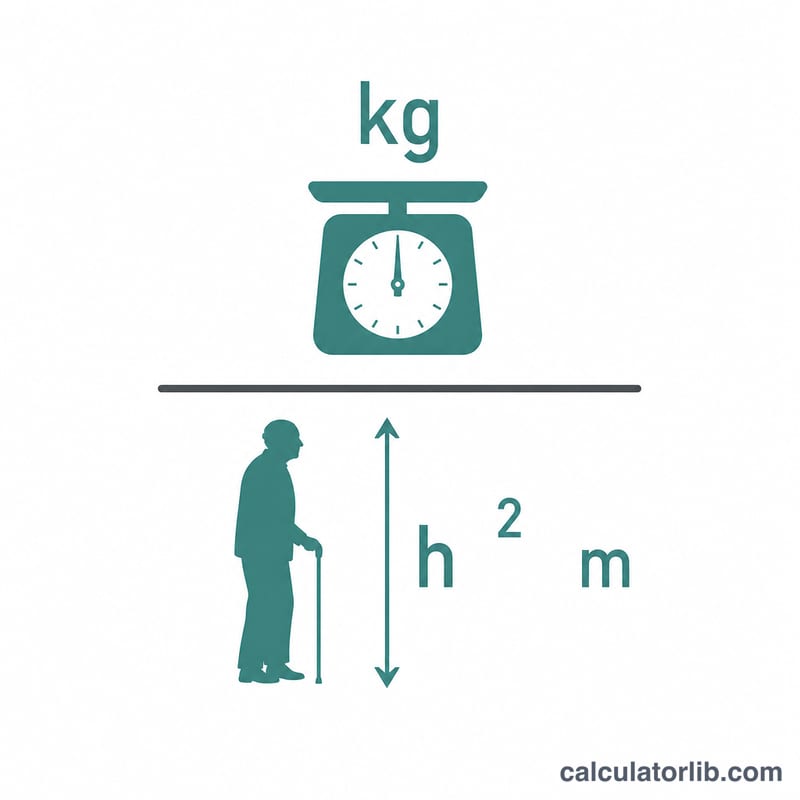
BMI is universal: weight in kilograms divided by height in metres squared.
$$\text{BMI} = \frac{\text{Weight (kg)}}{\left(\frac{\text{Height (cm)}}{100}\right)^2}$$A person who is 165 cm tall is 1.65 m, and \(1.65^2 = 2.7225\). The only difference for geriatric BMI is the interpretation — the numeric formula is identical, but the healthy band shifts upward to account for age-related changes in muscle mass and bone density.
Worked Example
A 72-year-old weighing 70 kg at 165 cm tall:
$$\text{BMI} = 70 \div (1.65 \times 1.65) = 70 \div 2.7225 \approx 25.71 \text{ kg/m}^2$$Under standard adult rules this is "overweight," but under geriatric ranges it falls comfortably within the healthy 23–30 band.
FAQ
Why is the normal range higher for older people? Studies link a BMI of 23–30 with the lowest mortality risk in seniors; very low BMI is associated with frailty and worse outcomes.
Does this replace medical advice? No. BMI is a screening tool only and does not measure body composition. Discuss results with a healthcare provider.
Can I use pounds and inches? This version uses metric units (kg and cm); convert first (1 lb ≈ 0.4536 kg, 1 inch = 2.54 cm).