
What is the Dog BMI Calculator?
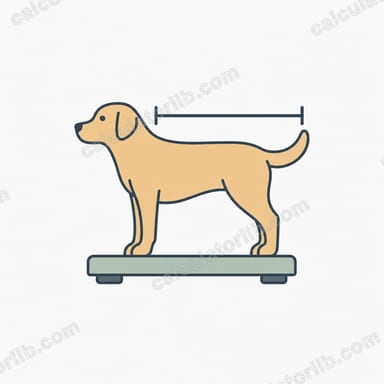
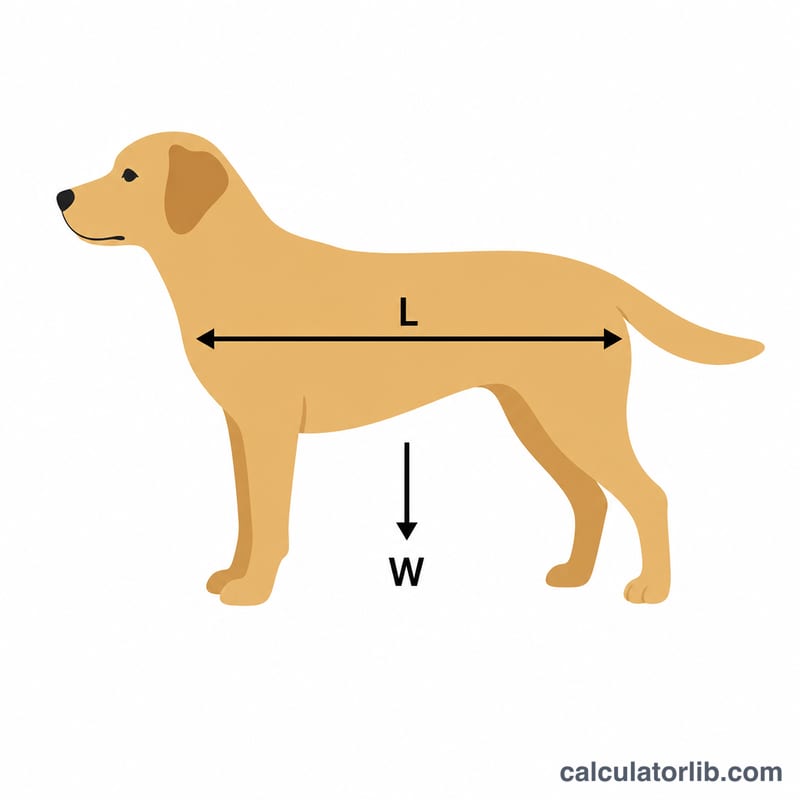
The Dog BMI Calculator gives you a body mass index proxy for your dog using the same idea as the human BMI: it divides body weight by the square of body length. Because dogs are not upright, "length" here means the horizontal body length — measured from the base of the neck (or nose, kept consistent) to the base of the tail. The result is expressed in kg/m² and is a rough relative indicator of build, not a clinical diagnosis.
How to use it
Weigh your dog in kilograms and measure its body length in centimeters. Enter both values and the calculator converts the length to meters, squares it, and divides the weight by that figure. Compare the same dog over time, or against littermates of similar frame, to track whether it is trending heavier or lighter.
The formula explained
$$\text{BMI} = \dfrac{\text{weight (kg)}}{\text{length (m)}^2}$$ First the length in centimeters is divided by 100 to get meters. That value is squared, and the weight in kilograms is divided by the result. A higher number suggests a heavier, more compact build for a given length; a lower number suggests a leaner or longer frame.
Worked example
Suppose a dog weighs 10 kg and is 60 cm long. Convert length: \(60 \div 100 = 0.6\) m. Square it: \(0.6 \times 0.6 = 0.36\) m². Divide: \(10 \div 0.36 \approx 27.78\) kg/m². That is the dog's BMI proxy.
FAQ
Is there a standard healthy BMI range for dogs? No universal range exists because breeds vary enormously in build. Use this as a relative tracking tool and rely on a vet's Body Condition Score for health decisions.
How do I measure body length? Have the dog stand naturally and measure horizontally from the base of the neck to the base of the tail. Keep your measuring point consistent each time.
Should I use this instead of a vet check? No. This is an informational estimate. Your veterinarian's assessment is the authoritative measure of a healthy weight.