
What Is the Dog Water Intake Calculator?
This tool estimates how much water a healthy adult dog should drink each day based on its body weight. A common veterinary guideline is that dogs need roughly 50 to 60 milliliters of water per kilogram of body weight per day. The calculator lets you choose the rate and instantly converts the result into milliliters, cups, and fluid ounces.
How to Use It
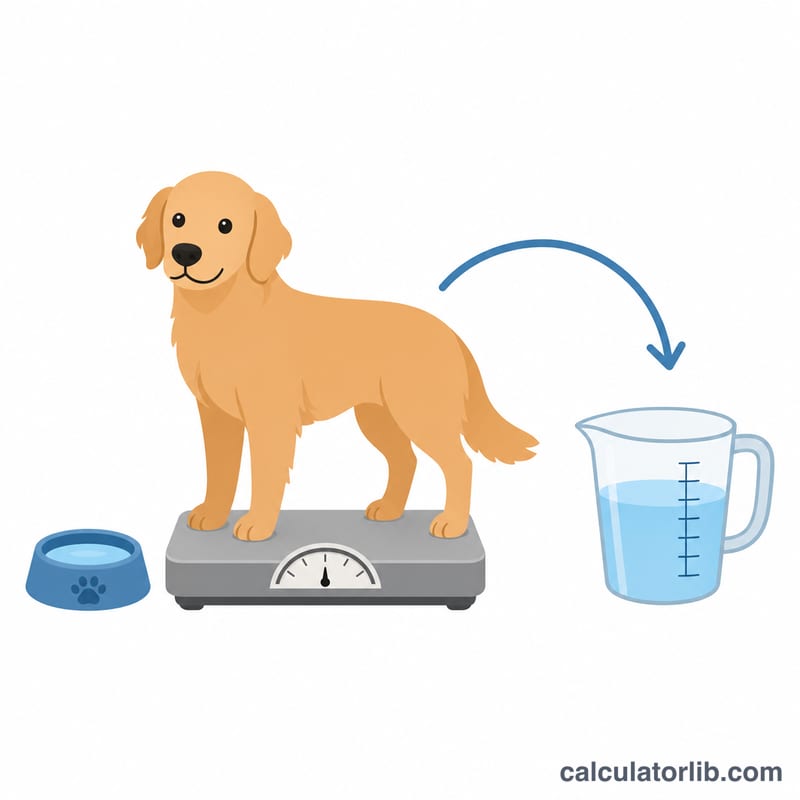
Enter your dog's weight in kilograms and the water rate per kilogram (the default of 50 ml/kg is a sensible starting point). The calculator multiplies the two values to give the recommended daily total. Increase the rate toward 60 ml/kg for active dogs or warm weather.
The Formula Explained
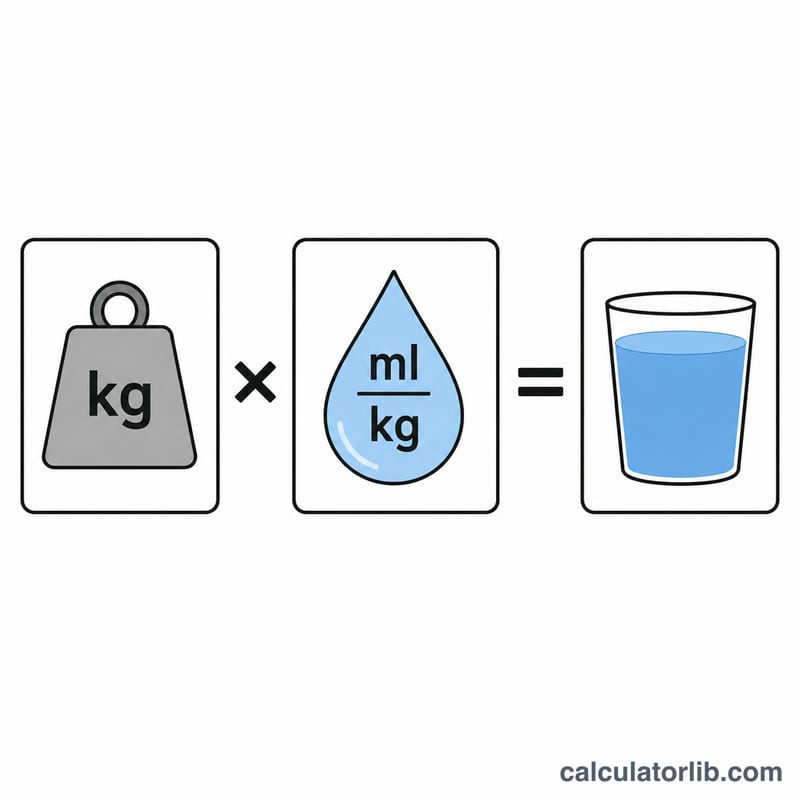
The math is simple: $$\text{Daily Water (ml)} = \text{Weight (kg)} \times \text{Rate (ml/kg)}$$ For example, a 10 kg dog at 50 ml/kg needs \(10 \times 50 = 500\) ml per day, which is about 2.08 cups or 16.9 fluid ounces. Larger dogs naturally need proportionally more.
Worked Example
Consider a 20 kg Labrador at the 55 ml/kg rate: $$20 \times 55 = 1{,}100 \text{ ml per day}.$$ That equals roughly 4.58 cups. On hot days or after exercise, the dog may safely drink toward the upper end of the range.
FAQ
Does food affect water needs? Yes. Dogs on wet food get extra moisture and may drink less, while dogs on dry kibble often drink more.
Is more or less water a concern? Sudden large changes in drinking can signal health issues such as kidney disease or diabetes. Consult a veterinarian if intake changes dramatically.
Is this for puppies too? Puppies have different needs and often drink more relative to size. Use this as a rough adult-dog guide and ask your vet for puppy-specific advice.