
What Is the Dog Size Calculator?
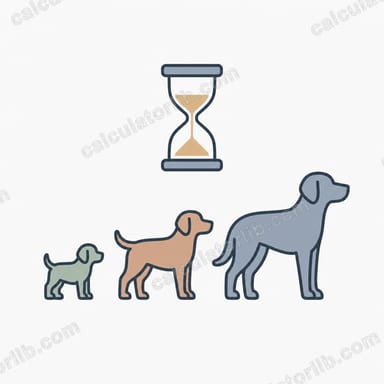
The Dog Size Calculator estimates how big your puppy will be as a fully grown adult. By taking your puppy's current weight and age, it projects an adult weight and sorts your dog into a small, medium, or large size category. This is a handy planning tool for choosing the right crate, harness, food portions, and even living space before your dog finishes growing.
How to Use It
Enter your puppy's current weight in pounds and its current age in weeks. Click calculate, and the tool returns an estimated adult weight along with a size category. For the most reliable result, measure your puppy around the 14–20 week mark, when growth patterns are clearer. Younger puppies and toy or giant breeds may show wider variation.
The Formula Explained
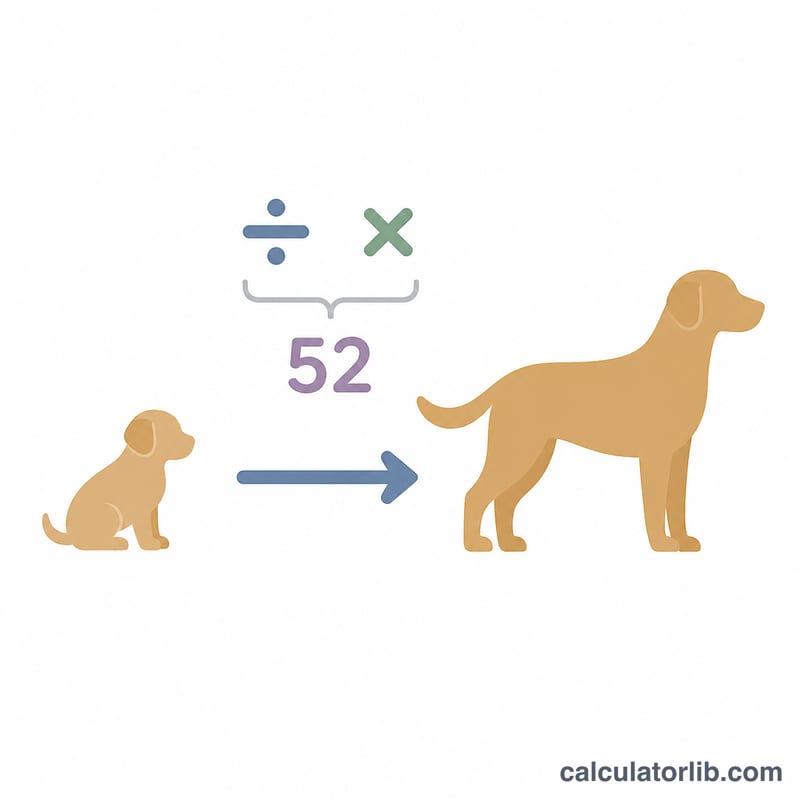
The calculator uses a simple linear growth proportion. It divides the puppy's current weight by its age in weeks to find a weekly growth rate, then multiplies by 52 (the number of weeks in a year) to project a full-year adult weight:
$$\text{Adult Weight (lb)} = \frac{\text{Puppy Weight}}{\text{Age in Weeks}} \times 52$$
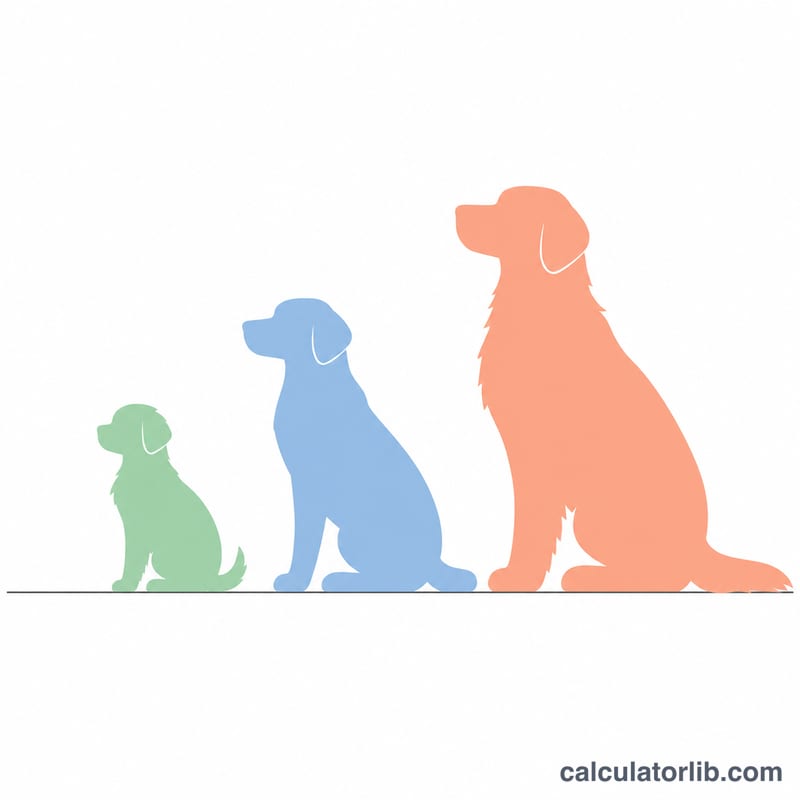
The resulting weight then determines the category: under 25 lb is small, 25–50 lb is medium, and over 50 lb is large.
Worked Example
Suppose your puppy weighs 5 lb at 12 weeks old. The calculation is: $$\left(\frac{5}{12}\right) \times 52 = 0.4167 \times 52 \approx 21.7 \text{ lb}.$$ Since 21.7 lb is below 25 lb, the dog falls into the Small size category.
FAQ
How accurate is this estimate? It is a rough projection based on linear growth. Real growth slows over time, so treat the result as a ballpark, not a guarantee.
When should I measure my puppy? Mid-puppyhood (roughly 14–20 weeks) tends to give the most representative estimate for many breeds.
Does breed matter? Yes. Toy breeds finish growing earlier while giant breeds keep growing for 18–24 months, so breed-specific charts may be more precise for those dogs.