
What Is Entropy Change?
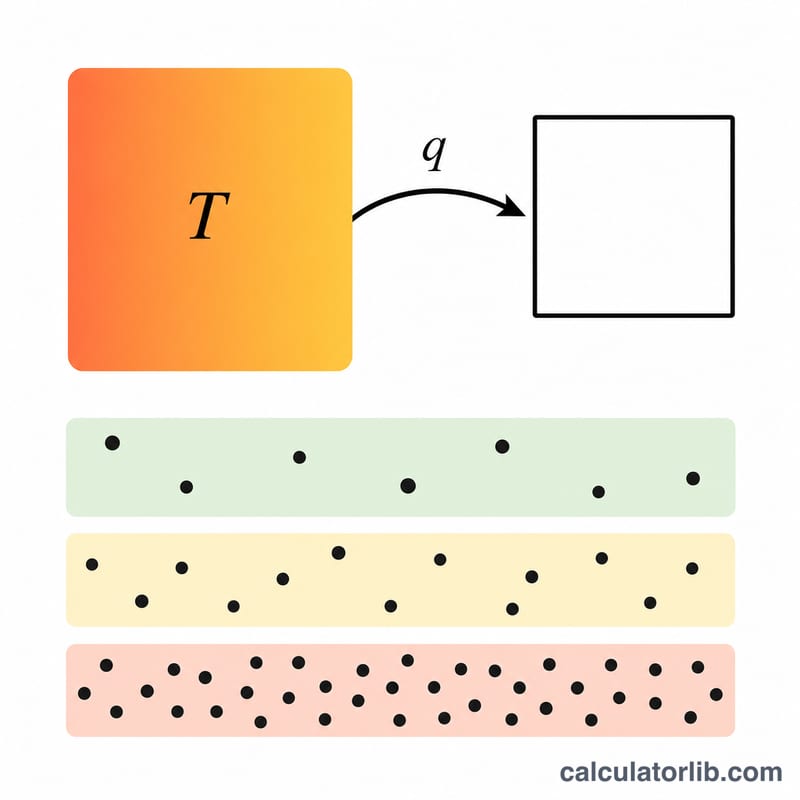
Entropy (S) is a measure of the disorder or the number of possible microscopic arrangements of a thermodynamic system. The entropy change (\(\Delta S\)) tells you how that disorder changes during a process. For a reversible transfer of heat at constant temperature, the entropy change is simply the heat added divided by the absolute temperature. This calculator uses the fundamental relationship \(\Delta S = q_{\text{rev}} / T\) to give you \(\Delta S\) in joules per kelvin (J/K).
How to Use This Calculator
Enter the heat transferred reversibly, q, in joules (J). Use a positive value when heat flows into the system and a negative value when heat leaves it. Then enter the absolute temperature T in kelvin (K) — remember to convert from Celsius by adding 273.15. The calculator divides q by T and returns the entropy change \(\Delta S\) in J/K.
The Formula Explained
The defining equation is:
$$\Delta S = q_{\text{rev}} / T$$Here \(q_{\text{rev}}\) is the heat exchanged along a reversible path and \(T\) is the constant absolute temperature in kelvin. Because temperature appears in the denominator, the same amount of heat produces a larger entropy change at a lower temperature. For chemical reactions, an alternative form is \(\Delta S = \sum S_{\text{products}} - \sum S_{\text{reactants}}\), summing standard molar entropies.
Worked Example
Suppose 1000 J of heat is reversibly absorbed by a system held at 300 K. Then:
$$\Delta S = 1000 \text{ J} \div 300 \text{ K} = \mathbf{3.3333 \text{ J/K}}.$$The positive sign confirms the system's entropy increased as it absorbed heat.
FAQ
Why must temperature be in kelvin? Entropy is defined using absolute (thermodynamic) temperature. Using Celsius would give incorrect, even undefined, results near 0 °C.
Can \(\Delta S\) be negative? Yes. If heat leaves the system (negative q), \(\Delta S\) is negative, meaning the system becomes more ordered.
What units does \(\Delta S\) have? Joules per kelvin (J/K). For molar entropy, divide by the number of moles to get J/(mol\(\cdot\)K).