
What Is the Rat Cage Size Calculator?
Pet rats are highly active, social animals that need plenty of room to climb, explore, forage, and exercise. This calculator estimates the minimum recommended cage volume based on how many rats you keep. A common guideline among rat owners and rescues is roughly 2.5 cubic feet of usable cage space per rat, with an absolute minimum of 2 cubic feet per rat for smaller setups.
How to Use It
Enter the number of rats you plan to house, then set the cubic feet allotted per rat. The default of 2.5 cu ft per rat reflects a comfortable target; the tool enforces a 2 cu ft floor since less than that is considered cramped for these intelligent rodents. The result shows the total minimum cage volume you should aim for, plus the equivalent in liters for comparing metric-rated cages.
The Formula Explained
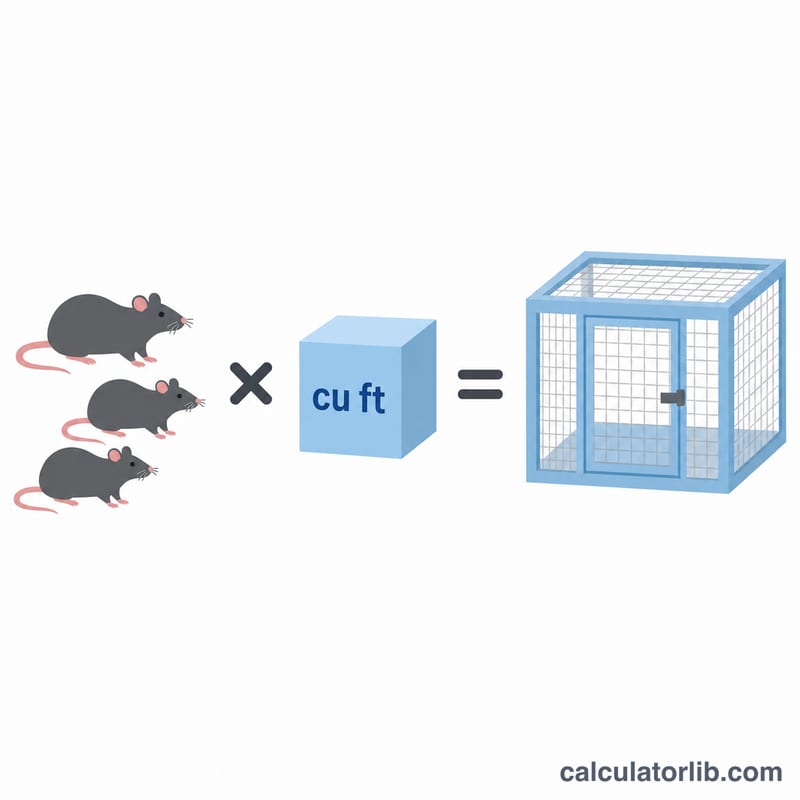
The calculation is straightforward: $$V = \text{Number of Rats} \times \text{Cubic Feet per Rat}$$. To convert cubic feet to liters, multiply by \(28.3168\). Because rats thrive in groups, you should rarely keep just one — most owners keep at least two, so a pair needs about 5 cubic feet of space.
Worked Example
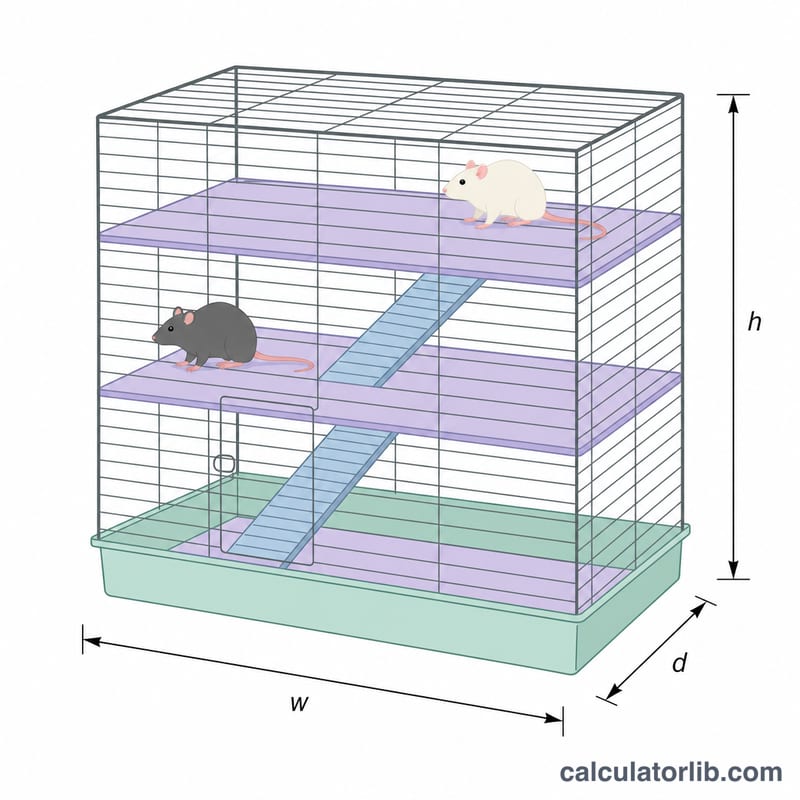
Suppose you have 4 rats and use the standard 2.5 cu ft per rat. The required volume is $$4 \times 2.5 = 10 \text{ cubic feet},$$ which equals about 283.17 liters. A tall, multi-level cage works well because rats love vertical space.
FAQ
Is bigger always better? Yes — as long as bar spacing is safe (about 0.5 inch for adults) and levels aren't dangerously high, more space and enrichment is always welcome.
Does cage shape matter? Vertical space and multiple levels are ideal since rats climb readily, but ensure they cannot fall far onto hard surfaces.
Can I keep one rat in a small cage? Rats are social and should be kept in pairs or groups; a lone rat in a tiny cage often becomes stressed or depressed.