
What Is BMI Prime?
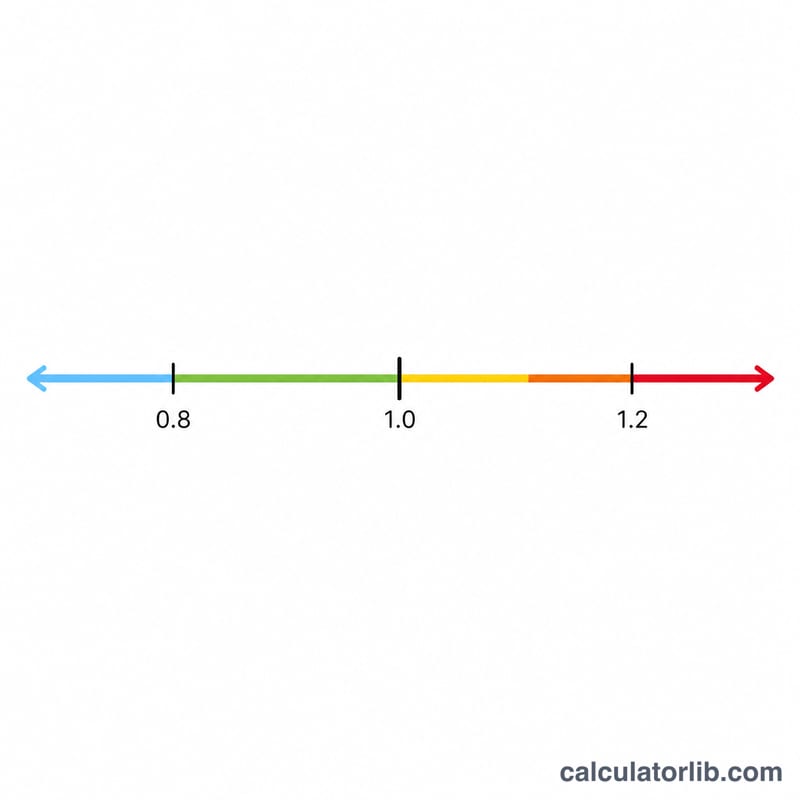
BMI Prime is a simple dimensionless ratio that compares a person's actual Body Mass Index (BMI) to the upper limit of the normal range, which is 25 kg/m². It was popularised as a quick way to see how far above or below the healthy ceiling a BMI falls. A BMI Prime of exactly 1.00 means your BMI is precisely 25; a value of 1.20 means your BMI is 20% above the normal upper limit, while 0.90 means you are 10% below it.
How to Use This Calculator
Enter your weight in kilograms and your height in centimetres, then read off your BMI Prime. The calculator also shows your underlying BMI and a quick interpretation band so you have full context. Because BMI Prime is just BMI scaled by 25, it carries the same well-known limitations: it does not distinguish muscle from fat and is a population-level screening figure, not a diagnosis.
The Formula Explained
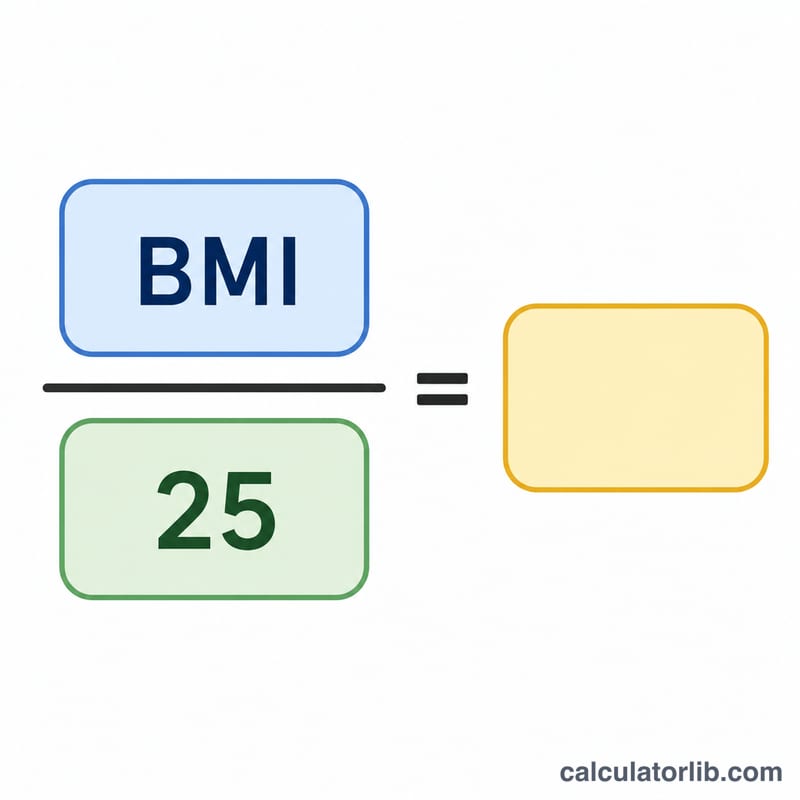
First the calculator computes BMI as weight (kg) divided by height (m) squared. Height entered in centimetres is converted to metres by dividing by 100. Then BMI Prime is found by dividing that BMI by 25:
$$\text{BMI Prime} = \frac{w / h^2}{25}$$
Worked Example
Suppose you weigh 80 kg and are 180 cm (1.8 m) tall. $$\text{BMI} = \frac{80}{1.8 \times 1.8} = \frac{80}{3.24} \approx 24.69 \text{ kg/m}^2$$ $$\text{BMI Prime} = \frac{24.69}{25} \approx 0.99$$ just under the upper normal limit — a healthy result.
BMI Prime Categories and Thresholds
BMI Prime is the ratio of your measured BMI to the upper limit of the normal range, 25 kg/m². A value of exactly 1.00 means your BMI sits right at the top of the healthy range. Multiply your BMI Prime by 100 to read it as a percentage of the upper healthy ceiling.
| Weight category | BMI range (kg/m²) | BMI Prime range |
|---|---|---|
| Severe (very) underweight | < 16.0 | < 0.64 |
| Underweight | 16.0 – 18.5 | 0.64 – 0.74 |
| Normal (healthy) | 18.5 – 25.0 | 0.74 – 1.00 |
| Overweight | 25.0 – 30.0 | 1.00 – 1.20 |
| Obese class I | 30.0 – 35.0 | 1.20 – 1.40 |
| Obese class II | 35.0 – 40.0 | 1.40 – 1.60 |
| Obese class III | ≥ 40.0 | ≥ 1.60 |
Each BMI Prime threshold is simply the BMI threshold divided by 25. For example, the overweight cutoff of \(25 \div 25 = 1.00\) and obese class I begins at \(30 \div 25 = 1.20\).
Interpreting Your BMI Prime
BMI Prime restates your body mass index relative to the healthy upper limit of 25, so it is read against a single anchor point of 1.00:
- Exactly 1.00 — your BMI is right at the top of the healthy range (BMI 25). You are at the ceiling that separates normal weight from overweight.
- Below 1.00 — your BMI is within or beneath the healthy band. A value of 0.74 corresponds to the lower edge of normal weight (BMI 18.5); values under 0.74 fall into the underweight range.
- Above 1.00 — your BMI exceeds the healthy ceiling. The amount above 1.00 tells you how far past the limit you are: 1.20 means your BMI is 20% above 25, and 1.40 means 40% above.
Because it is just a rescaling of BMI, BMI Prime carries the same limitations. It is a population screening indicator, not a diagnosis. It does not measure body fat directly, and it does not distinguish muscle from fat or account for where fat is stored. Very muscular people, athletes, older adults, pregnant people and some ethnic groups may be misclassified. Use it as a quick reference point and discuss any health concerns with a qualified professional. This is general information, not medical advice.
FAQ
What is a healthy BMI Prime? A range of about 0.74 to 1.00 corresponds to a normal BMI (18.5–25). Below 0.74 is underweight and above 1.00 is overweight.
Why use BMI Prime instead of BMI? It expresses your weight status as an easy-to-grasp percentage of the upper healthy limit, which some people find more intuitive than raw BMI numbers.
Does it work with pounds and inches? This version uses metric units; convert pounds to kilograms (÷2.2046) and inches to centimetres (×2.54) first.