What this calculator does
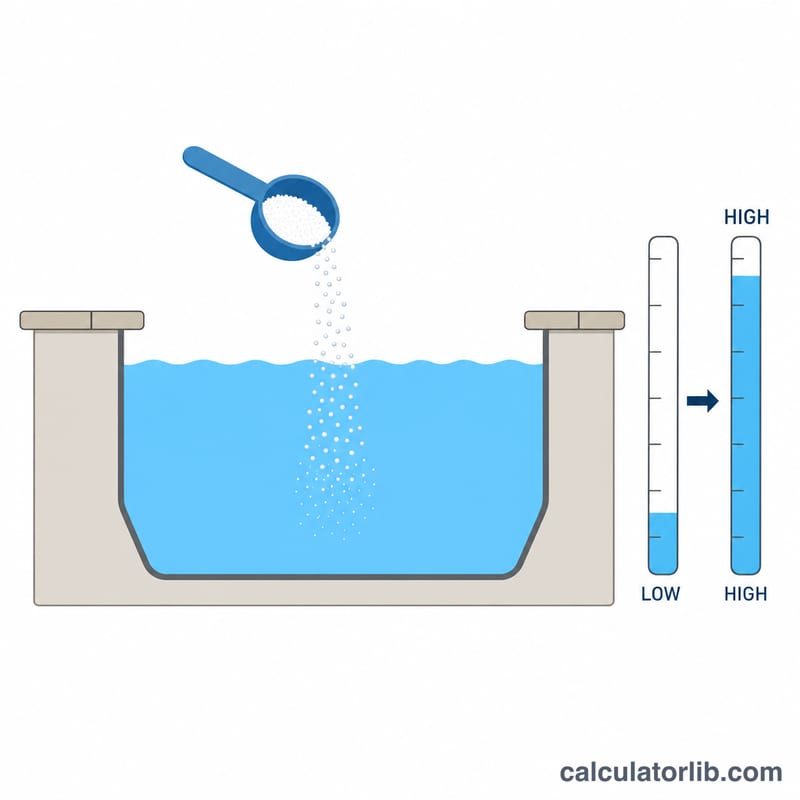
The Pool Chlorine Dosage Calculator tells you how much chlorine product to add to your swimming pool to raise the free chlorine concentration from its current level to your target level. It works for any liquid or granular chlorine product as long as you know its available (active) chlorine percentage.
How to use it
Enter your pool's volume in gallons, the current free chlorine reading (from a test kit, in ppm), your desired target ppm (typically 1–3 ppm for residential pools), and the available chlorine percentage printed on your product label. The calculator returns the dose in fluid ounces, with cups and quarts shown for convenience.
The formula explained
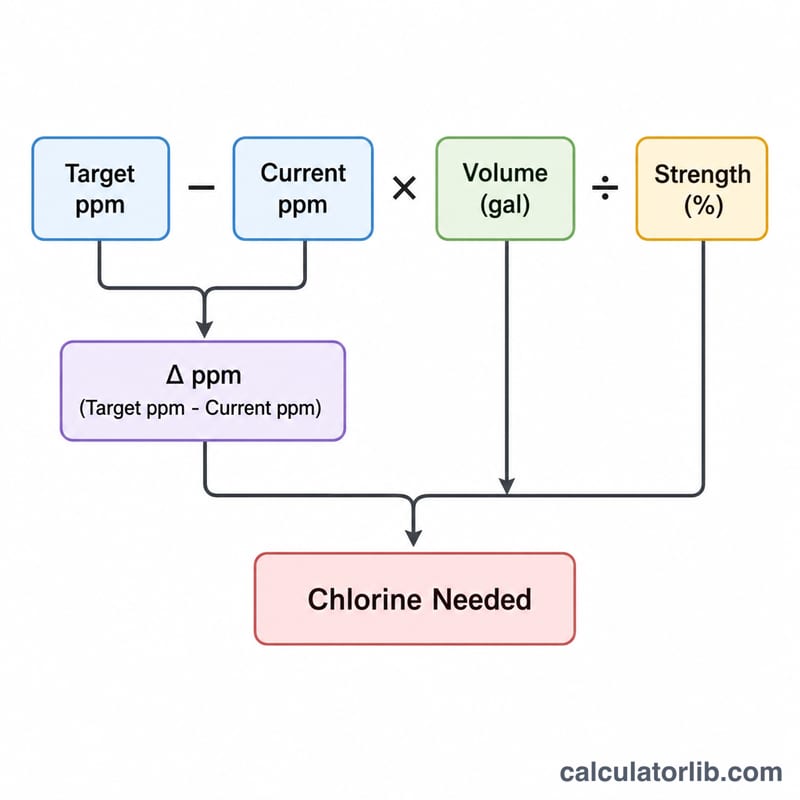
The constant 0.0000834 converts a one-ppm change across one gallon into ounces of pure (100% available) chlorine. Multiplying by gallons and by the ppm increase gives the pure-chlorine demand; dividing by the product's available fraction scales that up to the actual amount of your specific product. In short: $$\text{oz} = \dfrac{(\text{target}_{ppm} - \text{current}_{ppm}) \times \text{gallons} \times 0.0000834}{\%_{available}/100}$$.
Worked example
For a 15,000-gallon pool currently at 1 ppm, raising to 3 ppm using 10% liquid chlorine: \(\Delta\text{PPM} = 2\), so $$\text{oz} = \frac{(2 \times 15{,}000 \times 0.0000834)}{0.10} = \frac{2.502}{0.10} = 25.02 \text{ fluid ounces}$$ — about 3.1 cups.
Common Chlorine Products and Available Chlorine Percentages
The "Available (%)" field in the calculator is the percentage of available chlorine in the product you are adding. The values below are typical ranges seen in the United States and other markets. Strength varies by brand, and liquid chlorine loses strength as it ages, so always check the label on your container.
| Product | Form | Typical available chlorine | Notes |
|---|---|---|---|
| Liquid chlorine (sodium hypochlorite) | Liquid | 10–12.5% | Unstabilized (no cyanuric acid). Adds some salt and raises pH slightly. |
| Household bleach (sodium hypochlorite) | Liquid | about 6–8.25% | Unstabilized. Use plain, unscented bleach with no additives. Use the strength printed on the label. |
| Calcium hypochlorite (cal-hypo) | Granular or tablet | 65–73% | Unstabilized. Adds calcium hardness and raises pH. |
| Sodium dichlor (dichloroisocyanurate) | Granular | 56–62% | Stabilized. Adds cyanuric acid (CYA) with every dose. |
| Trichlor (trichloroisocyanuric acid) | Tablet or stick | about 90% | Stabilized and strongly acidic. Adds CYA and lowers pH over time. |
| Lithium hypochlorite | Granular | about 35% | Unstabilized. Less common and less widely available today. |
- Stabilized products (dichlor and trichlor) add cyanuric acid. CYA protects chlorine from sunlight, but it builds up over time and makes chlorine less effective if it gets too high.
- Liquid vs. solid: Liquid products are measured in fluid ounces, while the calculator's output for solids is better treated as an approximation. Follow the product label's dosing chart for granular and tablet products.
- Check the label: Enter the actual percentage shown on your container, not a typical value.
Recommended Free Chlorine Ranges for Pools
These figures come from general guidance such as the U.S. CDC Model Aquatic Health Code (MAHC) and industry bodies such as APSP/PHTA (Pool & Hot Tub Alliance). Local health codes differ, so check the rules that apply to your pool.
| Parameter | Typical range or target |
|---|---|
| Free chlorine, residential pool | 1–3 ppm |
| Free chlorine, public/commercial pool | Commonly cited minimum of 1 ppm (set by local code) |
| Free chlorine, spas and hot tubs | Commonly cited as about 2–4 ppm (CDC/MAHC guidance, higher than for pools) |
| Shock (superchlorination) level | About 10 times the combined chlorine, or enough to reach breakpoint; often 10 ppm or more |
| Cyanuric acid (CYA) | Ideal 30–50 ppm for most outdoor pools |
| pH | 7.2–7.8 |
Free chlorine and cyanuric acid
CYA binds some of the free chlorine, so the more CYA a pool has, the more free chlorine it needs. A commonly used rule of thumb is a minimum free chlorine of about 7.5% of the CYA level. For example, at 40 ppm CYA the minimum is about \(0.075 \times 40 = 3\) ppm. This is a community rule of thumb and is higher than the simple 1–3 ppm range often quoted for unstabilized pools.
Chlorine works best when pH is in range. Test free chlorine, pH and CYA with a reliable kit before and after dosing, and retest after the water has circulated.
Dosage Comparison by Pool Size and Product
The table shows fluid ounces of liquid chlorine needed to raise free chlorine by 2 ppm, using the calculator's formula:
$$\text{oz} = \frac{2 \times \text{gallons} \times 0.0000834}{\text{fraction available}}$$
Example: for 10,000 gal at 10%, \(\frac{2 \times 10000 \times 0.0000834}{0.10} = \frac{1.668}{0.10} =\) 16.68 oz.
| Pool volume | 6% liquid | 10% liquid | 12.5% liquid |
|---|---|---|---|
| 10,000 gal | 27.8 oz | 16.68 oz | 13.34 oz |
| 15,000 gal | 41.7 oz | 25.02 oz | 20.02 oz |
| 20,000 gal | 55.6 oz | 33.36 oz | 26.7 oz |
| 30,000 gal | 83.4 oz | 50.04 oz | 40.03 oz |
A weaker product or a larger pool needs proportionally more. Halving the strength doubles the dose, and doubling the volume doubles the dose.
Accuracy note: The constant 0.0000834 is a simplified approximation. A strict mass-based calculation, in which 1 ppm in 10,000 gal is about 37.9 g of chlorine, gives a larger dose for liquid chlorine. At 12.5% that is roughly 10 fl oz per 1 ppm per 10,000 gal. Treat these figures as a starting point, add in stages, retest after circulation, and follow the dosing chart on your product label.
FAQ
What target ppm should I use? Most pools are kept between 1 and 3 ppm of free chlorine. Raise it higher only for shock treatment.
My product is granular — does this still work? Yes, but the result is a volume estimate (fluid ounces). For granular products, weigh by label dose for best accuracy; the ounce figure here is a useful approximation.
Why did it return zero? If your target is at or below the current level, no chlorine is needed, so the calculator returns 0.