What this calculator does
A pesticide label gives you an application rate per unit of area (for example 250 mL per hectare) and a recommended spray volume, or water rate, for the same area (for example 200 L per hectare). Your sprayer, however, is filled by the tank, not by the hectare. This tool converts the label figures into the two numbers you actually need at the filling point: how much concentrate goes into one full tank, and how much product the whole job will consume. It also reports the dilution ratio, the mix concentration, and how many tank loads the area requires. The calculator is unit-agnostic for area: enter hectares if your rates are per hectare, or acres if they are per acre, as long as both rates use the same unit.
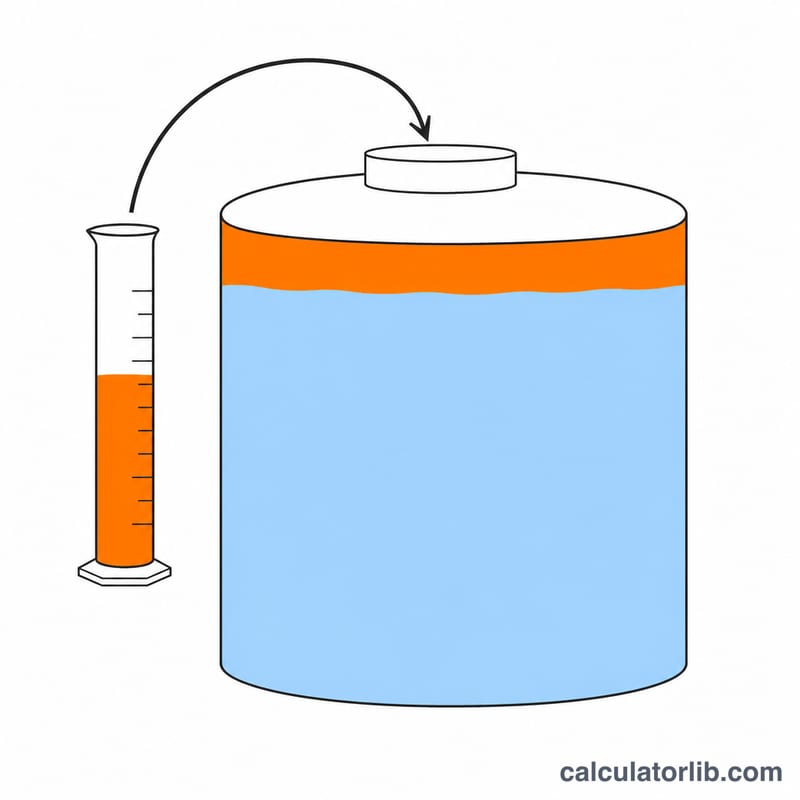
The formula explained
The ratio \(R/S\) is the amount of product carried in every litre of finished spray. Multiply it by the tank volume \(V_{tank}\) and you get the charge for one tank:
$$P_{tank} = V_{tank} \times \frac{R}{S}$$where \(R\) = product per area unit in mL, \(S\) = spray volume per area unit in litres, and \(V_{tank}\) = tank capacity in litres. Total product is simply \(P_{total} = A \times R\) for an area \(A\), and the dilution ratio is \(N = 1000S/R\), read as 1 part product to \(N\) parts finished mix.
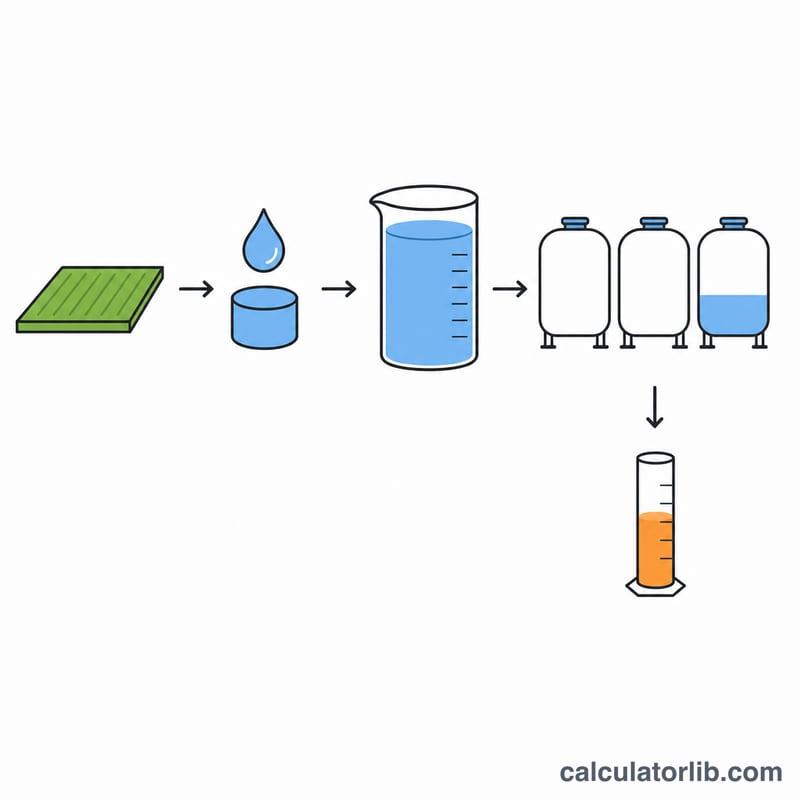
Worked example
You must treat 10 hectares at 250 mL/ha, applying 200 L/ha of spray, with a 600 L tank.
$$P_{tank} = 600 \times \frac{250}{200} = 750\,\text{mL}$$So each full tank takes 750 mL of concentrate and about 599.25 L of water. The job needs \(10 \times 200 = 2000\) L of mix, which is \(2000/600 = 3.33\) tank loads (three full tanks plus a 200 L part load), and \(10 \times 250 = 2500\) mL of product in total. The dilution ratio is \(1000 \times 200 / 250 = 800\), i.e. 1:800, or 0.125% concentration.
Unit Conversions for Rates, Volumes and Areas
Mismatched units are the most common source of dosing errors. Note in particular that the US gallon and the UK (imperial) gallon are different volumes, and that US fluid ounces are not imperial fluid ounces — check which country's label you are holding.
Volume
| Unit | Equivalent |
|---|---|
| 1 litre (L) | 1000 mL |
| 1 US gallon | 3.785 L |
| 1 UK (imperial) gallon | 4.546 L |
| 1 US fluid ounce | 29.57 mL |
| 1 US pint | 473.2 mL |
| 1 US quart | 946.4 mL |
Area
| Unit | Equivalent |
|---|---|
| 1 hectare (ha) | 2.471 acres |
| 1 acre | 0.4047 ha |
| 1 hectare | 10,000 m² |
| 1 acre | 43,560 ft² |
Rate conversions
| From | To | Multiply by | Example |
|---|---|---|---|
| mL/ha | US fl oz/acre | 0.01368 | 1500 × 0.01368 = 20.5 fl oz/acre |
| L/ha | US gal/acre | 0.1069 | 200 × 0.1069 = 21.4 gal/acre |
| US qt/acre | L/ha | 2.338 | 2 × 2.338 = 4.68 L/ha |
| US pt/acre | L/ha | 1.169 | 3 × 1.169 = 3.51 L/ha |
Dilution equivalences
These three ways of expressing the same strength are interchangeable: a ratio \(1{:}N\), a percent by volume, and millilitres of product per litre of finished spray.
| Ratio | % v/v | mL per L | Per 500 L tank |
|---|---|---|---|
| 1:100 | 1% | 10 mL/L | 5000 mL (5 L) |
| 1:200 | 0.5% | 5 mL/L | 2500 mL (2.5 L) |
| 1:500 | 0.2% | 2 mL/L | 1000 mL (1 L) |
| 1:800 | 0.125% | 1.25 mL/L | 625 mL |
| 1:1000 | 0.1% | 1 mL/L | 500 mL |
The conversion between the columns is simply $$\text{mL/L} = \frac{1000}{N} = 10 \times \%_{conc}$$ so 1:800 gives \(1000/800 = 1.25\) mL/L.
Dry formulations. Wettable powders (WP), water-dispersible granules (WG) and soluble powders are labelled in g/ha or kg/ha and follow exactly the same arithmetic — substitute grams for millilitres throughout. For a 900 g/ha rate at 200 L/ha the mix is \(900/200 = 4.5\) g/L, and a 500 L tank takes \(500 \times 4.5 = 2250\) g = 2.25 kg. Weigh dry product on a scale; do not convert grams to millilitres using a scoop, because bulk density varies widely between products. The only difference is step 5: a few kilograms of powder displace much less volume than their mass suggests, so simply fill the tank to the marked volume after the product has dispersed.
Practical Mixing and Tank-Filling Tips
The numbers above tell you what to put in the tank; these steps keep the actual mix matching them.
- Measure the concentrate properly. Use a graduated jug, dosing cylinder or dedicated measuring vessel with markings in the range you need — a 3750 mL charge measured in a 20 L container is guesswork. Read at eye level on a flat surface, and keep separate measuring equipment for herbicides and for other products.
- Half-fill first, then add product. Put roughly half the water in the tank, start the agitation, add the concentrate slowly, then top up to the final volume with agitation still running. Adding product to an empty or nearly full tank causes poor dispersion and, with some formulations, sludging.
- Mix only what the last load needs. For the part load, compute product from the litres you will actually fill: \(\text{product} = W \times R/S\). In the worked example the remainder is 400 L, so 3000 mL — not a full 3750 mL charge in a partly filled tank. This is the single easiest way to avoid leftover spray that then has to be disposed of.
- Do not round the charge by more than a few percent. The label rate is a legal maximum in most jurisdictions, so rounding up can be an offence and can leave illegal residues; rounding down gives sub-lethal exposure that selects for resistant pest and weed populations. Measure to the nearest convenient graduation, not the nearest tidy number.
- Buy in whole label pack sizes. Against a total requirement of 18 L, purchase in the pack sizes actually sold and allow a small margin for calibration error and re-treatment — but avoid large surpluses, since opened containers have limited shelf life and storage is regulated.
- Triple-rinse everything. Rinse the measuring jug and each empty container three times, adding every rinsate to the tank. This recovers product you have already paid for and already counted in the dose, and it is a normal condition of container disposal schemes.
- Verify sprayer output before you trust \(S\). A timed catch test on every nozzle, at working pressure and working speed, is the only way to know your true L/ha. Replace any nozzle whose output deviates noticeably from the others or from its rated flow.
- Check tank-mix compatibility. If mixing more than one product, add them in formulation order — water-dispersible granules and wettable powders first, then suspension concentrates, then soluble liquids, then emulsifiable concentrates, then adjuvants and oils — allowing each to disperse before the next. If you have not used the combination before, run a small jar test at the same proportions and watch for curdling, gelling or separation.
- Respect the label's intervals and buffers. Re-entry intervals, pre-harvest intervals, no-spray buffer zones near water and sensitive areas, wind-speed limits and protective-equipment requirements are all part of the approval and are not covered by any dose calculation.
The product label is the legally binding instruction and overrides any calculator output. This calculator performs arithmetic on the numbers you enter; it does not know your crop, your country's approved uses, your local water restrictions or your resistance-management programme. Approved rates, permitted crops and required intervals differ between countries and are set by national regulators. This section is general information for planning purposes, not professional agronomic, safety or legal advice — consult a qualified agronomist or your local extension or regulatory authority for decisions on a specific site.
FAQ
My label gives a ratio such as 1:500 instead of a rate. What do I enter? Set the spray volume to 1 area unit worth of water, say 100 L, and the product rate to \(100000/500 = 200\) mL, which reproduces the same 1:500 mix.
Should I subtract the product volume from the water? For dilute foliar sprays the difference is tiny, but the calculator does it anyway and shows the exact water figure.
Can I mix a part tank? Yes. Scale the product in proportion to the water actually loaded, for example a half tank takes half the product per tank figure.