What a mash bill is
A mash bill is the recipe of grains a distiller cooks and ferments before distilling whiskey. It is always quoted in percentages by grain weight — for example 70% corn, 18% rye, 12% malted barley. This calculator converts the raw weights in your recipe into those percentages, so you can scale a batch, compare recipes or check a label rule. The percentage math is universal; the 51% label check shown with the result follows United States federal standards of identity (bourbon, rye, wheat and malt whiskey), so ignore that note if you distill outside the US.
How to use it
Enter the weight of each grain in the same unit — pounds, kilograms or bushels all work, because a ratio has no units. Leave a grain at 0 if you do not use it. The tool reports each grain share, the total grain weight and which grain dominates the bill.
The formula
With \(w_i\) = the weight of grain \(i\) and \(w_{\text{total}}\) = the sum of all grain weights:
$$p_i = \frac{w_i}{w_{\text{total}}} \times 100\%$$Because every share is divided by the same total, the shares always add up to 100%.
Worked example
A 250 lb test batch uses 150 lb corn, 50 lb wheat, 30 lb malted barley and 20 lb rye. The total is
$$w_{\text{total}} = 150 + 50 + 30 + 20 = 250\,\text{lb}$$so the corn share is
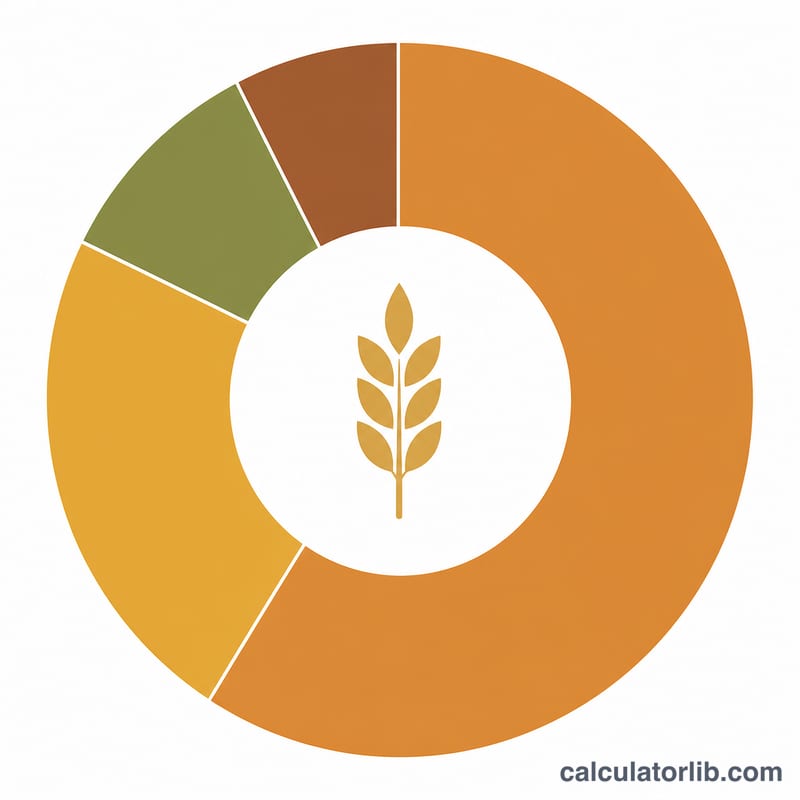
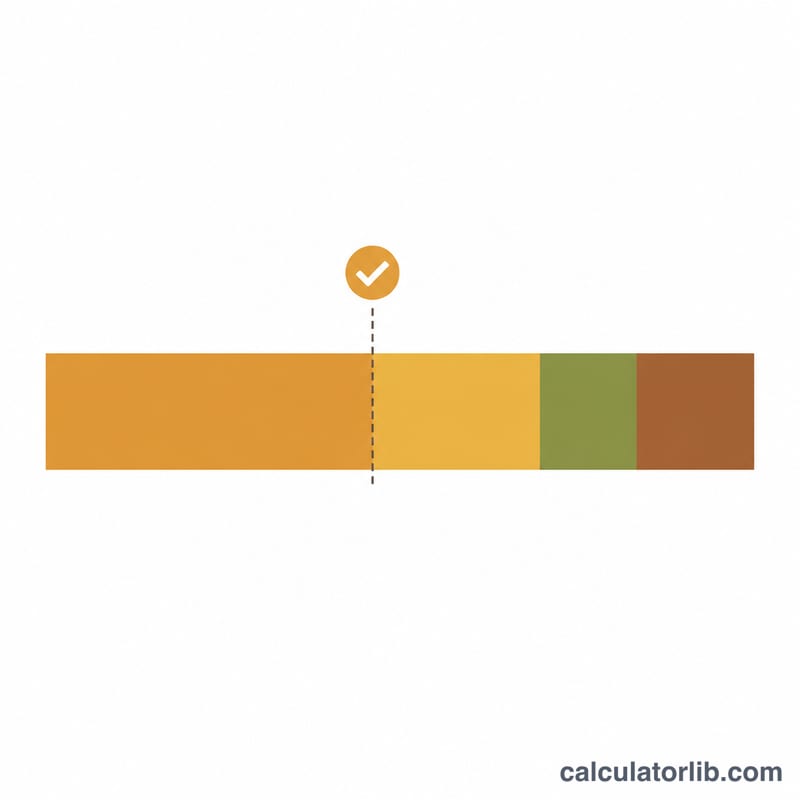
$$p_{\text{corn}} = \frac{150}{250} \times 100\% = 60\%$$and the rest work out to 20% wheat, 12% malted barley and 8% rye. Corn clears 51%, so this is a wheat-forward bourbon-style grain bill.
Typical Mash Bills by Whiskey Style
A mash bill is simply the recipe of grains, expressed as a percentage of total grain weight. The table below separates two very different things: legal minimums, which in the United States come from the standards of identity in 27 CFR 5.143, and typical industry ranges, which are conventions rather than rules. The typical ranges are broad generalisations — individual distilleries routinely sit outside them.
| Style | Typical grain percentages (by weight) | Governing rule |
|---|---|---|
| Traditional / high-corn bourbon (US) | 70–80% corn, 8–18% rye, 5–12% malted barley | ≥51% corn (27 CFR 5.143) |
| High-rye bourbon (US) | 60–70% corn, 18–35% rye, 5–10% malted barley | ≥51% corn (27 CFR 5.143) |
| Wheated bourbon (US) | 68–78% corn, 15–20% wheat, 5–12% malted barley | ≥51% corn (27 CFR 5.143) |
| American rye whiskey | 51–95% rye, balance corn and/or malted barley | ≥51% rye (27 CFR 5.143) |
| Wheat whiskey (US) | ≥51% wheat, balance corn, malted barley or rye | ≥51% wheat (27 CFR 5.143) |
| Malt whiskey (US) | ≥51% malted barley, balance other grains | ≥51% malted barley (27 CFR 5.143) |
| Corn whiskey (US) | ≥80% corn, balance malted barley and/or small grains | ≥80% corn (27 CFR 5.143) |
| Scotch single malt (UK) | 100% malted barley | UK Scotch Whisky Regulations 2009 — malted barley only, single distillery, pot still |
| Irish single pot still (Ireland) | Mixed malted and unmalted barley, commonly around 50/50; other cereals permitted in a minor share | Irish Whiskey Technical File / EU geographical-indication rules |
Note the asymmetry: the US categories above are defined by an explicit minimum percentage of one named grain (51%, or 80% for corn whiskey), while Scotch and Irish categories are defined by grain type, production method and place rather than by a percentage threshold. Outside the United States — in Canada, Japan, Australia, India and elsewhere — grain-composition rules differ or may not exist at all, so a bill that qualifies as "bourbon" under US rules is not automatically a legally defined category in another market.
Interpreting Your Mash Bill Result
The calculator converts each grain weight into a share of the total grain charge:
$$p_i = \frac{w_i}{w_{\text{total}}} \times 100\%, \qquad w_{\text{total}} = \sum_i w_i$$
It then compares the leading grain against the US named-grain minimums. Here is what each outcome actually tells you.
A passing check is necessary, not sufficient
Clearing the threshold — bourbon ≥51% corn, rye whiskey ≥51% rye, wheat whiskey ≥51% wheat, malt whiskey ≥51% malted barley, corn whiskey ≥80% corn — only satisfies the grain element of the US standard of identity. The same regulation also imposes limits your mash bill cannot express: a maximum distillation proof, a maximum proof at barrel entry, a new charred oak container requirement for most of these types (corn whiskey being the exception), and a minimum bottling proof of 80° US proof (40% ABV). A recipe can be 75% corn and still not be bourbon if it is distilled too high or aged in the wrong vessel.
Only one 51% threshold can ever be met at once
Above 51%, a single grain occupies more than half the charge, so no second grain can also reach 51%. If your result appears to clear two thresholds, a weight has been entered twice or a unit is inconsistent. The one genuinely overlapping case is corn: a bill at 85% corn satisfies both the bourbon minimum and the corn whiskey minimum, and the producer chooses which category to declare based on how the spirit is distilled and stored.
A bill that clears no threshold still has a home
If no grain reaches its minimum — a 40% corn / 35% rye / 25% malted barley charge, for example — the product is not disqualified from being whiskey. Provided it meets the general definition of whisky (fermented mash of grain, distilled at less than 190° proof, stored in oak where required, bottled at 80° proof or more), it can be labelled simply "whiskey", or fall into a specialty class such as a distilled spirits specialty product. Producers often describe these as "four-grain" or "blended-grain" whiskies on the front label.
Rounding can hide a failing bill
A result displayed as 51% may be 50.6% rounded up. Because the regulatory test is a true minimum, a bill sitting at 50.x% fails even though it reads as passing. If your leading grain lands between roughly 50% and 52%, work from the unrounded figure and build in a deliberate margin — many producers target several points above the line so that scale-weighing tolerance, moisture variation and small batching errors cannot push an individual batch under.
Percentages are by pre-cook grain weight
The shares are computed on the dry grain as charged to the cooker, before mashing, fermentation or distillation. They are not fermentable-extract shares, not post-mash solids, and not a share of final yield. Corn, rye, wheat and malted barley differ in starch content and extract efficiency, so a 70% corn bill by weight does not contribute 70% of the alcohol. Keep all five inputs in the same unit — pounds, kilograms or bushels — since the ratio is unit-independent only when the units match. If you are working from bushels, convert to weight first, because a bushel of corn and a bushel of barley are different weights.
This section is a labelling and compliance reference, not legal advice. Before committing a recipe or a label, read the current text of 27 CFR Part 5 and, where applicable, consult the TTB or a qualified beverage-alcohol attorney. Outside the United States, your national regulator's rules govern instead.
FAQ
Does the mash bill alone make it bourbon? No. In the US the grain bill must be at least 51% corn, but the spirit must also be distilled to no more than 160 proof, barrelled at no more than 125 proof in new charred oak, and bottled at 80 proof or higher.
How much malted barley do I need? Traditionally 5-12% of the bill, enough to supply the enzymes that convert starch to sugar. Distillers using exogenous enzymes can go lower.
Should malt be counted in the percentages? Yes. Every grain charged to the cooker counts toward the total, including malted barley, malted rye and adjuncts such as oats or rice.