What this calculator does
A grain bill is the list of malts in a beer recipe and the weight of each one. This tool reverses the usual gravity calculation: instead of asking what gravity a given pile of malt will give you, it asks how much malt you need to reach the original gravity you want. Give it your batch size, target OG, brewhouse efficiency and the percentage split of your grist, and it returns the weight of every grain plus the total. It works in US units (gallons and pounds) or metric (liters and kilograms) while still using PPG, the extract potential figure printed on most malt spec sheets.
The formula
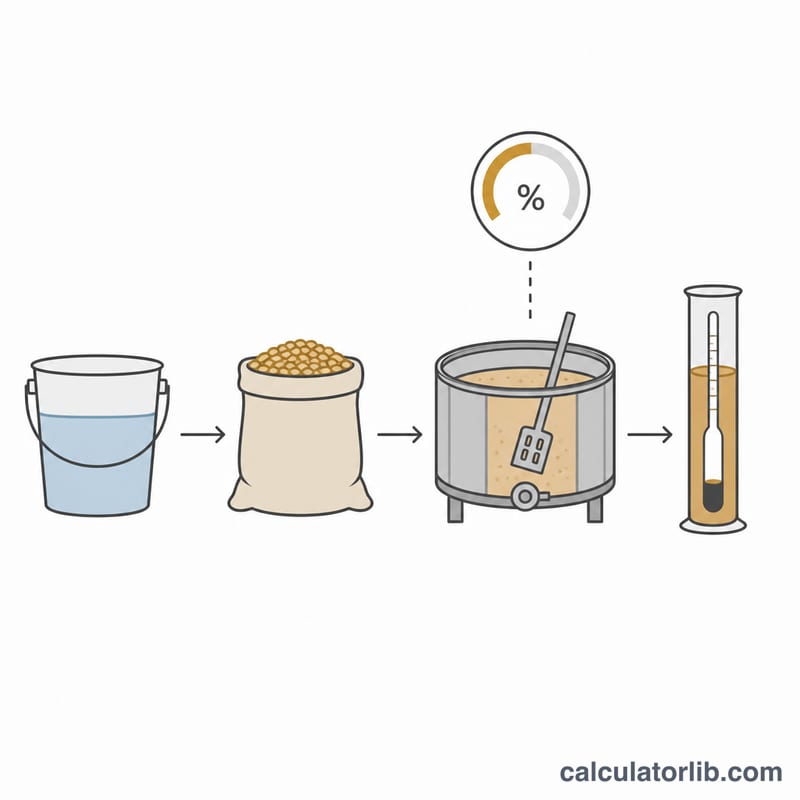
Gravity is measured in points: an OG of 1.050 is 50 points. One pound of malt with a potential of 37 PPG dissolved in one gallon yields 37 points at 100% efficiency. So the malt needed is
$$W_{\text{total}} = \frac{(OG - 1) \times 1000 \times V}{\overline{PPG} \times E}$$where \(V\) = batch volume in gallons, \(E\) = brewhouse efficiency as a decimal, and \(\overline{PPG}\) is the share-weighted average potential of the grist, \(\overline{PPG} = \sum \frac{p_i}{100} \times PPG_i\). Each grain then weighs \(W_i = W_{\text{total}} \times \frac{p_i}{100}\). Shares are normalised automatically, so 8/1/1 behaves like 80/10/10.
Gravity points are computed on the US scale (points per pound per gallon). In metric mode the batch volume is converted to gallons and the answer converted back to kilograms, so grain specs quoted as PPG can be used either way.
Worked example
A 5 gallon amber ale at OG 1.060, 70% efficiency, built from 80% pale malt (37 PPG), 10% Munich (35 PPG) and 10% crystal (34 PPG):
$$\overline{PPG} = 0.8 \times 37 + 0.1 \times 35 + 0.1 \times 34 = 36.5$$$$W_{\text{total}} = \frac{60 \times 5}{36.5 \times 0.70} = \frac{300}{25.55} = 11.74\,\text{lb}$$That splits into 9.39 lb pale, 1.17 lb Munich and 1.17 lb crystal.
Malt Extract Potential (PPG) Reference Table
PPG — points per pound per gallon — is the US customary measure of how many gravity points one pound of a grain contributes to one US gallon of wort at 100% extraction. The metric equivalent used on most European maltster spec sheets is PKL (points per kilogram per litre) or simply "extract, fine grind, dry basis" as a percentage. The three scales are interchangeable:
$$\text{PKL} = \text{PPG} \times 8.3454 \qquad\text{and}\qquad \text{Extract }\% = \frac{\text{PPG}}{46.21} \times 100$$
The divisor 46.21 is the PPG of pure sucrose, which by convention represents 100% extract.
| Fermentable | Type | PPG (typical) | PKL (approx.) | Extract %, FGDB |
|---|---|---|---|---|
| US 2-row pale malt | Base | 37 | 309 | 80% |
| Maris Otter (UK pale ale) | Base | 38 | 317 | 82% |
| Pilsner malt | Base | 37 | 309 | 80% |
| Vienna malt | Base | 36 | 300 | 78% |
| Munich malt | Base | 35 | 292 | 76% |
| Wheat malt | Base | 37–39 | 309–326 | 80–84% |
| Flaked oats | Adjunct | 33 | 275 | 71% |
| Flaked maize (corn) | Adjunct | 37 | 309 | 80% |
| Carapils / dextrin malt | Specialty | 33 | 275 | 71% |
| Crystal / caramel 40 °L | Specialty | 34 | 284 | 74% |
| Crystal / caramel 60 °L | Specialty | 34 | 284 | 74% |
| Crystal / caramel 120 °L | Specialty | 34 | 284 | 74% |
| Chocolate malt | Roast | 28 | 234 | 61% |
| Roasted barley | Roast (unmalted) | 25 | 209 | 54% |
| Black patent malt | Roast | 25 | 209 | 54% |
| Table sugar (sucrose) | Sugar | 46 | 384 | ~100% |
| Honey | Sugar | 35 | 292 | — |
| Dry malt extract (DME) | Extract | 44 | 367 | 95% |
| Liquid malt extract (LME) | Extract | 36 | 300 | 78% |
How to read these numbers. Malt figures are fine-grind, dry-basis maxima taken from maltster specification sheets — the laboratory ceiling produced by a congress mash on a finely milled, moisture-corrected sample. Your mash tun will not reach it; the shortfall is exactly what the efficiency input in this calculator absorbs. Sugars, honey and extracts are not mashed, so they contribute close to their full listed value regardless of your efficiency figure (many brewers enter 100% efficiency for a sugar line, or simply add it outside the grain bill).
Honey is quoted "as is" rather than dry-basis, because it is sold at roughly 17% moisture; its actual yield varies with the batch. Crystal malts of different colours are grouped at 34 because extract changes little across the colour range even though flavour changes a great deal.
These are representative averages across suppliers, not a standard. Extract potential varies by crop year, by maltster and by lot, and a single maltster's Certificate of Analysis for the sack in front of you always overrides a generic table — type that number into the PPG field instead.
Key Brewing Terms Used in This Calculator
- Original gravity (OG)
- The specific gravity of the wort before fermentation begins, measured against water at 1.000 — dimensionless. A 1.050 wort is 5% denser than water, almost entirely because of dissolved sugar. Most homebrewed beers fall between 1.035 and 1.075.
- Gravity points
- The decimal part of OG multiplied by 1000: OG 1.050 is 50 points. Points are what make the arithmetic work, because they add and scale linearly with volume. Continental European brewers often use degrees Plato (°P) instead — roughly \(^\circ\text{P} \approx \text{points} / 4\), so 1.050 ≈ 12.4 °P.
- PPG (points per pound per gallon)
- Gravity points that one pound of a fermentable yields in one US gallon of wort at 100% extraction. Units: points·lb⁻¹·gal⁻¹. This is a US customary convention; the field appears on US recipe software and US-oriented spec sheets.
- PKL / metric extract potential
- Points per kilogram per litre, the metric counterpart to PPG: \(\text{PKL} = \text{PPG} \times 8.3454\). European maltsters more often publish extract as a percentage, fine grind dry basis (FGDB) — the fraction of the dry malt that dissolves in a laboratory congress mash. Convert with \(\text{PPG} = 0.4621 \times \text{extract }\%\).
- Grist and grain bill
- The grain bill is the recipe list of fermentables and their weights. The grist is that same material after milling — the crushed grain that goes into the mash tun. In casual use the terms are often swapped.
- Base malt
- Fully modified malt that supplies the bulk of the extract and enough enzyme to convert itself and some adjuncts. Pale, Pilsner, Maris Otter, Vienna and Munich are base malts; they typically make up 70–100% of the bill.
- Specialty malt
- Kilned or roasted malt used in small proportions for colour, flavour and body — crystal, chocolate, black patent, roasted barley. Most have little or no enzyme activity and several contribute unfermentable sugars, so they change mouthfeel as well as gravity. Roast malts are usually kept to 1–10% of the bill.
- Brewhouse efficiency
- The percentage of the grist's theoretical maximum extract that actually ends up as sugar in the fermenter. It bundles together milling, conversion, lautering and all volume losses to trub and dead space. Typical homebrew values are 65–80%; this is the figure the calculator's efficiency field expects.
- Mash (conversion) efficiency
- A narrower measure: the fraction of available starch converted to sugar inside the mash tun, before any wort is lost to the grain bed or kettle trub. It is normally higher than brewhouse efficiency — often 85–95% — and isolating the two tells you whether a poor result came from the mash or from lautering losses.
- Pre-boil volume
- The wort volume in the kettle at the start of the boil, before evaporation. Its gravity is lower than the OG by roughly the ratio of pre-boil to post-boil volume.
- Post-boil volume
- What remains in the kettle after the boil, once 8–15% per hour has evaporated. Gravity points concentrate as water leaves: boiling 6 gal at 1.042 down to 5 gal gives about 1.050.
- Batch size (into fermenter)
- The finished volume actually transferred to the fermenter — the number this calculator wants. It is smaller than post-boil volume because hop and break material stay behind in the kettle. Entering a kettle volume here will overstate the grain needed.
- Diastatic power
- A malt's enzyme strength, its capacity to convert starch to sugar, expressed in degrees Lintner (°L, US/UK) or degrees WK (Windisch–Kolbach, continental Europe); \(^\circ\text{WK} \approx 3.5 \times {}^\circ\text{Lintner} - 16\). A base malt at 100–140 °Lintner can convert itself plus a share of enzyme-free adjuncts; roast malts and flaked maize contribute none, which limits how much of them a bill can carry.
- Percentage share of the bill
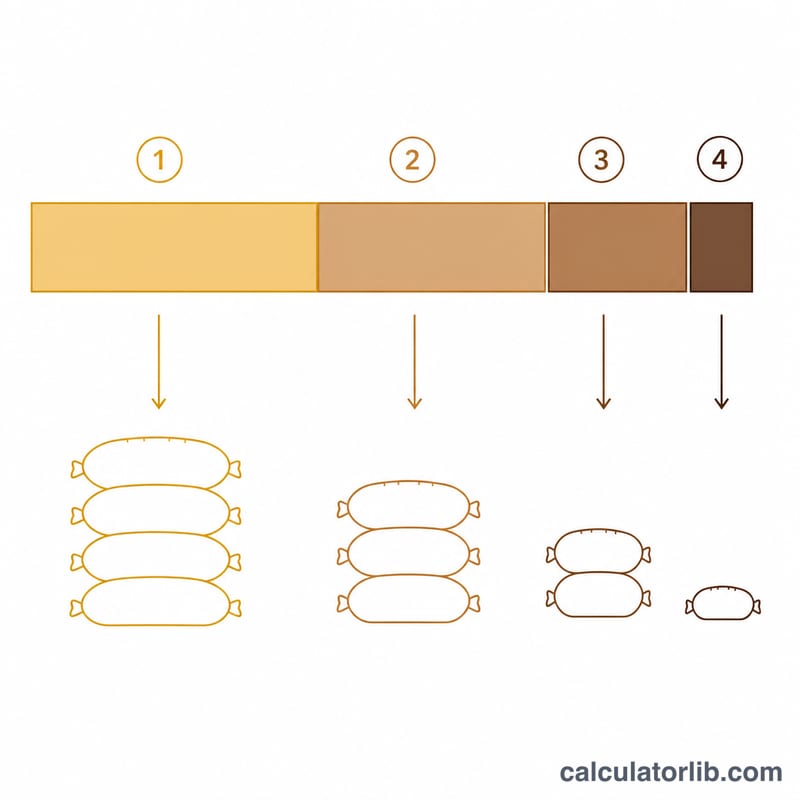
- Each grain's weight as a percentage of the total. The calculator normalises whatever shares you enter by their sum \(S\), so entering 90 and 10, or 9 and 1, or 45 and 5 all give the same split — you are describing proportions, not absolute weights.
FAQ
What efficiency should I enter? Use the figure your system actually hits. Most homebrew all-grain setups land between 65% and 80%; if you have never measured it, 72% is a reasonable starting guess and you can refine it after a brew day.
Where do I find PPG values? Maltsters publish fine-grind extract as a percentage or as PPG. Base malts are usually 36-38, Munich and wheat around 35-39, caramel malts 33-35, and roasted grains 25-30.
Does this include sugar or extract additions? Not directly, but you can enter a sugar as one of the grains with a potential of about 46 PPG and a small share, and treat its share as fully converted.