What is grain test weight?
Test weight is the bulk density of grain: how many pounds of grain fit into one volumetric bushel. It is the oldest and quickest quality check at the elevator, because light, shrivelled, frost-damaged or immature kernels pack less mass into the same space. This calculator uses United States (USDA) grain marketing conventions, where one bushel is a volume of 2150.42 cubic inches (35.23907 L) and each crop has a legal standard bushel weight — corn 56 lb, wheat and soybeans 60 lb, barley 48 lb, oats 32 lb, rough rice 45 lb.
How to use the calculator
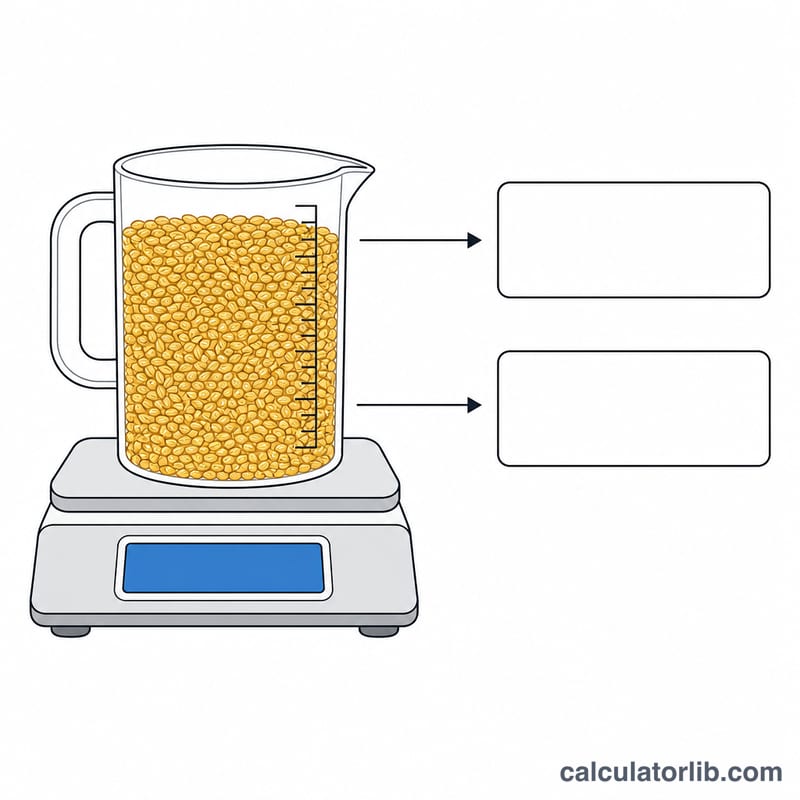
Fill a standard one dry quart kettle, strike it level with a stroker, and weigh it on a gram scale. Enter the grain type, the sample weight with its unit, and the container volume with its unit. The calculator reports test weight in lb/bu, the metric equivalent in kg/hL and g/L, and how your sample compares with the standard bushel weight for that crop.
The formula explained
Sample weight \(W\) is converted to pounds and container volume \(V\) to bushels, then
$$\text{TW}_{\text{lb/bu}} = \frac{W_{\text{lb}}}{V_{\text{bu}}}$$Because 1 lb/bu equals 1.2871864 kg/hL, the metric value follows directly, and the quality index is \(P = \text{TW} / \text{TW}_{\text{std}} \times 100\).
Worked example
A one dry quart kettle of shelled corn weighs 725 g. Converting to pounds:
$$W = \frac{725}{453.59237} = 1.5984\ \text{lb}$$One dry quart is \(1/32\) bushel, so
$$\text{TW} = 1.5984 \times 32 = 51.15\ \text{lb/bu}$$$$\text{TW}_{\text{kg/hL}} = 51.15 \times 1.2871864 = 65.84$$Against the 56 lb corn standard that is \(51.15 / 56 \times 100 = 91.3\%\), about 4.85 lb/bu light — typically a discount at delivery.
Standard Bushel Weights and Test Weight Grade Limits by Crop
In the United States a "bushel" of grain is a fixed weight, not a measured volume: the legal bushel weight is what the trade uses to convert pounds to bushels. Test weight, by contrast, is the actual bulk density of your sample, expressed in the same units (lb/bu) or in the metric equivalent kilograms per hectolitre (kg/hL), using \(\text{kg/hL} = 1.2871864 \times \text{lb/bu}\).
The grade minimums below are from the USDA Federal Grain Inspection Service (FGIS), Official United States Standards for Grain, as applied in the FGIS Grain Grading Handbook. They are a United States system — Canada (CGC), the EU, Australia (GTA) and other markets grade on different factors and usually quote density in kg/hL only, so these numbers should not be read as international thresholds.
| Crop / class | US legal bushel weight (lb/bu) | Metric equivalent (kg/hL) | US No. 1 minimum test weight (lb/bu) | US No. 2 minimum test weight (lb/bu) |
|---|---|---|---|---|
| Corn (maize) | 56 | 72.08 | 56.0 | 54.0 |
| Soybeans | 60 | 77.23 | 56.0 | 54.0 |
| Wheat — Hard Red Spring and White Club | 60 | 77.23 | 58.0 | 57.0 |
| Wheat — all other classes (HRW, SRW, Durum, Hard/Soft White) | 60 | 77.23 | 60.0 | 58.0 |
| Barley | 48 | 61.79 | 47.0 | 45.0 |
| Oats | 32 | 41.19 | 36.0 | 33.0 |
| Rough rice (paddy) | 45 | 57.92 | Not a grade factor | Not a grade factor |
| Grain sorghum (milo) | 56 | 72.08 | 57.0 | 55.0 |
| Rye | 56 | 72.08 | 56.0 | 54.0 |
Several rows deserve a note:
- Oats and sorghum can grade above their own bushel weight. Oats have a 32 lb/bu legal bushel but need 36 lb/bu for US No. 1; sorghum needs 57 lb/bu against a 56 lb/bu bushel. A percent-of-standard figure over 100% is completely normal for these crops.
- Soybeans are the opposite. The legal bushel is 60 lb but US No. 1 only requires 56 lb/bu, so sound soybeans routinely read well under 100% of the bushel weight without any grade penalty.
- Rough rice and canola are not graded on test weight at all under the US standards — rice grades on milling yield, damaged and chalky kernels, and canola on damaged kernels, distinctly green seeds and admixture. A test weight figure for these is still useful for bin-space and shrink planning (rough rice is traded at 45 lb/bu, canola commonly at 50 lb/bu), but it is not a grading factor.
- Hard Red Spring and White Club wheat carry lower minimums than the other wheat classes, so the class you enter matters: 58 lb/bu is a No. 1 as spring wheat but only a No. 2 as hard red winter.
Finally, and most importantly: under the US standards a lot grades on the lowest-grading factor. Test weight is one of several — moisture-independent factors such as broken kernels and foreign material, total and heat-damaged kernels, and shrunken/thin kernels are all assessed, and the final grade is the poorest result among them. A sample can hit 58 lb/bu of corn and still grade US No. 3 on damaged kernels. Test weight alone never establishes a grade.
What Your Test Weight Result Means
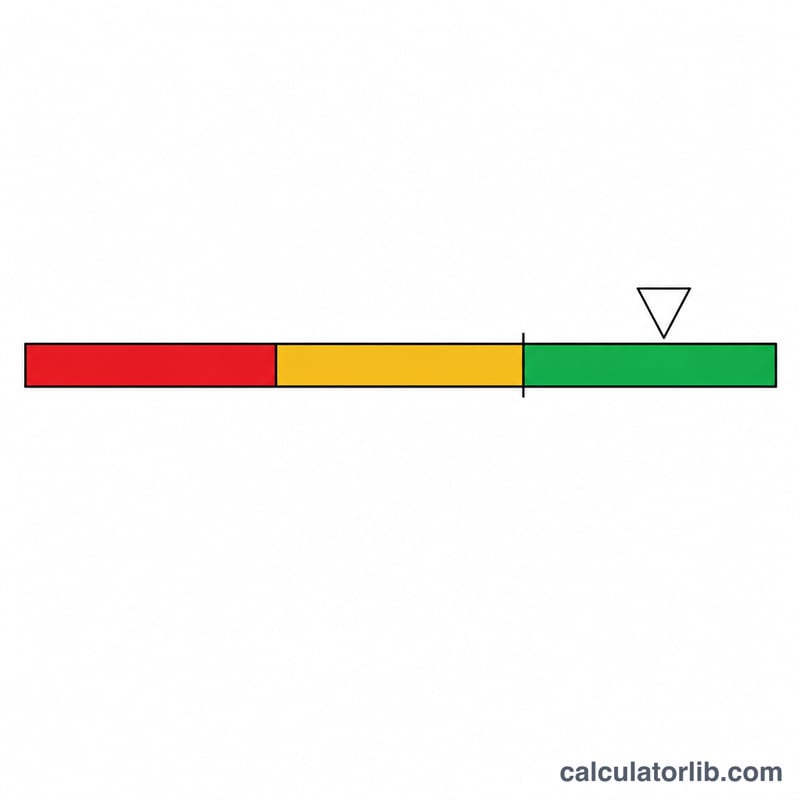
The calculator reports three things: test weight in lb/bu, the same density in kg/hL, and your result as a percentage of the US legal bushel weight for the crop you selected. The percentage is the quickest read, but it has to be compared against the grade minimums for that crop, not against 100% by itself.
Reading the percent-of-standard figure
- At or above 100% of standard. The sample packs at or above the legal bushel weight. For corn, rye and the winter/white wheat classes this is squarely US No. 1 territory on the test weight factor, and it usually signals well-filled, sound, fully mature kernels. For oats and sorghum, remember that 100% is below the No. 1 minimum — oats need about 112% of their 32 lb/bu bushel to make No. 1.
- Roughly 96–100% of standard. Depending on the crop this is commonly still No. 1 or No. 2. Corn at 54–56 lb/bu (96.4–100%) is a No. 2; hard red winter wheat at 58–60 lb/bu is a No. 2; spring wheat in this band is a clean No. 1. Grain here is generally sound and storable, and normally moves without a test weight discount.
- Below the US No. 2 minimum for the crop. The sample grades No. 3 or lower on this factor and is exposed to elevator discount schedules — typically a per-bushel deduction for each pound (or half-pound) below a stated threshold. These schedules are set by the individual buyer, processor or terminal and vary by location, crop year and destination; USDA does not set discounts, it only defines the grades. Ask the specific buyer for their posted schedule rather than assuming a rate.
A worked example
Suppose a corn sample fills a one-quart measure and weighs 780 g. Converting to pounds and bushels:
$$W_{\text{lb}} = \frac{780}{453.59237} = 1.7196\ \text{lb}, \qquad V_{\text{bu}} = \frac{1}{32} = 0.03125\ \text{bu}$$
$$\text{TW} = \frac{1.7196}{0.03125} = 55.03\ \text{lb/bu}$$
That is 55.03 lb/bu, or \(1.2871864 \times 55.03 = 70.83\) kg/hL, which is \(55.03 \div 56 \times 100 = 98.3\%\) of the corn standard. Above the 54 lb/bu No. 2 minimum, below the 56 lb/bu No. 1 minimum: a No. 2 on test weight, normally no discount.
What test weight does and does not tell you
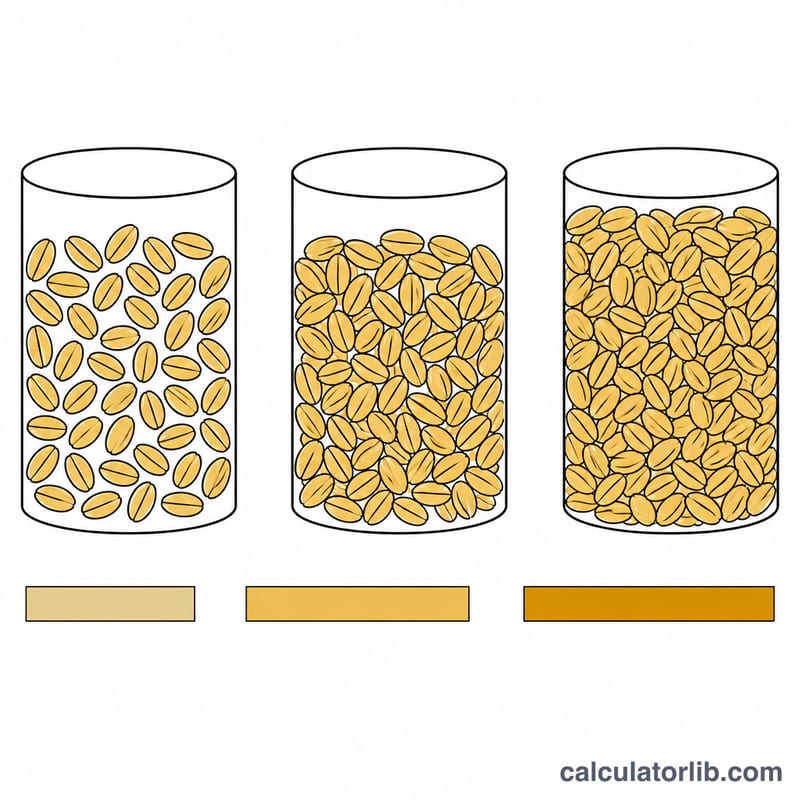
Test weight is a bulk-density and packing measure. It responds to how tightly kernels settle together, which is why it correlates with kernel soundness and fill, and — for corn, wheat and barley — with milling yield, ethanol yield per bushel and general storability. Low test weight in corn often accompanies immature, frost-damaged, drought-stressed or mould-affected kernels, which is the real reason buyers care about it.
It is equally important to know what it is not:
- It is not a yield measurement. A field's bushels per acre are computed from total harvested weight at a reference moisture, using the legal bushel weight — not from your test weight. Light test weight grain is still sold in standard bushels.
- It is not a moisture measurement, and it cannot substitute for one. Use a calibrated moisture meter.
- It is not a grade. As noted above, the grade is set by the lowest-scoring factor across the whole standard.
- It is sensitive to method. Kernel shape, surface texture, dockage and fines, how the container is filled and whether it is struck level all shift the reading. Official FGIS results use a specified filling and stroking procedure with an approved apparatus; a kitchen-scale measurement is an estimate, useful for comparing your own samples but not an official figure.
Always record the moisture alongside the test weight. Test weight generally rises as grain dries and kernels shrink and pack more tightly, so a figure quoted without its moisture content is not comparable between samples, bins or years. "57 lb/bu" means something quite different at 20% moisture than at 15%. Official inspection reports test weight on the sample as received, at its actual moisture — do the same, and note both numbers together.
FAQ
Does moisture change test weight?
Yes. Wet grain usually tests lighter, and drying often raises test weight by 0.5 to 1.5 lb/bu per point of moisture removed, so always note the moisture reading beside the result.
Can I use a kitchen cup?
Only if you enter its true volume in litres or cubic inches. Official readings need a calibrated quart kettle and a level strike.
Is low test weight the same as low yield?
No. Test weight measures packing density, not bushels harvested, although both often fall together after drought or an early frost.