What this calculator does
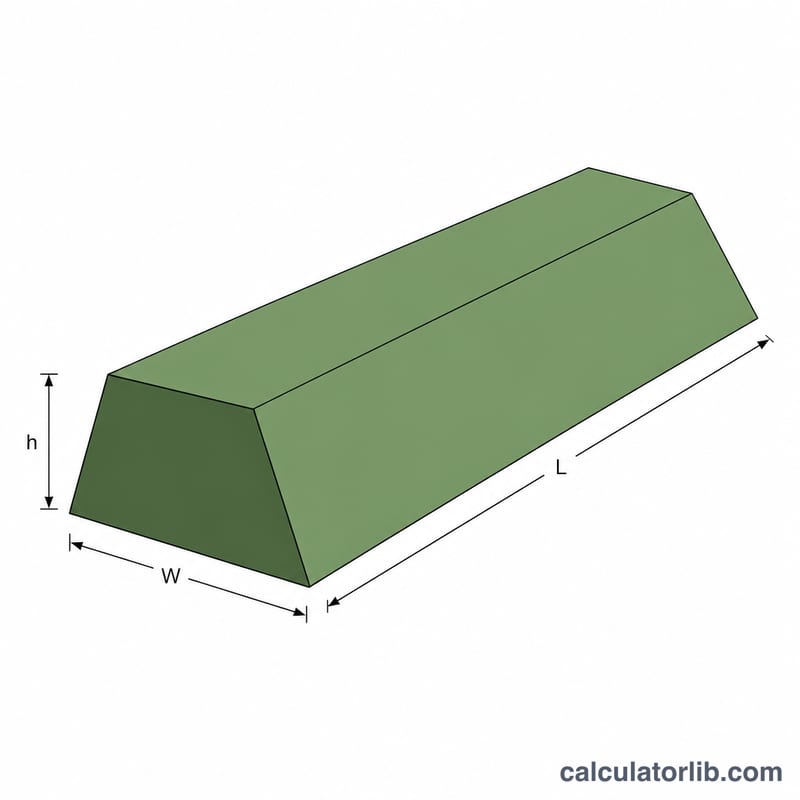
This tool sizes a drive-over silage pile (bunker-style stack without walls) using US customary units: feet for dimensions, short tons (2,000 lb) for tonnage and pounds per cubic foot for as-fed density. Enter how much silage you must store, the packed density you expect to achieve, and the pile shape you can build on your feed pad. The calculator returns the pile length required, along with total volume, tons stored per foot of length, ground footprint and the approximate area of plastic needed to cover the top and both side slopes.
The formula explained
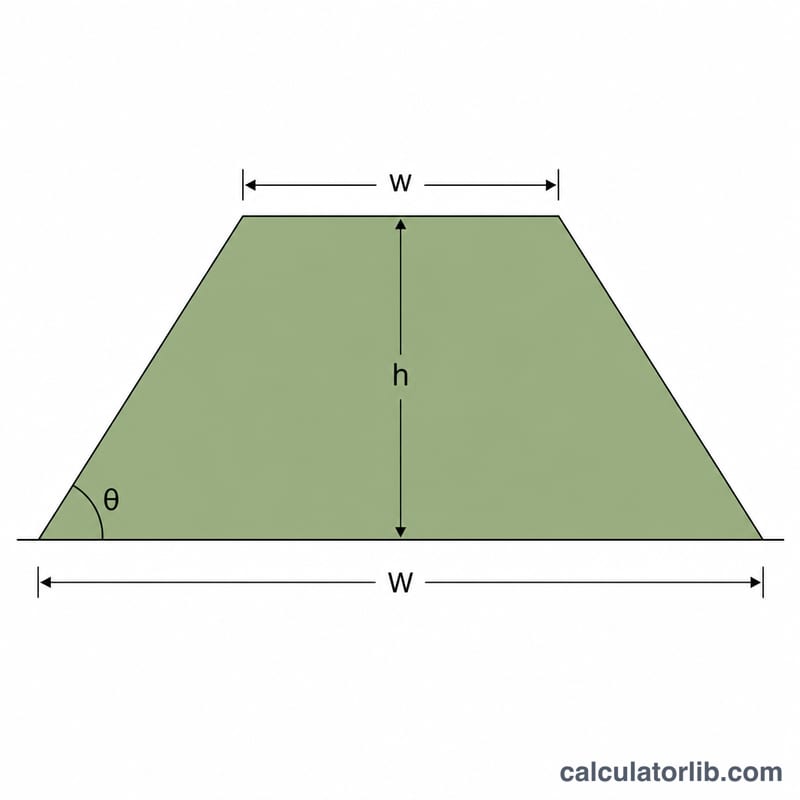
A packed pile is modelled as a trapezoidal prism. With \(W_b\) = base width in ft, \(H\) = settled height in ft and \(s\) = side slope ratio (feet of horizontal run per 1 ft of rise), the top width is \(W_t = W_b - 2sH\) and the cross-sectional area is
$$A = \frac{W_b + W_t}{2}\times H = (W_b - sH)H$$The volume needed for \(T\) tons at density \(D\) lb/ft³ is \(V = 2000T/D\), so the length is
$$L = \frac{2000\,T}{D\,(W_b - sH)H}$$If the base is too narrow for the requested height, the slopes meet and the pile is capped at a peak of \(H_{max} = W_b/(2s)\).
Worked example
Store 1,000 tons at 44 lb/ft³ on a 60 ft base, 10 ft settled height, 2:1 slopes. Top width is \(60 - 2\times 2\times 10 = 20\) ft, so
$$A = \frac{60 + 20}{2}\times 10 = 400\ \text{ft}^2$$$$V = \frac{2000\times 1000}{44} = 45{,}455\ \text{ft}^3,\qquad L = \frac{45{,}455}{400} \approx 113.6\ \text{ft}$$Each foot of that pile holds \(400\times 44/2000 = 8.8\) tons.
Key Terms and Variables
| Term | Symbol / unit | Meaning |
|---|---|---|
| Base width | \(W_b\), ft | Width of the pile's ground footprint, measured toe-to-toe across the pad. It is the widest dimension and sets the maximum possible height. |
| Top width | \(W_t\), ft | Width of the flat crown, derived rather than entered: \(W_t=\max(W_b-2sH,\,0)\). A result of 0 means the slopes meet in a ridge and the cross-section is a triangle. |
| Settled height | \(H\), ft | Height after packing and settling, not the height of the loose heap during filling. Loose material typically settles substantially, so entering filling height overstates capacity. |
| Maximum height | \(H_{max}=\dfrac{W_b}{2s}\), ft | Height at which both side slopes intersect. Any entered height above this is capped by the calculator, because the extra height cannot physically exist on that base. |
| Side slope ratio | \(s\), ft run per 1 ft rise | Horizontal run for each foot of vertical rise, written 3:1 (enter 3). Larger \(s\) means flatter, safer-to-drive sides but less volume per foot of length. |
| Packed as-fed density | \(D\), lb/ft³ (wet basis) | Mass of wet, as-fed forage per cubic foot of settled pile. US extension guidance commonly targets at least 44 lb/ft³ as-fed for packed corn silage; 38 lb/ft³ represents a light pack and 48 lb/ft³ a very good one. |
| Dry matter vs as-fed | % DM | As-fed mass includes water; dry matter (DM) is what remains after moisture is removed. Corn silage at 35% DM and 44 lb/ft³ as-fed holds about 15.4 lb DM/ft³. This calculator works entirely in as-fed tons and as-fed density — do not enter a DM density. |
| Short ton | 2,000 lb | The mass unit used throughout (the US customary ton), which is where the factor 2000 in \(L=2000T/(D\!\cdot\!A)\) comes from. A metric tonne is 2,204.6 lb and is not what this tool assumes. |
| Cross-sectional area | \(A\), ft² | Area of the trapezoid (or triangle) seen when looking at the feed-out face: \(A=\frac{W_b+W_t}{2}H\). |
| Tons per foot of length | t/ft | \(D\cdot A/2000\) — how much feed sits behind each foot of face. The single most useful number for matching pile shape to herd size and feed-out rate. |
| Feed-out face | — | The vertical cut end being fed from. Face removal rate is how far that face advances per day, in in/day; US extension guidance commonly cites at least 6 in/day in cool weather and 12 in/day in warm weather to stay ahead of aerobic spoilage. |
| Shrink | % DM loss | Dry matter lost to fermentation, respiration, surface spoilage and feed-out. It is not included in this calculator's geometry: the tonnage you enter is the tonnage the pile holds, not the tonnage you will feed. |
| Drive-over pile | — | A free-standing pile built on a pad with no side walls, packed by driving over the sloped sides. A bunker silo has concrete walls (so the sides are vertical and this slope model does not apply), and a silage bag is a sealed polyethylene tube — both store the same crop with different geometry and different packing control. |
| Cover area | ft² | Plastic needed to cover the crown plus both slopes: \(L\left(W_t+2H\sqrt{s^{2}+1}\right)\). It excludes the two end faces and includes no overlap or ground-sealing allowance. |
Practical Sizing and Cover Recommendations
- Size for the crop going in, not the feed you need out. The calculator's geometry ignores shrink, so add roughly 10–15% to the tonnage you actually intend to feed before entering it. If you need 1,000 t at the bunk, size for about 1,100–1,150 t. At 44 lb/ft³, a 60 ft base, 10 ft settled height and 3:1 slopes, 1,150 t needs 174.2 ft rather than 151.5 ft — nearly 23 ft of extra pad from the shrink allowance alone.
- Add 10–20 ft to the computed length on the pad. The number the calculator returns is the length of forage only. You still need a run-up ramp at the back, room to square up and trim the feed-out face, and turning space for the loader and packing tractor. Measure the pad before you commit to the base width.
- Order plastic 4–6 ft wider than the computed cover area on every side. The cover figure covers the crown and slopes exactly, edge to edge at the toe. To seal the sheet at ground level and weight it you need material lying flat on the pad, plus overlap at any seam and enough to wrap both end faces. A common practice is an oxygen-barrier film placed directly on the forage with a conventional top cover over it, which protects the thin barrier film from tearing.
- Weight the cover heavily and seal the edges hardest. A working rule is about one tire sidewall per 4–5 ft² of covered surface, touching or nearly touching, with a continuous line of weight along both toes and across every seam. The baseline pile above at 9,583 ft² therefore needs roughly 1,900–2,400 sidewalls. Edges and seams are where air gets in; the middle of the sheet is the least critical area.
- Do not solve a short pad by building taller. Height is capped at \(H_{max}=W_b/(2s)\) — on a 60 ft base with 4:1 slopes that is 7.5 ft, and entering 10 ft simply produces a peak the calculator refuses to count. If you need more volume, widen the base or flatten the slope decision consciously; a wider base raises tons per foot far faster than a taller peak does.
- Match packing weight to delivery rate. The density you enter is an assumption, not a guarantee. A common US rule of thumb is roughly 800–1,000 lb of packing tractor weight for every ton of crop delivered per hour: at 100 t/hr delivered, that is 80,000–100,000 lb of tractor on the pile, spread in thin layers (6 in or less) with continuous packing. If your real packing weight is short, plan on 38 lb/ft³ rather than 44 and accept the longer pile.
- Check tons per foot against your daily feed-out before you build. Divide your daily as-fed usage by the tons-per-foot figure to get the face advance, then multiply by 12 for in/day. The baseline pile at 6.60 t/ft advances 6 in/day only if you feed at least 3.3 t/day and 12 in/day only at 6.6 t/day. If your herd cannot sustain roughly 6 in/day in cool weather and 12 in/day in warm weather, rebuild the pile narrower or lower — never longer. A long, narrow pile of the same tonnage feeds out fast; a short, fat one spoils at the face.
- Verify the assumed density once the pile is closed. Weigh loads in and measure the finished pile, then back-calculate \(D=2000T/(A\cdot L)\). That measured value is the number to use for next year's sizing and for your inventory.
This section is general agronomic and management information based on widely used US extension guidance for drive-over piles; it is not professional agronomic, engineering or safety advice for your specific operation. Silage piles are a serious avalanche and machinery hazard — never undercut a face, never stand at the toe of an unshaved face, and consult your local extension service, a qualified nutritionist and your insurer for site-specific requirements.
FAQ
What density should I use? Well-packed corn silage typically runs 40-48 lb/ft³ as-fed; haylage and light-packed piles run lower. Use 44 lb/ft³ as a working default and adjust from a core sample.
Why do side slopes matter? Slopes flatter than about 3:1 are safer for packing tractors, but they shrink the top width and therefore the tons per foot, forcing a longer pile.
Does the result include shrink? No. Fermentation and surface spoilage commonly cost 10-15% of the crop, so add that margin to your target tonnage before sizing.
How fast should I feed across the face? Compare your daily feed-out to the tons-per-foot figure: removing at least 6 in per day in winter and 12 in in summer keeps the face stable.