What this calculator does
Many medicines — cytotoxic chemotherapy, some antivirals, immunoglobulins and several paediatric drugs — are prescribed per square metre of body surface area (BSA) rather than per kilogram. This tool turns a height and weight into a BSA figure and then multiplies it by the prescribed dose intensity in mg/m² to give the total dose and the amount per administration. It is universal arithmetic, not tied to any country, but it is an educational aid only.
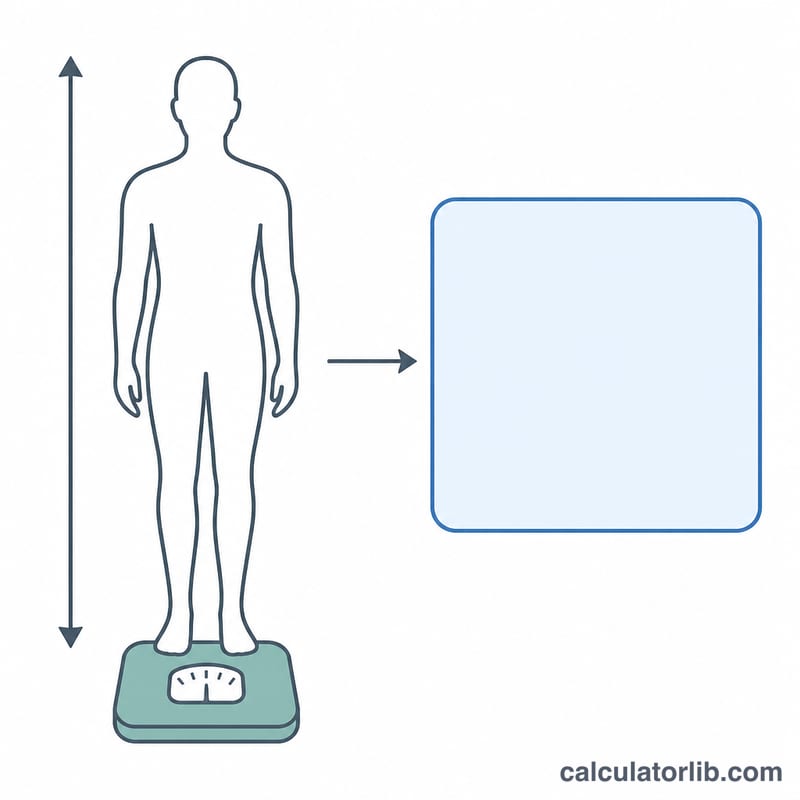
The formula explained
The default method is the Mosteller equation, popular because it is easy to verify by hand:
$$\text{BSA} = \sqrt{\frac{H \times W}{3600}}$$where \(H\) = height in centimetres and \(W\) = weight in kilograms, giving BSA in m². The classic Du Bois equation is also offered:
$$\text{BSA} = 0.007184 \times H^{0.725} \times W^{0.425}$$Haycock and Gehan & George use the same power-law shape with different constants; for adults the four typically agree to within a few percent. The dose then follows directly:
$$\text{Dose}_{\text{total}} = \text{BSA} \times D$$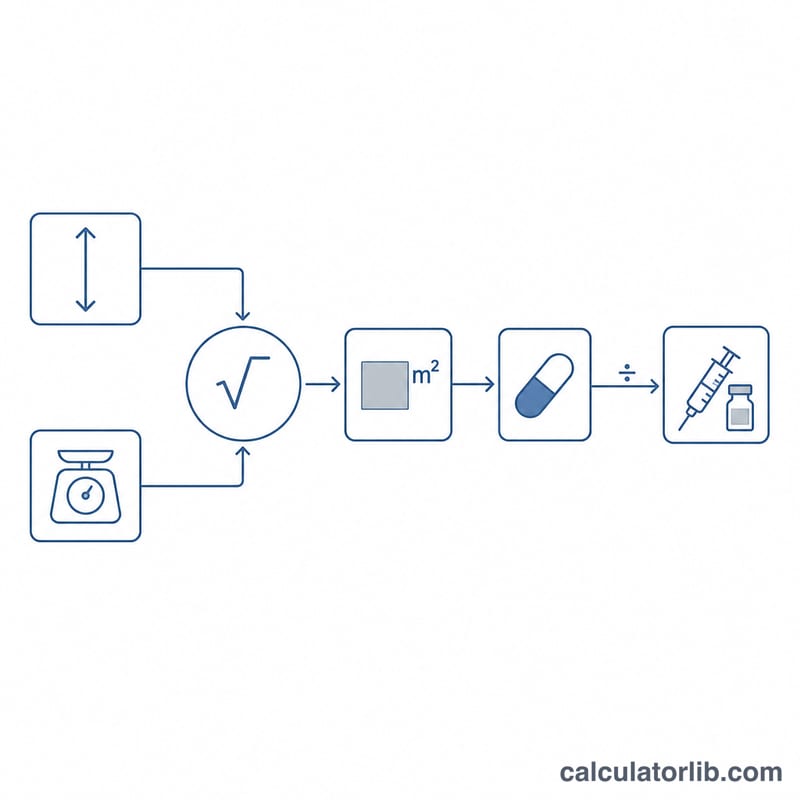
Worked example
An adult is 180 cm and 75 kg, prescribed 100 mg/m² split into two daily doses. Mosteller gives:
$$\text{BSA} = \sqrt{\frac{180 \times 75}{3600}} = \sqrt{3.75} = 1.94\,\text{m}^2$$The total dose is \(1.94 \times 100 = 193.6\,\text{mg}\), so each of the two administrations is about \(96.8\,\text{mg}\) — roughly 2.58 mg/kg.
How to use it
Choose metric or imperial units (inches and pounds are converted internally), enter height and weight, pick the BSA formula your protocol names, then enter the mg/m² figure and how many doses the total is divided into. Compare the four BSA values in the table to see how method choice moves the answer.
BSA Formulas and Their Coefficients
All equations below are written in the metric form this calculator uses: height \(H\) in centimetres, weight \(W\) in kilograms, output in square metres (m²). Selecting imperial units in the tool converts your inputs to cm and kg before the equation is applied.
| Formula | Equation (metric) | Year | Derivation population | Notes |
|---|---|---|---|---|
| Mosteller | \(\text{BSA} = \sqrt{\dfrac{H \times W}{3600}}\) | 1987 | Proposed as a simplified equation checked against the Du Bois and Gehan–George values rather than against new direct measurements | Easiest to compute and verify by hand; the most widely used default in oncology |
| Du Bois & Du Bois | \(\text{BSA} = 0.007184 \times H^{0.725} \times W^{0.425}\) | 1916 | Only 9 subjects, one of them a child, measured by a manual surface-moulding (coating) method | The historical standard and still specified by many older protocols; tends to read lowest at large body sizes |
| Haycock | \(\text{BSA} = 0.024265 \times H^{0.3964} \times W^{0.5378}\) | 1978 | 81 subjects spanning neonates, infants, children and adults, measured geometrically | Developed specifically so that one equation would work in paediatric and neonatal patients |
| Gehan & George | \(\text{BSA} = 0.0235 \times H^{0.42246} \times W^{0.51456}\) | 1970 | 401 direct measurements, the largest classical dataset of the four | Statistically the best-supported regression of the classical set |
| Boyd (optional, not in this tool) | \(\text{BSA}_{\text{cm}^2} = 0.0003207 \times H^{0.3} \times W_g^{\,(0.7285 - 0.0188 \log_{10} W_g)}\) | 1935 | Large compiled series of published direct measurements | Note the different units: \(W_g\) is weight in grams and the result is in cm², so divide by 10 000 to obtain m² |
Unit warning
The constants above are valid only for centimetres and kilograms. Versions of the Du Bois, Gehan and Haycock equations have also been published with height in inches and weight in pounds, and those carry different leading constants and, for Du Bois, a different original presentation. Mixing an imperial height or weight into a metric-constant equation produces a badly wrong BSA — convert first, then apply the formula, or let the calculator's unit selector do it.
Reading the exponents
All four equations behave similarly: BSA rises with roughly the square root of weight and with a somewhat weaker power of height. Mosteller makes this explicit — both height and weight carry an exponent of exactly 0.5. Du Bois is the outlier, weighting height more heavily (0.725) and weight less (0.425), which is the main reason its estimates drift away from the others in very heavy patients.
FAQ
Which formula should I pick? Follow the protocol or monograph. If none is specified, Mosteller is the most widely used and is easy to double-check.
Should I cap BSA at 2.0 m²? Some institutions cap BSA for certain cytotoxic drugs to limit toxicity in very large patients. This calculator does not cap automatically — apply your local rule to the result.
Can I use it for children? The equations apply across ages, and Haycock was derived partly from paediatric data, but paediatric dosing needs clinical verification and often has separate weight-band rules.