What this calculator does
A recipe written for four people is rarely the recipe you need. This tool converts ingredient quantities from the serving count printed in the recipe to the serving count you actually want to cook, using one consistent multiplier so the proportions — and therefore the flavour and texture — stay intact. It works with any unit (cups, grams, tablespoons, millilitres, whole eggs) because scaling is purely proportional.
The formula
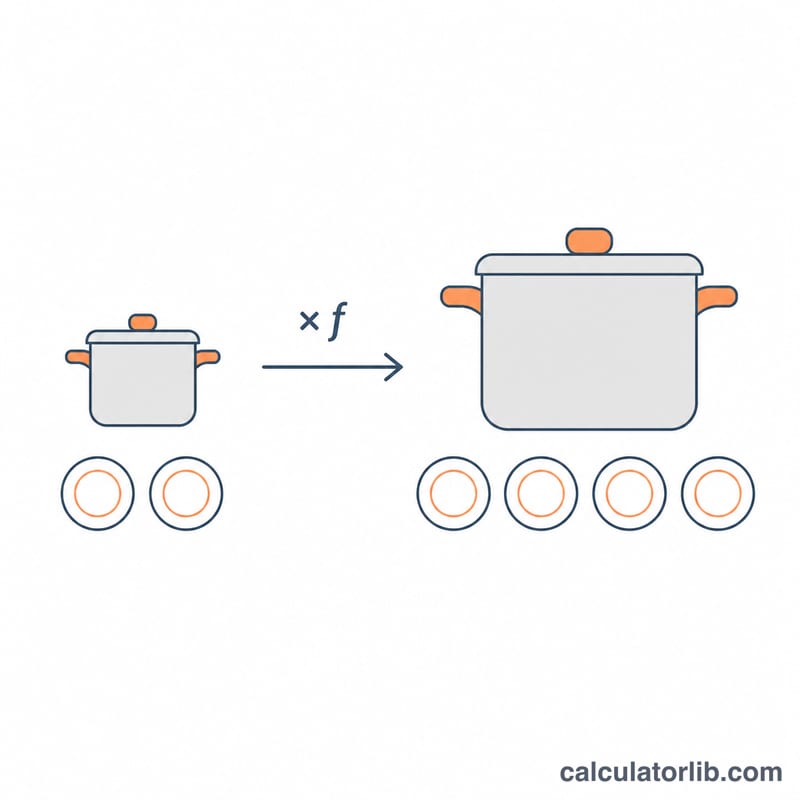
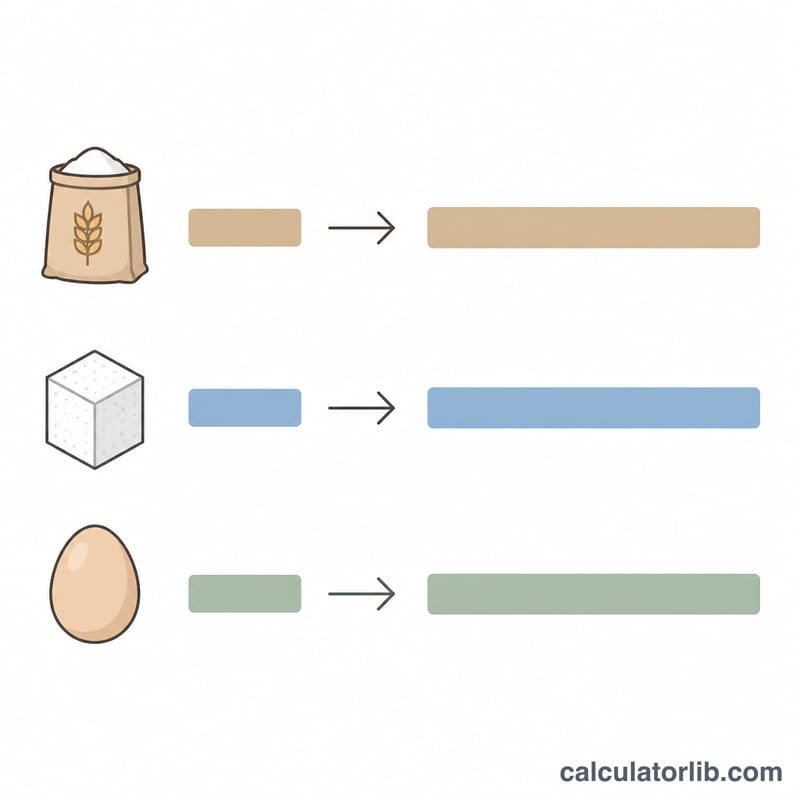
Everything follows from a single scaling factor \(f\), where \(S_{old}\) = the servings the recipe was written for and \(S_{new}\) = the servings you want:
$$f = \frac{S_{new}}{S_{old}} \qquad Q_{new} = Q_{old} \times f$$\(Q_{old}\) is an original ingredient amount and \(Q_{new}\) is the amount to use. A factor above 1 means you are scaling up, below 1 means scaling down, and exactly 1 means no change.
How to use it
Enter the recipe original servings, the servings you want, then up to three ingredients with their amounts. The calculator returns the scaling factor plus each adjusted quantity and the percentage change in batch size. Apply the same factor by hand to any remaining ingredients.
Worked example
A pancake recipe serves 4 and calls for 2 cups of flour, 1.5 cups of milk and 0.75 tablespoons of butter. You need 6 servings:
$$f = \frac{6}{4} = 1.5$$$$\text{Flour} = 2 \times 1.5 = 3\,\text{cups}$$$$\text{Milk} = 1.5 \times 1.5 = 2.25\,\text{cups}$$Butter becomes \(0.75 \times 1.5 = 1.125\) tablespoons, and the batch grows by 50%.
Common Kitchen Measurement Conversions
Scaling a recipe often produces amounts that are easier to handle in a different unit — a factor of 0.5 applied to 3 tablespoons is simpler to measure as 4½ teaspoons. The tables below give the standard equivalences used in US customary and metric kitchens. Note that measuring-spoon and cup sizes are national standards, not universal: the tables here use the US legal/nutrition-label conventions unless stated otherwise.
Volume equivalences
| Unit | Equivalent | Metric (approx.) |
|---|---|---|
| 1 teaspoon (tsp) | — | 5 mL |
| 1 tablespoon (tbsp) | 3 tsp | 15 mL |
| 1 fluid ounce (US fl oz) | 2 tbsp | 29.6 mL |
| 1 cup (US) | 16 tbsp = 8 US fl oz | 237 mL |
| 1 cup (metric, AU/NZ and many metric recipes) | — | 250 mL |
| 1 pint (US liquid) | 2 cups | 473 mL |
| 1 quart (US liquid) | 2 pints = 4 cups | 946 mL |
| 1 litre (L) | — | 1000 mL |
A US cup (237 mL) is about 5% smaller than a metric cup (250 mL). The difference is negligible for soup, but it matters for baking — if a recipe's origin is unclear, weigh the ingredients instead.
Weight equivalences
| Unit | Equivalent | Metric |
|---|---|---|
| 1 ounce (oz, avoirdupois) | — | 28.35 g |
| 1 pound (lb) | 16 oz | 453.6 g |
| 1 kilogram (kg) | ≈ 2.205 lb | 1000 g |
Approximate cup-to-gram weights
Volume-to-weight conversion depends entirely on the ingredient's bulk density and on how it is packed into the cup, so these figures are approximate and scooping method changes them by 10–20%.
| Ingredient (1 US cup) | Approx. weight | Notes |
|---|---|---|
| All-purpose (plain) flour | ~120 g | Spooned and levelled; scooping straight from the bag can give 140 g or more |
| Granulated white sugar | ~200 g | Free-flowing, levelled |
| Brown sugar | ~220 g | Firmly packed |
| Butter | ~227 g | Equals 2 US sticks (½ lb) |
| Water or milk | ~240 g | Water is ~1 g/mL; whole milk is slightly denser |
In symbols, converting a scaled volume to a weight uses the ingredient's density \(\rho\):
$$m = V \times \rho \qquad\text{e.g. } 1.5 \text{ cups flour} \approx 1.5 \times 120\ \text{g} = 180\ \text{g}$$
Scaling Factor Scenarios at a Glance
Every scaled amount comes from a single number, the scaling factor:
$$f = \frac{\text{Desired Servings}}{\text{Original Servings}}, \qquad \text{Scaled Amount} = \text{Original Amount} \times f$$
The table applies common factors to one sample base recipe: 2 cups flour, 1.5 cups milk, 3 eggs, yielding 4 servings.
| Original servings | Desired servings | Factor \(f\) | Flour | Milk | Eggs | Change in batch size |
|---|---|---|---|---|---|---|
| 4 | 2 | 0.5 | 1 cup | 0.75 cup | 1.5 | −50% |
| 6 | 2 | 0.333 | 0.667 cup | 0.5 cup | 1.0 | −66.7% |
| 4 | 4 | 1 | 2 cups | 1.5 cups | 3 | 0% |
| 4 | 6 | 1.5 | 3 cups | 2.25 cups | 4.5 | +50% |
| 4 | 8 | 2 | 4 cups | 3 cups | 6 | +100% |
| 4 | 12 | 3 | 6 cups | 4.5 cups | 9 | +200% |
Worked example: 4 → 6 servings
Step 1 — the factor:
$$f = \frac{6}{4} = 1.5$$
Step 2 — each ingredient:
$$\text{Flour} = 2 \times 1.5 = 3 \text{ cups}, \quad \text{Milk} = 1.5 \times 1.5 = 2.25 \text{ cups}, \quad \text{Eggs} = 3 \times 1.5 = 4.5$$
Step 3 — the change in batch size:
$$\text{Change} = (1.5 - 1) \times 100\% = +50\%$$
Rows that give non-whole eggs
The 4 → 2 row (1.5 eggs) and the 4 → 6 row (4.5 eggs) both land on half-eggs; the 6 → 2 row gives 0.999 ≈ 1 egg, which rounds cleanly. To use half an egg, beat one whole egg, weigh it (a large egg out of shell is roughly 50 g) and use half by weight — or round to the nearest whole egg and nudge the liquid slightly. Rounding up an egg adds moisture and structure; rounding down makes the result a little drier and more crumbly.
Also note that 0.667 cup of flour is not a standard measure: use ½ cup + 2 tbsp + 2 tsp, or simply weigh it (~80 g).
Practical Tips for Cooking the Scaled Recipe
The arithmetic is the easy part — the cooking is where scaled recipes succeed or fail. The scaling factor applies cleanly to masses of ingredients, but not to time, temperature, pan geometry or the perception of seasoning.
- Round to a measure you can actually make. Round liquids and dry goods to the nearest ¼ teaspoon, the nearest 5 g on a scale, or the nearest whole egg. A scaled 0.83 tsp of vanilla is simply ¾ tsp; 4.5 eggs is 4 eggs plus half of a beaten fifth egg (weigh it — about 25 g).
- Weigh instead of measuring by volume above about 2×. Cup-measuring errors are proportional, so a 15% over-scoop of flour that was tolerable in a single batch becomes a large absolute excess in a triple batch. A digital scale eliminates the problem and makes awkward fractions irrelevant.
- Keep pan depth constant. Use more pans or a larger-area pan, not a deeper fill. Doubling a cake batter into the same tin roughly doubles depth, which changes the heat path completely — the edges overbake long before the centre sets. Aim to match the original batter or liquid depth, and check that the new pan's area is roughly \(f\) times the original.
- Do not change the oven or fryer temperature. Keep the original temperature and start checking for doneness at the original time. Larger, deeper batches usually need more time (sometimes 1.3–1.5× for a doubled roast or casserole); smaller batches are often done noticeably earlier. Judge by internal temperature, colour and texture, never by the clock alone.
- Scale salt, strong spices, chilli and chemical leaveners slightly under the factor. A practical starting point is about 0.75–0.9 of the full factor for salt, chilli, cloves, garlic and similar assertive flavours, then taste and add more. Baking soda and baking powder can taste metallic or soapy when scaled generously, and excess leavener makes a batter rise and then collapse. Add strong flavours back at the end, when you can taste the actual batch.
- Check your equipment volume before you commit. A tripled batter needs a mixing bowl with real headroom, and a stand mixer has a maximum working capacity that a large dough will exceed. Confirm that pot, bowl and oven capacity can take \(f\) times the original volume before the ingredients are in the bowl — splitting into two batches is often the better answer.
- Remember what does not scale linearly. Yeast quantities scale sub-linearly, and fermentation time depends on temperature and dough mass more than on the factor — go by dough appearance and volume increase, not minutes. Reducing a sauce, cooking off alcohol and evaporating liquid all depend on the exposed surface area, so a doubled sauce in the same pan takes far more than double the time; use a wider pan or accept a longer reduction. Browning and searing depend on pan surface too — crowding a pan steams food instead of browning it, so sear in batches.
- Write the scaled amounts down before you start. Rescaling in your head mid-recipe is where most errors creep in. Print or note the converted list, including your rounded values, and cross off ingredients as you add them — especially useful when a batch is large enough that a forgotten ingredient wastes a lot of food.
This section is general cooking guidance, not professional or nutritional advice. Scaled batches also change per-serving nutrition and food-safety handling (larger quantities cool more slowly and should be chilled in shallow containers); if you are cooking for people with allergies, medical dietary needs or for the public, follow the food-safety rules that apply in your own country.
FAQ
Does cooking time scale too? No. Time and temperature are governed by heat transfer, not volume. Keep the temperature the same, spread food over more pans rather than piling it deeper, and start testing for doneness at the original time.
What about eggs and other whole items? Round to the nearest practical unit. For 1.5 eggs, beat two eggs and use roughly three quarters of the mixture by weight.
Should salt, spices and leavening scale linearly? Mostly, but taste as you go. Strong spices, chilli and baking soda often feel disproportionately strong when a recipe is more than doubled — scale them slightly under and adjust at the end.