What this calculator does
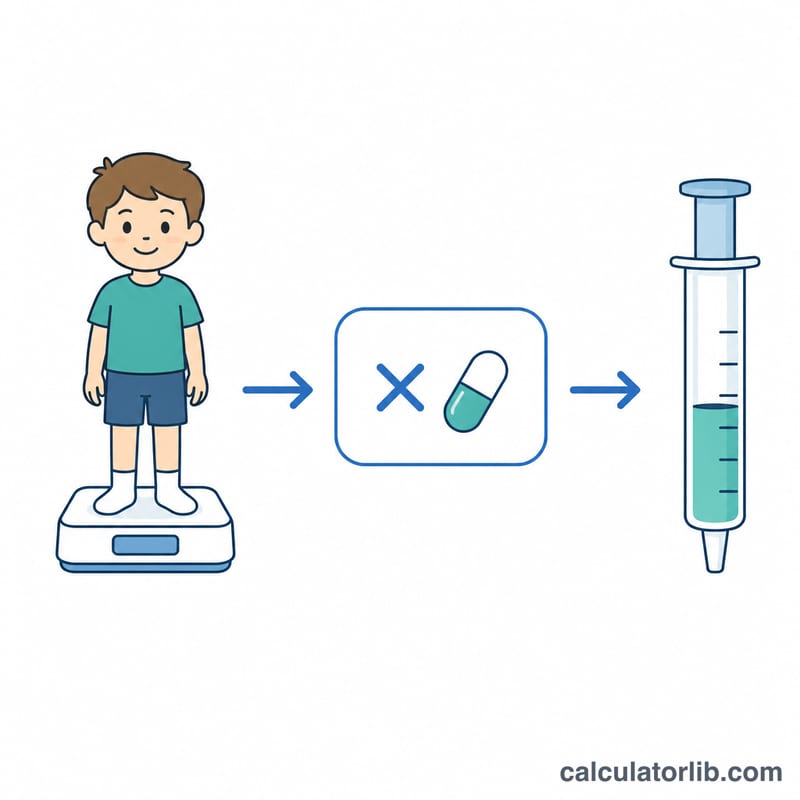
Pediatric medicines are almost never dosed as a fixed adult tablet. Instead the prescriber states a rate, either milligrams per kilogram of body weight or milligrams per square metre of body surface area, and the actual dose has to be worked out for each child. This calculator turns that rate into three practical numbers: the milligrams in one dose, the millilitres of liquid you need to measure, and the total amount the child receives over 24 hours. It applies anywhere in the world because it is pure arithmetic on the prescription, not a country-specific rule.
How to use it
Choose the dosing method, enter the child weight in kg (and height in cm, which is needed for surface area), then the prescribed dose rate and how many doses per day. Enter the concentration of the bottle as mg per mL: a syrup labelled 160 mg per 5 mL is \(160/5 = 32\) mg/mL. If the prescription has a ceiling such as 500 mg per dose, put it in the maximum field; enter 0 to ignore the cap.
The formula explained
For weight-based dosing, with \(W\) = weight in kg, \(D_{kg}\) = mg per kg per dose and \(C\) = concentration in mg/mL:
$$\text{Dose} = W \times D_{kg}, \qquad V = \frac{\text{Dose}}{C}, \qquad \text{Daily} = \text{Dose} \times n$$For mg per m2 dosing the body surface area is estimated with the Mosteller equation, where \(H\) = height in cm:
$$\text{BSA} = \sqrt{\frac{H \times W}{3600}}$$
Worked example
An 18 kg child is prescribed 15 mg/kg every 6 hours (4 doses a day) of a 32 mg/mL suspension:
$$\text{Dose} = 18 \times 15 = 270\,\text{mg}$$$$V = \frac{270}{32} = 8.44\,\text{mL}, \qquad \text{Daily} = 270 \times 4 = 1080\,\text{mg}$$That is 60 mg/kg/day, which the calculator also reports so you can compare it with the recommended daily maximum.
Interpreting Your Result
The calculator turns a prescribed dose rate into the four numbers you actually need at the bedside or the kitchen counter. Every one of them is only as good as the three inputs behind it: the child's current weight, the dose rate written by the prescriber, and the concentration printed on the bottle in front of you.
Single dose (mg)
This is the amount of drug for one administration, calculated as weight × dose rate (or BSA × dose rate in the mg/m² method), then limited by the maximum single dose if one is entered:
$$D = \min\left(W \times r,\; D_{\max}\right)$$
Milligrams are the medically meaningful quantity — the millilitres are just the vehicle that carries them. Two bottles of the same medicine at different strengths give the same milligram dose in very different volumes.
Volume per dose (mL)
\(V = D / C\), where \(C\) is the concentration in mg/mL. This volume should be measured with an oral syringe (or the dosing cup or dropper supplied with the product), never with a kitchen teaspoon or tablespoon. Household cutlery varies widely in capacity and is a well-documented source of paediatric dosing error; an oral syringe also lets you read fractional millilitres such as 6.6 mL, which a cup cannot. If the calculated volume falls between graduation marks, round to the nearest mark your device can actually show and confirm that rounding with the pharmacist rather than inventing a precision the syringe does not have.
24-hour totals (mg and mL)
\(D_{\text{day}} = D \times n\) and \(V_{\text{day}} = V \times n\), where \(n\) is doses per day. The milligram total is the figure to check against the product's labelled maximum daily dose. The millilitre total tells you how much liquid the child will swallow in a day and how long a bottle will last — useful for spotting when a refill is needed mid-course.
The mg/kg/day figure
Dividing the daily total by weight gives \(D_{\text{day}} / W\) in mg/kg/day. This is the single number to compare against a published daily ceiling in the product label, national formulary or the prescriber's instructions, because daily ceilings for children are almost always expressed per kilogram per day. A per-dose amount that looks modest can still breach a daily ceiling if the frequency is high.
What a capped dose means
If the result is flagged as capped, weight × dose rate came out larger than the maximum single dose you entered, so the ceiling applies instead. In practice this happens with older or heavier children whose weight-based calculation overtakes the adult or prescribed maximum. When a dose is capped, the effective rate is lower than the nominal rate — for example, a 40 kg child at a nominal 15 mg/kg would compute to 600 mg, but a 500 mg ceiling gives 500 mg, an effective 12.5 mg/kg per dose. That is expected behaviour, not an error, but the cap is only as correct as the number you typed into the maximum field.
Worked check
A 14 kg child, 15 mg/kg per dose, four doses a day, suspension labelled 160 mg/5 mL (= 32 mg/mL), no cap reached at 500 mg:
$$D = \min(14 \times 15,\; 500) = \min(210,\; 500) = 210\ \text{mg}$$
$$V = \frac{210}{32} = 6.56\ \text{mL} \qquad D_{\text{day}} = 210 \times 4 = 840\ \text{mg} \qquad \frac{840}{14} = 60\ \text{mg/kg/day}$$
The single dose here is 210 mg.
Signals to stop and verify
- The volume is larger than the supplied syringe, cup or dropper can hold in one draw — a common sign that the wrong concentration was entered (for example an infant drops strength used for a children's suspension, or vice versa).
- The 24-hour total in mg exceeds the maximum daily dose on the label, or the mg/kg/day figure exceeds the published ceiling.
- The result disagrees with the dose written on the prescription label or the pharmacy sticker.
- The weight used is out of date, is a birth or clinic weight from months ago, or was converted from pounds without checking.
In any of those cases, do not adjust the dose yourself — contact the prescriber or dispensing pharmacist. This calculator is an arithmetic aid for a dose that has already been prescribed. It does not select a drug, does not recommend a dose rate, does not know the child's kidney or liver function, and does not replace the prescriber's written instructions or the product label. This is general information, not professional medical advice; follow the instructions you were given for your child.
Concentration and Unit Conversions
The concentration field wants a single number in mg/mL, but paediatric liquids are labelled as a mass per stated volume ("160 mg/5 mL"). The general rule is:
$$C\ (\text{mg/mL}) = \frac{\text{mg on the label}}{\text{stated volume in mL}}$$
Common paediatric liquid labels
| Label on the bottle | Concentration in mg/mL | Typical form |
|---|---|---|
| 120 mg / 5 mL | 24 mg/mL | Suspension (paracetamol strength used in the UK and many Commonwealth countries) |
| 160 mg / 5 mL | 32 mg/mL | Suspension (standard US children's acetaminophen strength) |
| 250 mg / 5 mL | 50 mg/mL | Suspension (a common antibiotic strength, e.g. amoxicillin) |
| 100 mg / 1 mL | 100 mg/mL | Concentrated infant drops — note that US manufacturers voluntarily withdrew 80 mg/0.8 mL (100 mg/mL) acetaminophen infant drops in 2011 in favour of a single 160 mg/5 mL strength, but concentrated drops remain on sale in other countries |
| 100 mg / 5 mL | 20 mg/mL | Suspension or solution |
| 200 mg / 5 mL | 40 mg/mL | Suspension (a common ibuprofen strength) |
Product strengths and which strengths are legally marketed differ by country. Always read the concentration from the bottle you are holding rather than from memory or from this table.
Mass conversions
| From | To | Relation |
|---|---|---|
| 1 g | milligrams | 1 g = 1000 mg |
| 1 mg | micrograms | 1 mg = 1000 mcg (µg) |
| 1 g | micrograms | 1 g = 1 000 000 mcg |
Many health services (including the UK NHS) require "microgram" or "mcg" to be written in full rather than as "µg" or "ug", because handwritten abbreviations have been misread as milligrams — a 1000-fold error.
Volume conversions
| From | To | Relation |
|---|---|---|
| 1 teaspoon (tsp) | millilitres | 1 tsp = 5 mL (dosing convention; the US legal teaspoon is 4.93 mL, rounded to 5 mL for medicines) |
| 1 tablespoon (tbsp) | millilitres | 1 tbsp = 15 mL = 3 tsp |
| 1 mL | cubic centimetres | 1 mL = 1 cc (identical volumes) |
| 1 litre | millilitres | 1 L = 1000 mL |
Teaspoon and tablespoon units appear on some older labels and in some countries' home-care instructions, but regulators in the US, UK and EU now recommend metric-only dosing with a supplied oral syringe. Use mL whenever the option exists.
Weight in pounds to kilograms
The calculator's weight field is in kilograms. If a weight was recorded in pounds (common in US clinical records):
$$\text{kg} = \frac{\text{lb}}{2.2046} \qquad \text{e.g.}\quad \frac{22}{2.2046} = 9.98\ \text{kg}$$
| Pounds (lb) | Kilograms (kg) |
|---|---|
| 11 lb | 4.99 kg |
| 22 lb | 9.98 kg |
| 33 lb | 14.97 kg |
| 44 lb | 19.96 kg |
| 66 lb | 29.94 kg |
| 88 lb | 39.92 kg |
A quick mental check: kg ≈ lb ÷ 2.2, and 1 kg = 2.2046 lb.
Percentage strengths (w/v)
A percentage on a liquid label means grams of drug per 100 mL of product (weight in volume):
$$x\% \text{ w/v} = \frac{x\ \text{g}}{100\ \text{mL}} = x \times 10\ \text{mg/mL}$$
| Percentage (w/v) | g per 100 mL | mg/mL |
|---|---|---|
| 0.9% | 0.9 g | 9 mg/mL |
| 1% | 1 g | 10 mg/mL |
| 2% | 2 g | 20 mg/mL |
| 5% | 5 g | 50 mg/mL |
| 10% | 10 g | 100 mg/mL |
Ratio strengths such as 1:1000 mean 1 g in 1000 mL, i.e. 1 mg/mL.
Definitions & Glossary
- Body weight (W, kg)
- The child's current mass in kilograms — the basis of nearly all paediatric dosing. This calculator uses actual body weight exactly as entered; it does not apply ideal, adjusted or lean body weight, and it does not know whether the entered weight is current. Weigh the child rather than estimating, and re-check after growth or illness.
- Height / length (H, cm)
- Standing height, or recumbent length in infants, in centimetres. Used only by the BSA method.
- Body surface area (BSA, m²)
-
An estimate of the child's external surface area, used for drug classes (notably cytotoxic chemotherapy) whose dosing correlates better with surface area than with mass. This tool uses the Mosteller formula:
$$\text{BSA} = \sqrt{\frac{H \times W}{3600}}$$
with H in cm and W in kg, giving BSA in m². - Dose rate, mg/kg/dose
- Milligrams per kilogram for one single administration. Multiply by weight to get the single dose.
- Dose rate, mg/kg/day
- Milligrams per kilogram for the whole 24 hours, to be divided among the daily doses. Confusing the two is one of the most consequential paediatric arithmetic errors: reading a per-day rate as a per-dose rate multiplies the daily exposure by \(n\) (four-fold at q6h), while reading a per-dose rate as a per-day rate divides it by \(n\) and under-treats. Always check which the prescription means before entering it.
- mg/m²/dose
- The BSA-based equivalent: milligrams per square metre for one administration. The single dose is BSA × rate. A mg/m²/day rate must likewise be divided by the number of doses before use as a per-dose rate.
- Concentration (C, mg/mL)
- Milligrams of active drug per millilitre of the liquid product. Read it from the bottle in hand; the same medicine is sold in several strengths.
- Single dose (D, mg)
- The milligrams given at one time: \(D = \min(W \times r,\; D_{\max})\), or \(\min(\text{BSA} \times r,\; D_{\max})\) in the BSA method.
- Volume per dose (V, mL)
- The millilitres of liquid that contain the single dose: \(V = D / C\).
- Dosing frequency / doses per day (n)
-
How many administrations fall in 24 hours. Prescriptions often state an interval instead:
"As needed" (PRN) schedules have no fixed \(n\); entering the maximum permitted number of doses shows the worst-case 24-hour total.
Interval Meaning Doses per day (n) q4h every 4 hours 6 q6h (QID) every 6 hours 4 q8h (TID) every 8 hours 3 q12h (BID) every 12 hours 2 q24h (daily) once daily 1 - Maximum single dose (Dmax, mg)
- A ceiling on one administration, taken from the prescription, the product label or the adult maximum. The calculated dose is never allowed to exceed it.
- Maximum daily dose (mg or mg/kg/day)
- The ceiling on the 24-hour total. The calculator reports the daily total and the mg/kg/day figure so you can compare them against this limit; it does not store label limits, which vary by drug and by country.
- Capped dose
- A result where the weight- or BSA-based calculation exceeded the maximum single dose, so the maximum is returned instead. The effective mg/kg then falls below the nominal rate.
- Suspension
- Solid drug particles dispersed in liquid; they settle, so the bottle must be shaken well before every dose or the concentration actually drawn will be wrong.
- Solution
- Drug fully dissolved in the liquid; concentration is uniform and shaking is not required for accuracy.
- Drops
- A concentrated liquid for infants, dosed in small volumes with a dropper. Because the mg/mL is much higher than a suspension, mixing up the two products is a classic overdose route.
- Oral syringe
- A graduated syringe without a needle, designed to measure and give oral liquids. It is the recommended measuring device for paediatric liquid medicines; kitchen spoons are not. Many are designed not to fit intravenous connectors, a safety feature against wrong-route administration.
Terminology, abbreviations and available product strengths differ between countries and health systems. This glossary is general information, not professional medical advice — follow the prescriber's and pharmacist's instructions for your child.
FAQ
Should I use weight or body surface area? Weight-based dosing covers most everyday medicines. Surface area dosing is typical for chemotherapy and some specialist drugs, where the prescription is written in mg per m2.
Why does my dose get capped? Many drugs have a fixed adult ceiling. Once a child is heavy enough that weight times rate exceeds that ceiling, the ceiling applies instead, and the calculator flags it.
Can I round the millilitres? Round only to what your oral syringe can actually measure, and never round upward past the prescribed dose. If the number looks odd, check the concentration you entered and confirm with a pharmacist or clinician.