What this calculator does
Most liquid medicines for children, and many for adults, are prescribed in milligrams per kilogram of body weight per dose, but the bottle in your hand is labelled in milligrams per a fixed volume of syrup. This calculator closes that gap: it converts a weight-based prescription into the exact number of millilitres to draw up, the total milligrams given per day, and how that daily total compares with a stated maximum. It is a universal unit-and-concentration tool, not a drug database, so it works for any medicine and any country as long as you supply the figures from the prescription and the label.
How to use it
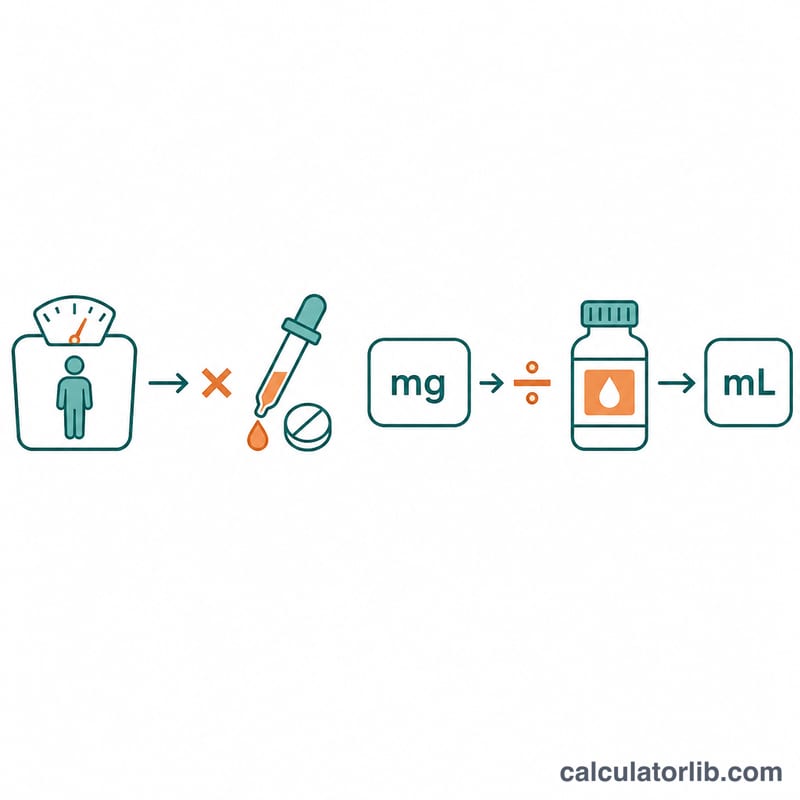
Enter the patient weight in kilograms, the prescribed dose in mg/kg per dose, and how many doses are given in 24 hours (BID = 2, TID = 3, QID = 4). Then copy the strength from the bottle, for example 160 mg per 5 mL, and optionally the maximum daily dose. Set the maximum to 0 to skip the safety comparison.
This tool has no drug-specific limits. Check the medicine label for the maximum single dose, the maximum daily dose and the minimum time between doses, and never exceed them. A child's dose must never exceed the adult maximum.
The formula explained
With \(W\) = weight in kg, \(D\) = mg/kg per dose, \(n\) = doses per day, and a bottle strength of \(S_{mg}\) per \(S_{mL}\), the concentration is \(C = S_{mg}/S_{mL}\) in mg/mL and
$$V = \frac{W \times D}{C}, \qquad \text{Daily}_{mg} = W \times D \times n$$The percent of maximum is \(P = \text{Daily}_{mg}/M \times 100\), where \(M\) is the stated daily ceiling.
Worked example
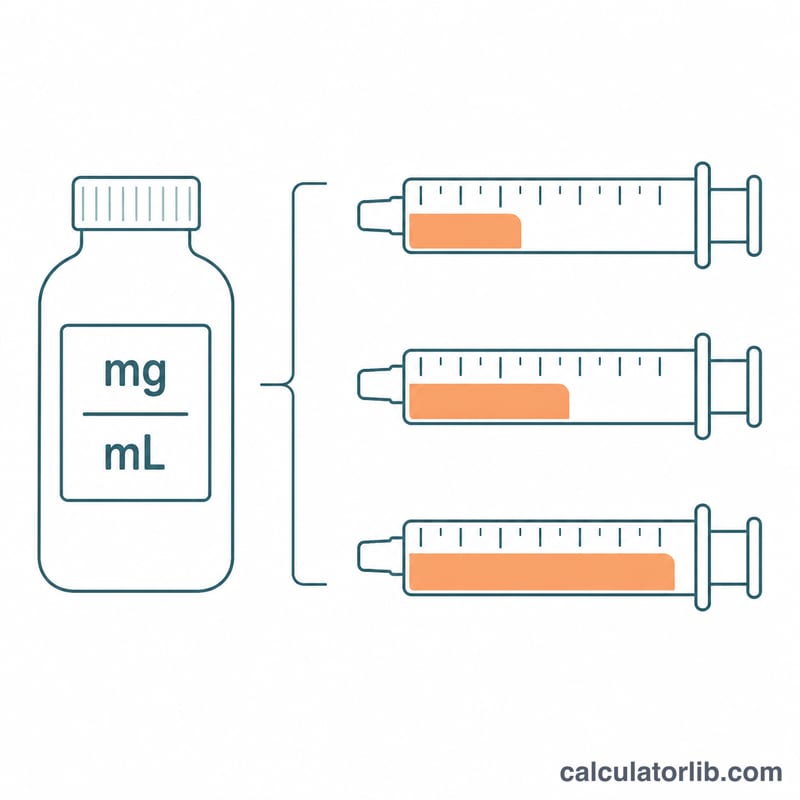
A 20 kg child is prescribed 15 mg/kg per dose, four times a day, using a 160 mg per 5 mL suspension with a 2000 mg daily maximum. The concentration is \(C = 160/5 = 32\ \text{mg/mL}\), so
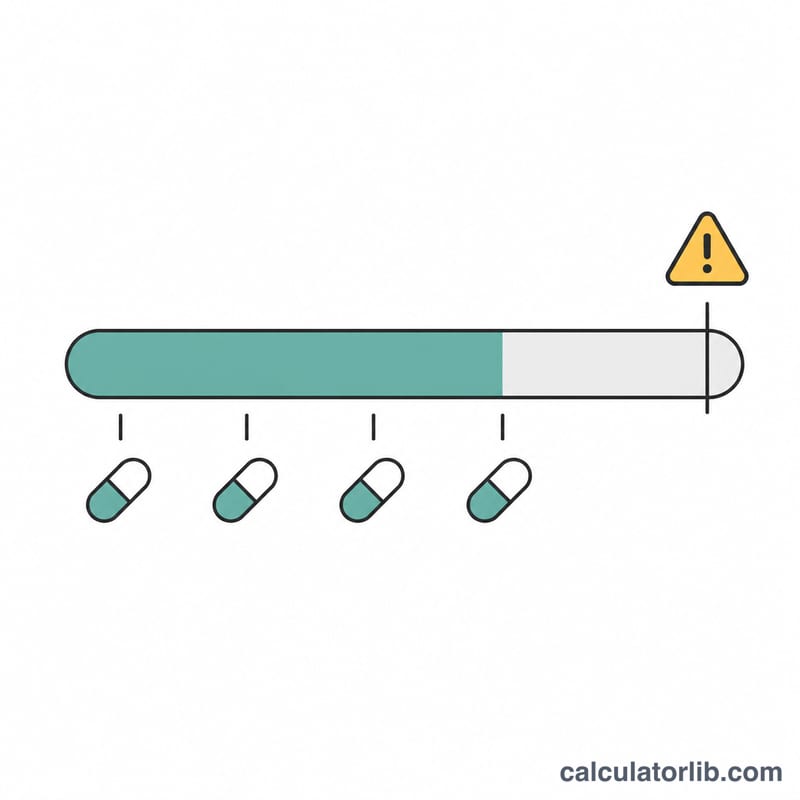
$$\text{Dose} = 20 \times 15 = 300\ \text{mg}, \qquad V = \frac{300}{32} = 9.375\ \text{mL}$$The daily total is \(300 \times 4 = 1200\) mg, which is \(1200/2000 \times 100 = 60\%\) of the maximum, so the regimen sits comfortably inside the ceiling.
Interpreting Your Result
The calculator performs four pieces of arithmetic on the numbers you typed and nothing more. Reading each output correctly means knowing exactly what it is — and is not — telling you.
Per-dose milligrams
The mg figure is \(D_{\text{dose}} = \text{weight} \times \text{dose per kg}\). It is valid only if the mg/kg value you entered was a per-dose figure. Prescriptions and labels also quote mg/kg per day, and the two are not interchangeable: a per-day figure entered as if it were per-dose multiplies the daily total by the number of doses. The weight must be in kilograms; a pound value entered unconverted inflates every output by roughly 2.2×.
Millilitres to measure
The volume is \(V_{\text{dose}} = D_{\text{dose}} \div C\), where \(C\) is the concentration implied by the strength and per-volume pair you entered. The result is an exact quotient and will often be a value no household spoon can reproduce — 3.47 mL, for example. A volume is only usable if you have a measuring device graduated finely enough to hit it: an oral syringe or dosing cup marked in 0.1 mL or 0.5 mL steps, not a kitchen teaspoon. If the calculated volume falls between the graduations on the device you actually have, that is a question for the dispensing pharmacist, not something to round on your own.
Percent of daily maximum
This output is \(\%_{\max} = (D_{\text{daily}} \div \text{max daily}) \times 100\%\), and it reads as follows:
| Result | What it factually means |
|---|---|
| Under 100% | The regimen as entered totals less than the ceiling you typed. The remainder is headroom in that arithmetic only. |
| Exactly 100% | The regimen as entered sits at the ceiling you typed, with no room for an extra dose, a shortened interval, or a second product containing the same active ingredient. |
| Over 100% | The figures as entered exceed the ceiling you typed. Recheck each input against the prescription: per-dose vs per-day mg/kg, the number of doses per day, the weight unit, and the maximum itself. |
Combination products are a common reason a real-world total differs from the calculated one. Many multi-symptom cold, flu and pain preparations contain the same active ingredient as the single-ingredient product being dosed, and the ceiling applies to the combined intake from all sources — the calculator sees only the one regimen you entered.
What the calculator does not do
- The maximum is yours, not ours. The percent-of-maximum output uses whatever number you typed into the maximum field. It is not a verified, drug-specific or jurisdiction-specific limit, and the calculator does not check it against any formulary or label.
- No weight cap is applied. Weight-based paediatric dosing is frequently capped at the adult dose once a child's weight is high enough — beyond that weight the mg/kg multiplication keeps rising while the actual prescribed dose does not. The calculator applies no such cap; it multiplies whatever weight you give it.
- The mg/kg figure is not validated. Nothing here judges whether the dose per kilogram you entered is appropriate for the drug, the indication, the patient's age, kidney or liver function, or any other medicine being taken. That judgement belongs to the prescriber or pharmacist.
- Rounding is not clinical rounding. The outputs are raw arithmetic. Decisions about rounding to a measurable volume, to a tablet size, or to a standard dosing band are clinical ones.
Label conventions and maximum doses also vary by country for the same drug — the strength of a children's oral suspension sold in one market is often different from the strength sold under a similar name elsewhere — so always read the figures off the bottle in your hand rather than from memory or from a source written for another country.
This section is general information about how the calculation works, not medical advice. It is not a substitute for the prescription, the product label, or guidance from a qualified prescriber or pharmacist, and it gives no recommended dose for any person or drug. For dosing decisions, overdose concerns, or any doubt about a figure, contact a pharmacist, your prescriber, or your local poison or emergency service.
Converting Bottle Strengths to mg/mL
The calculator divides milligrams by a concentration in mg/mL. Liquid medicine labels, however, rarely state mg/mL directly — most quote milligrams per a stated volume, usually 5 mL. Converting is a single division: \(C = \text{strength (mg)} \div \text{per volume (mL)}\). The table below works that division for label formats commonly seen on oral liquids.
| Label reads | Division | Concentration (mg/mL) |
|---|---|---|
| 100 mg / 5 mL | 100 ÷ 5 | 20 mg/mL |
| 120 mg / 5 mL | 120 ÷ 5 | 24 mg/mL |
| 125 mg / 5 mL | 125 ÷ 5 | 25 mg/mL |
| 160 mg / 5 mL | 160 ÷ 5 | 32 mg/mL |
| 200 mg / 5 mL | 200 ÷ 5 | 40 mg/mL |
| 250 mg / 5 mL | 250 ÷ 5 | 50 mg/mL |
| 400 mg / 5 mL | 400 ÷ 5 | 80 mg/mL |
| 100 mg / 1 mL (concentrated drops) | 100 ÷ 1 | 100 mg/mL |
| 1 g / 10 mL | 1000 ÷ 10 | 100 mg/mL |
Note that the specific strengths available differ between countries for the same drug — for example, 120 mg/5 mL and 160 mg/5 mL are both common paediatric suspension strengths in different markets. The table shows the arithmetic for each format; it does not imply that a given strength exists, or is appropriate, where you are.
Companion conversions
| Conversion | Relationship |
|---|---|
| Grams to milligrams | 1 g = 1000 mg |
| Milligrams to micrograms | 1 mg = 1000 mcg (µg) |
| Teaspoon to millilitres | 1 teaspoon ≈ 5 mL |
| Tablespoon to millilitres | 1 tablespoon ≈ 15 mL |
| Pounds to kilograms | kg = lb ÷ 2.2046 |
The teaspoon and tablespoon equivalents are the nominal dosing values used on medicine labels (the US customary standard defines the medicinal teaspoon as exactly 5 mL); actual kitchen cutlery varies widely in capacity and should not be used to measure medicine. The pound-to-kilogram factor matters because weight is often recorded in pounds in some countries while dosing is universally per kilogram — a 44 lb child is \(44 \div 2.2046 = 19.96\) kg, not 44 kg.
The fivefold trap: mg/5 mL versus mg/mL
The single most consequential label misreading in liquid dosing is treating a mg per 5 mL claim as mg per mL, or the reverse. The two differ by a factor of five, and so does every volume derived from them. Illustrating with pure arithmetic: a 200 mg dose drawn from a 100 mg/5 mL bottle (20 mg/mL) requires 10 mL, while the same 200 mg drawn from concentrated 100 mg/mL drops requires only 2 mL. (This is an arithmetic illustration of the label difference, not a suggested dose.)
Two practical habits follow. First, enter both numbers from the label into the calculator exactly as printed — put 160 in the strength field and 5 in the per-volume field rather than mentally converting to 32. Second, re-read the label every time the bottle, brand or formulation changes, because concentrated infant drops and standard suspensions of the same drug can sit side by side on a shelf with similar packaging and very different concentrations.
Definitions & Glossary
| Term | Definition |
|---|---|
| mg/kg per dose | Milligrams of drug per kilogram of body weight for a single dose. This is the basis the calculator's dose field expects: \(D_{\text{dose}} = \text{kg} \times \text{mg/kg}\). |
| mg/kg per day | Milligrams per kilogram for the whole day, across all doses. To use it here, divide by the number of doses per day first: a per-day figure of 30 mg/kg given three times daily is 10 mg/kg per dose. Entering a per-day figure into the per-dose field is a classic multiplication error. |
| Concentration (mg/mL) | Milligrams of active ingredient in one millilitre of liquid. The calculator derives it as strength ÷ per-volume and uses it to convert milligrams into a measurable volume. |
| Strength / label claim | The milligram amount stated on the label for a stated volume, e.g. "250 mg per 5 mL". The pair of numbers is the label claim; neither number alone is meaningful. |
| Suspension | A liquid in which undissolved drug particles are dispersed. The concentration is only correct after shaking; an unshaken bottle delivers too little drug early and too much at the end. |
| Solution | A liquid in which the drug is fully dissolved, so concentration is uniform throughout and does not depend on shaking. |
| Concentrated drops | A high-concentration liquid formulation (often for infants) supplied with a small syringe or dropper. Because the mg/mL figure is several times that of a standard suspension, the same milligram dose corresponds to a much smaller volume. |
| Oral syringe graduation | The smallest volume increment marked on the measuring device — commonly 0.1 mL, 0.2 mL or 0.5 mL. A calculated volume can only be delivered accurately if it lands on, or very near, a graduation. |
| Dosing interval | The time between consecutive doses, e.g. every 8 hours. Interval and doses-per-day are linked: \(\text{doses per day} = 24 \div \text{interval in hours}\). |
| BID | Twice a day (from Latin bis in die) — frequency 2. |
| TID | Three times a day (ter in die) — frequency 3. |
| QID | Four times a day (quater in die) — frequency 4. |
| q6h, q8h, q12h | "Every 6 / 8 / 12 hours" — a fixed clock interval giving 4, 3 or 2 doses per 24 hours. It differs from QID/TID/BID in intent: q6h implies round-the-clock dosing including overnight, whereas QID is often spread across waking hours. Both map to the same doses-per-day number in this calculator. Several medication-safety organisations discourage Latin frequency abbreviations in favour of plain wording because they are easily misread. |
| Maximum daily dose (ceiling) | The highest total milligram amount intended in 24 hours from all sources of that active ingredient. In this calculator it is simply the number you enter — it is not looked up or verified. |
| Total daily dose | The per-dose milligrams multiplied by the number of doses per day: \(D_{\text{daily}} = D_{\text{dose}} \times \text{frequency}\). The daily volume is \(V_{\text{daily}} = V_{\text{dose}} \times \text{frequency}\). |
| Percent of maximum | The total daily dose expressed as a share of the ceiling entered: \(\%_{\max} = (D_{\text{daily}} \div \text{max daily}) \times 100\%\). Over 100% means the entered figures exceed the entered ceiling. |
| mg (milligram) | One thousandth of a gram. The standard unit for oral drug amounts: 1 g = 1000 mg. |
| mcg (microgram, µg) | One thousandth of a milligram: 1 mg = 1000 mcg, so 1 g = 1 000 000 mcg. Used for potent drugs; confusing mcg with mg is a thousandfold error. |
| g (gram) | 1000 mg. Antibiotic and some analgesic totals are often quoted in grams and must be converted to milligrams before entry. |
| mL (millilitre) | One thousandth of a litre; the unit of measured liquid volume. 5 mL is the conventional medicinal teaspoon. |
| kg (kilogram) | The weight unit all mg/kg dosing is based on. 1 kg ≈ 2.2046 lb, so pounds must be divided by 2.2046 before entry. |
These definitions are general information, not medical advice. Dose figures, ceilings and formulations for a specific drug and patient come from the prescription, the product label and a qualified prescriber or pharmacist.
FAQ
Is the mg/kg figure per dose or per day? This calculator treats it as per dose. If your reference quotes mg/kg/day, divide it by the number of doses before entering it.
What if the volume is awkward, like 9.375 mL? Round to what your syringe can actually measure, following the prescriber or pharmacist guidance; never round up past the daily maximum.
Can I use it for tablets or injections? Yes, as long as you enter the strength consistently, for example 500 mg per 1 unit for a tablet, in which case the volume result becomes a count of tablets.
Is this medical advice? No. It is an arithmetic aid for education only; always verify every dose with a qualified professional.