What this calculator does
This tool computes measured creatinine clearance from an actual timed urine collection rather than estimating it from serum creatinine alone. Because it uses the creatinine your kidneys really excreted over 24 hours, it is independent of the population assumptions baked into Cockcroft-Gault or CKD-EPI, which makes it useful in pregnancy, extremes of muscle mass, amputation, cirrhosis, and when a precise clearance is needed for drug dosing or transplant workup. Conventional US laboratory units are assumed (creatinine in mg/dL); if your laboratory reports micromoles per litre, divide by 88.4 first.
How to use it
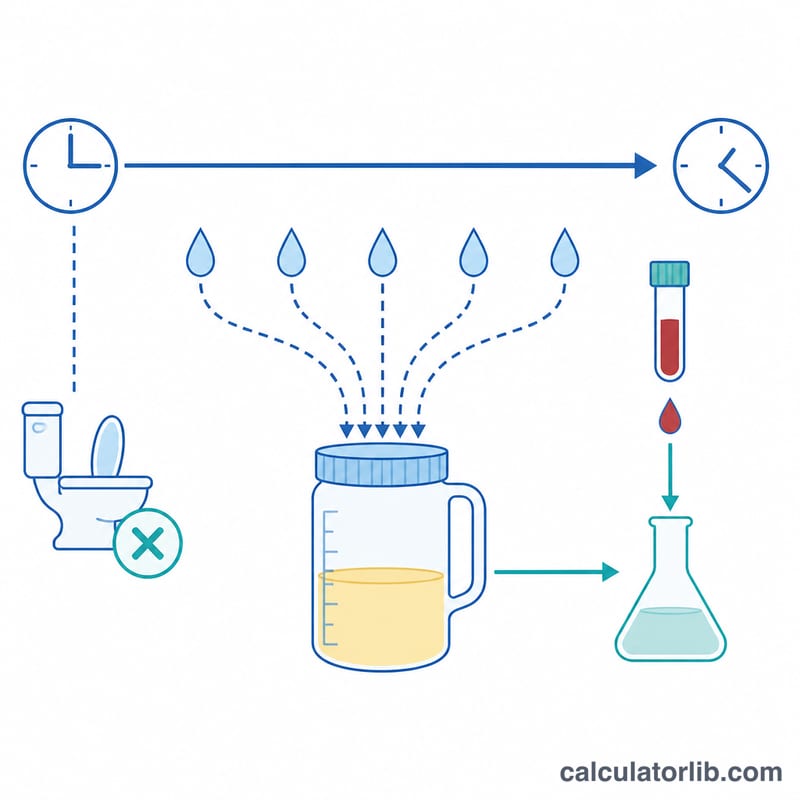
Discard the first morning void, then collect every drop of urine for the next 24 hours, finishing with a void at the same clock time the next morning. Record the total volume in millilitres, send a mixed aliquot for creatinine, and draw a serum creatinine during the same window. Enter the collection length in hours if it was not exactly 24. Height and weight are used only for the body-surface-area correction.
The formula explained
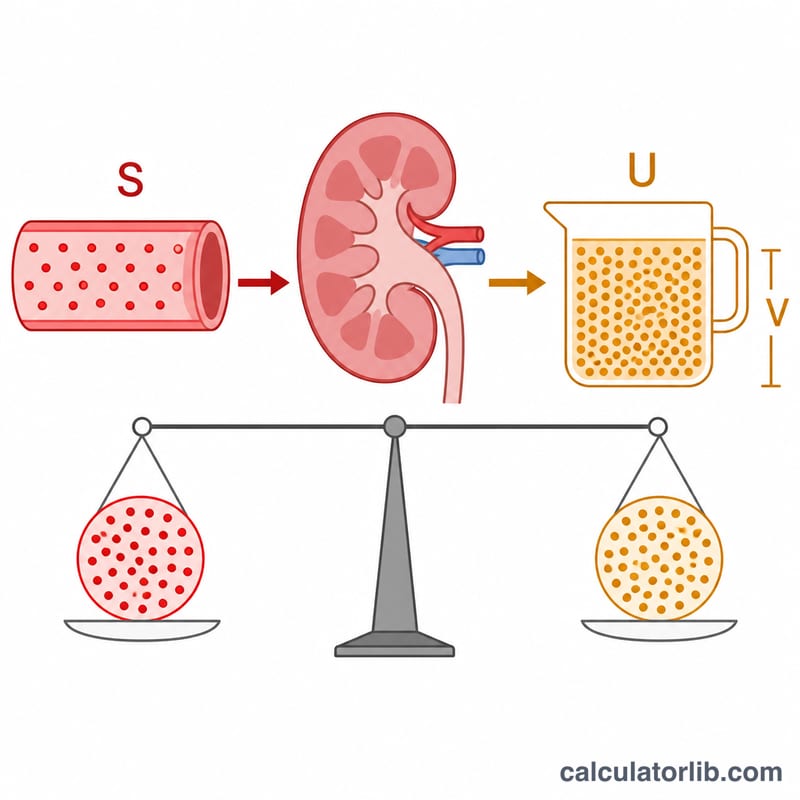
Clearance is the volume of plasma fully cleared of a solute per minute, so the excreted mass is divided by the plasma concentration and the collection time:
$$\text{CrCl} = \frac{U_{cr} \times V}{S_{cr} \times t}$$with \(U_{cr}\) = urine creatinine in mg/dL, \(V\) = total volume in mL, \(S_{cr}\) = serum creatinine in mg/dL, and \(t\) = collection time in minutes (\(24\ \text{h} = 1440\ \text{min}\)). The concentration units cancel, leaving mL/min. The result is then scaled to a standard body size using Du Bois body surface area: $$\text{CrCl}_{1.73} = \text{CrCl} \times \frac{1.73}{\text{BSA}}$$
Worked example
A 170 cm, 70 kg adult collects 1500 mL in 24 hours; urine creatinine is 100 mg/dL and serum creatinine 1.0 mg/dL.
$$\text{CrCl} = \frac{100 \times 1500}{1.0 \times 1440} = \frac{150000}{1440} = 104.2\ \text{mL/min}$$Body surface area is \(0.007184 \times 170^{0.725} \times 70^{0.425} = 1.81\ \text{m}^2\), so the normalised value is $$104.2 \times \frac{1.73}{1.81} = 99.6\ \text{mL/min/1.73 m}^2$$
Normal Creatinine Clearance Reference Values
Expected creatinine clearance depends strongly on sex and age. The figures below follow the convention used in clinical laboratory reference intervals and in the KDIGO 2012 CKD guideline, where adult population values are quoted normalised to a body surface area of 1.73 m² (units: mL/min/1.73 m²). A raw, uncorrected mL/min result for an individual will differ from these ranges roughly in proportion to how far that person's BSA is from 1.73 m² — larger people above, smaller people below — so compare like with like before calling a value "low".
Approximate expected creatinine clearance by age and sex
| Age group | Men (mL/min/1.73 m²) | Women (mL/min/1.73 m²) | Basis |
|---|---|---|---|
| 20–29 years | ~95–140 | ~85–125 | Normalised to 1.73 m² |
| 30–39 years | ~90–135 | ~80–120 | Normalised to 1.73 m² |
| 40–49 years | ~85–130 | ~78–115 | Normalised to 1.73 m² |
| 50–59 years | ~80–122 | ~72–108 | Normalised to 1.73 m² |
| 60–69 years | ~75–115 | ~67–100 | Normalised to 1.73 m² |
| 70 years and over | ~65–105 | ~60–95 | Normalised to 1.73 m² |
The young-adult figures (men approximately 95–140 mL/min, women approximately 85–125 mL/min) are the values most laboratories quote as the adult reference interval. The age-stratified rows reflect the well-documented decline in clearance of roughly 6–7 mL/min per 1.73 m² per decade after about age 40, described in longitudinal ageing studies of renal function. That decline is a population average: cross-sectional and longitudinal studies both show that a substantial minority of healthy older adults show little or no measurable decline, so an "age-expected" value is a context, not a target.
Pregnancy
Pregnancy markedly increases renal plasma flow and GFR. Creatinine clearance rises early and is typically about 40–50% above pre-pregnancy values by the second trimester, which is why serum creatinine normally falls during a healthy pregnancy and why a "normal-looking" creatinine in late pregnancy can conceal impaired function. Clearance declines back toward baseline near term and postpartum. Non-pregnant reference ranges should not be applied to pregnant patients.
Completeness check: expected 24-hour creatinine excretion
Because muscle-derived creatinine production is relatively constant, total 24-hour excretion is the standard check that the collection was neither incomplete nor over-collected. Expected values for adults with typical muscle mass:
| Group | Expected excretion (mg/kg/day) | Approximate SI equivalent (µmol/kg/day) |
|---|---|---|
| Adult men | ~20–25 | ~175–220 |
| Adult women | ~15–20 | ~133–177 |
Example: a 24-hour collection from an 80 kg man would be expected to contain roughly 1600–2000 mg of creatinine. Substantially less suggests lost urine; substantially more suggests a collection period longer than 24 hours. Expected excretion is lower than the table indicates in older adults, in people with low muscle mass, amputation, malnutrition, chronic illness or advanced CKD, and higher in heavily muscled individuals and with creatine supplementation — so the check is a sanity test, not a strict criterion.
Important caveats
- These ranges are approximate and convention-based. Reference intervals are laboratory- and assay-specific (enzymatic versus Jaffe creatinine methods differ, and Jaffe methods are susceptible to non-creatinine chromogens), so the interval printed on your own laboratory report takes precedence over any table here.
- Paediatric reference values differ substantially and are not covered above; neonates and infants have much lower clearances that rise over the first two years of life.
- Measured creatinine clearance overestimates true GFR because of tubular creatinine secretion, so values near the lower end of a reference range may correspond to a somewhat lower actual GFR.
- Units matter: mg/dL for creatinine and mL for volume are the US conventional convention; many countries report creatinine in µmol/L and volume in litres, and the inputs must be consistent with what the calculator expects.
This table is general educational information, not medical advice. Whether a particular clearance value is normal, reduced, or requires follow-up is a clinical judgement for the ordering clinician.
FAQ
How do I know the collection was complete? Adults normally excrete about 15–25 mg of creatinine per kilogram per day (slightly less in women and the elderly). A value far below that range usually means urine was missed, and the clearance will be falsely low.
Why is measured clearance higher than my eGFR? Creatinine is both filtered and actively secreted by the tubules, so creatinine clearance typically overestimates true glomerular filtration rate by roughly 10–20 percent.
Should I use corrected or uncorrected clearance? Use the uncorrected mL/min value for weight-based drug dosing, and the 1.73 m² normalised value when comparing kidney function against reference ranges or staging.