What this calculator does
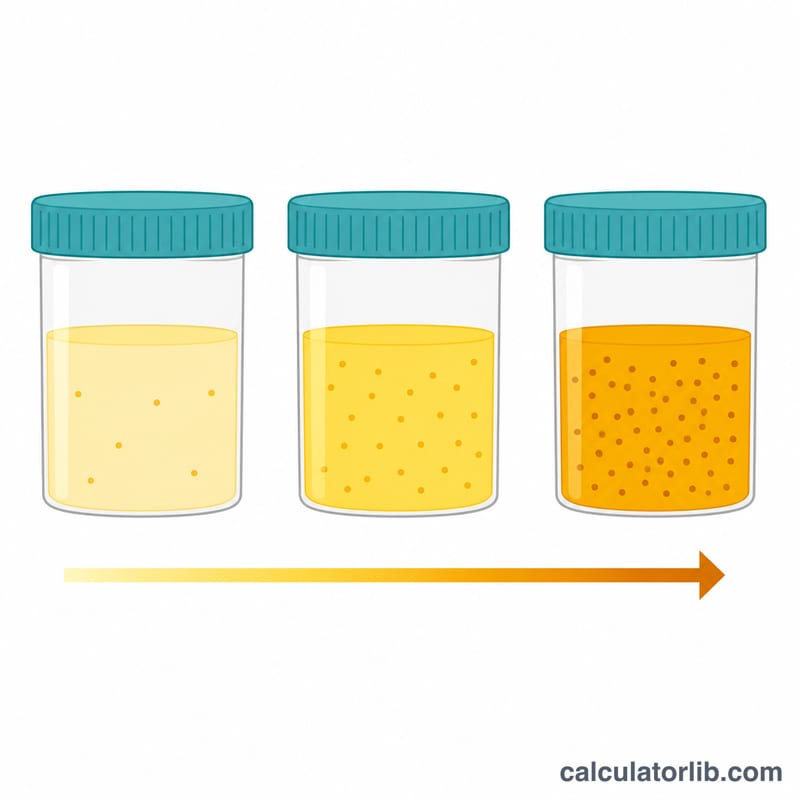
Urine osmolarity measures how many osmotically active particles the kidney has packed into each litre of urine. It is central to working up hyponatremia, polyuria, acute kidney injury and diabetes insipidus. This tool estimates it two ways: from a dipstick or refractometer specific gravity, or from measured urine sodium, potassium, urea nitrogen and glucose. Units are US conventional (mg/dL for urea nitrogen and glucose, mmol/L for electrolytes).
The formulas
The solute method sums the major osmoles, doubling the cations to account for their accompanying anions:
$$U_{osm} = 2 \times (\text{Na} + \text{K}) + \frac{\text{Urea N} }{2.8} + \frac{\text{Glucose} }{18}$$Here \(\text{Na}\) and \(\text{K}\) are urine sodium and potassium in mmol/L, \(\text{Urea N}\) is urine urea nitrogen in mg/dL, and \(\text{Glucose}\) is urine glucose in mg/dL. The divisors 2.8 and 18 convert mg/dL to mmol/L. When only a specific gravity is available, the bedside approximation is
$$U_{osm} \approx 300 + (\text{SG} - 1.010) \times 20300$$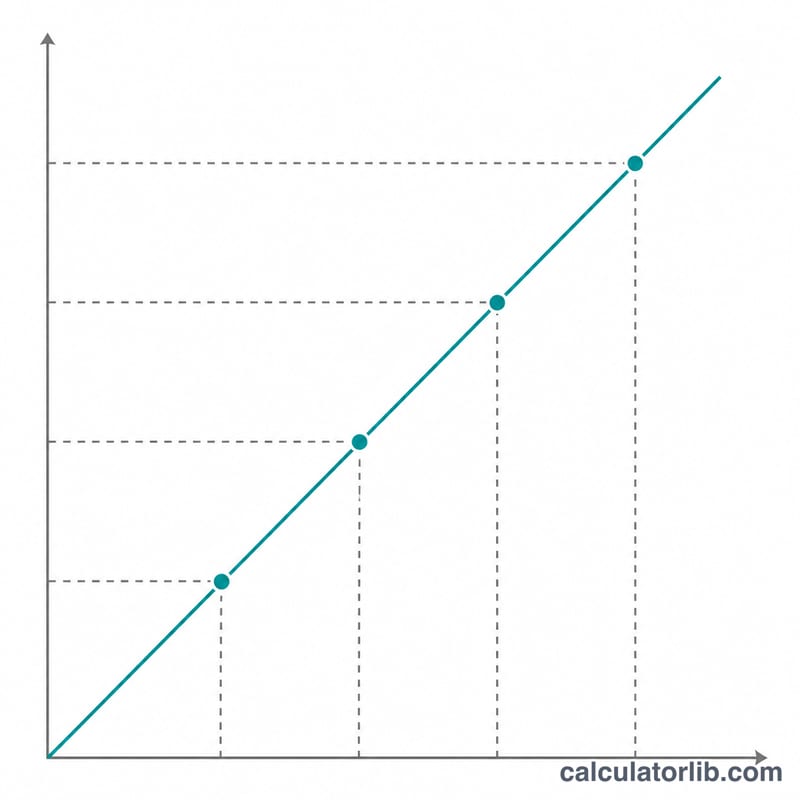
Worked example
A patient has urine sodium 80 mmol/L, potassium 40 mmol/L, urea nitrogen 600 mg/dL and no glucosuria:
$$U_{osm} = 2 \times (80 + 40) + \frac{600}{2.8} + 0 = 240 + 214.3 = 454\,\text{mOsm/L}$$That corresponds to an equivalent specific gravity of \(1.010 + (454 - 300)/20300 \approx 1.018\) — urine that is only modestly concentrated.
Interpreting Your Urine Osmolarity Result
Urine osmolarity (Uosm) is a measure of how many osmotically active particles the kidney has packed into each litre of urine. It answers one clinical question above all others: is the kidney currently diluting or concentrating? The estimate produced here comes either from the bedside specific-gravity shortcut, \(U_{osm} \approx 300 + (SG - 1.010) \times 20300\), or from the measured solutes, \(U_{osm} \approx 2 \times (\text{Na} + \text{K}) + \frac{\text{UUN}}{2.8} + \frac{\text{Glucose}}{18}\).
General interpretive bands
| Estimated Uosm (mOsm/L) | Physiological meaning | Typically seen in |
|---|---|---|
| < 100 | Maximally dilute urine; antidiuretic hormone (ADH) is essentially switched off, or there is too little solute to excrete | Primary (psychogenic) polydipsia, low-solute intake states including "beer potomania" and tea-and-toast diets, appropriate response to a large water load |
| 100–300 | Dilute but not maximally so: impaired concentrating ability, or water excess with some residual ADH effect | Chronic kidney disease with loss of the medullary gradient, partial diabetes insipidus, recovering tubular injury, diuretic effect |
| 300–600 | Isosthenuria / intermediate range — urine roughly iso-osmolar with plasma (~275–295 mOsm/kg), meaning the kidney is neither concentrating nor diluting effectively | Intrinsic acute kidney injury, acute tubular necrosis (ATN), advanced CKD, osmotic diuresis |
| > 500–600 | Intact ADH action with avid water conservation; the concentrating mechanism is working | Hypovolaemia and prerenal states, dehydration, SIADH when there is coexisting hyponatraemia, heart failure or cirrhosis with reduced effective circulating volume |
The classic hyponatraemia fork
In a patient with a low serum sodium, urine osmolarity splits the differential in two. A Uosm below roughly 100 mOsm/L means ADH is appropriately suppressed and the kidney is excreting maximally dilute urine — the problem is water intake or solute supply outstripping excretory capacity (primary polydipsia, beer potomania, low-solute diets). A Uosm above roughly 100 mOsm/L means ADH is acting despite hypotonicity, which points to SIADH, hypovolaemia, thiazide effect, hypothyroidism, adrenal insufficiency, or an oedematous state. This threshold is a decision point, not a diagnosis.
The mirror image: hypernatraemia
In hypernatraemia or a rising serum sodium, the kidney should be producing maximally concentrated urine (commonly >600–800 mOsm/kg). A Uosm that is inappropriately low in that setting — often well under 300 mOsm/L in complete central or nephrogenic diabetes insipidus — indicates a failure to generate or respond to ADH, and is the reason a water-deprivation or copeptin-based assessment may be pursued.
Never read this number alone
- Serum osmolality and serum sodium define whether concentrating or diluting is the appropriate response.
- Urine sodium separates volume depletion and prerenal physiology (typically low urine Na) from SIADH and salt-wasting (typically higher urine Na).
- Urine volume and total daily solute output matter: a modest Uosm with a very large volume can still represent a huge solute load (osmotic diuresis), while a low solute intake caps how much water can be excreted no matter how dilute the urine.
- Glucose, mannitol, contrast and radiocontrast-like solutes inflate specific gravity far more than they inflate osmolarity, so the SG shortcut can be badly misleading when they are present.
Estimate, not measurement
Both equations here are approximations. Osmolarity (per litre of solution) is calculated; osmolality (per kilogram of water) is what the laboratory measures by freezing-point depression, and the two differ slightly. The solute equation also ignores unmeasured osmoles — ammonium salts, other organic acids, exogenous agents — so a measured osmolality is often higher than the calculated value; that difference is the urine osmolal gap. This calculator provides general educational information only and is not medical advice, not a laboratory result, and not a substitute for assessment by a qualified clinician. Any real clinical decision should rest on a measured urine osmolality interpreted together with the full clinical picture.
Urine Osmolarity Across Typical Clinical Scenarios
Every row below is computed with this article's own solute equation, \(U_{osm} = 2 \times (\text{Na} + \text{K}) + \frac{\text{UUN}}{2.8} + \frac{\text{Glucose}}{18}\), where sodium and potassium are in mmol/L and urine urea nitrogen (UUN) and glucose are in mg/dL. The "equivalent SG" column simply inverts the bedside constant: \(SG = 1.010 + \frac{U_{osm} - 300}{20300}\). The input values are illustrative patterns chosen to show the physiology, not measurements from real patients.
| Scenario | Urine Na (mmol/L) | K (mmol/L) | Urea N (mg/dL) | Glucose (mg/dL) | Computed Uosm (mOsm/L) | Equivalent SG |
|---|---|---|---|---|---|---|
| Maximally dilute urine (large water load, ADH fully suppressed) | 10 | 10 | 60 | 0 | 61 | < 1.001 |
| Primary polydipsia / low-solute intake ("beer potomania", tea-and-toast) | 15 | 15 | 100 | 0 | ≈ 96 | < 1.001 |
| Prerenal / hypovolaemic, concentrated urine | 10 | 40 | 1200 | 0 | 529 | ≈ 1.021 |
| SIADH pattern (hyponatraemia with concentrated, sodium-rich urine) | 70 | 30 | 500 | 0 | ≈ 379 | ≈ 1.014 |
| ATN / isosthenuric intrinsic AKI | 60 | 20 | 250 | 0 | ≈ 249 | ≈ 1.008 |
| Osmotic diuresis with heavy glucosuria (uncontrolled diabetes) | 40 | 20 | 400 | 2000 | ≈ 374 | ≈ 1.014 (calculated) — measured SG far higher |
How each row is built
- Maximally dilute: \(2 \times (10 + 10) + \frac{60}{2.8} + 0 = 40 + 21.4 = 61.4\) mOsm/L, i.e. \(SG = 1.010 + \frac{61.4 - 300}{20300} < 1.001\). Urine this dilute is a normal kidney doing exactly what it should with excess free water.
- Low-solute intake: \(2 \times (15 + 15) + \frac{100}{2.8} = 60 + 35.7 = 95.7\) mOsm/L. The concentration is nearly normal for a suppressed-ADH state — the danger here is the tiny total solute load, which caps maximum daily water excretion and allows hyponatraemia at modest intakes.
- Prerenal: \(2 \times (10 + 40) + \frac{1200}{2.8} = 100 + 428.6 = 528.6\) mOsm/L. Note the pattern as much as the number: very low urine sodium with a very high urea contribution is the fingerprint of avid tubular reabsorption.
- SIADH: \(2 \times (70 + 30) + \frac{500}{2.8} = 200 + 178.6 = 378.6\) mOsm/L. Lower osmolarity than the prerenal row, but the urine sodium is high because volume status is not the driver — ADH is.
- ATN: \(2 \times (60 + 20) + \frac{250}{2.8} = 160 + 89.3 = 249.3\) mOsm/L — damaged tubules can neither concentrate nor conserve sodium, so the urine drifts toward plasma tonicity.
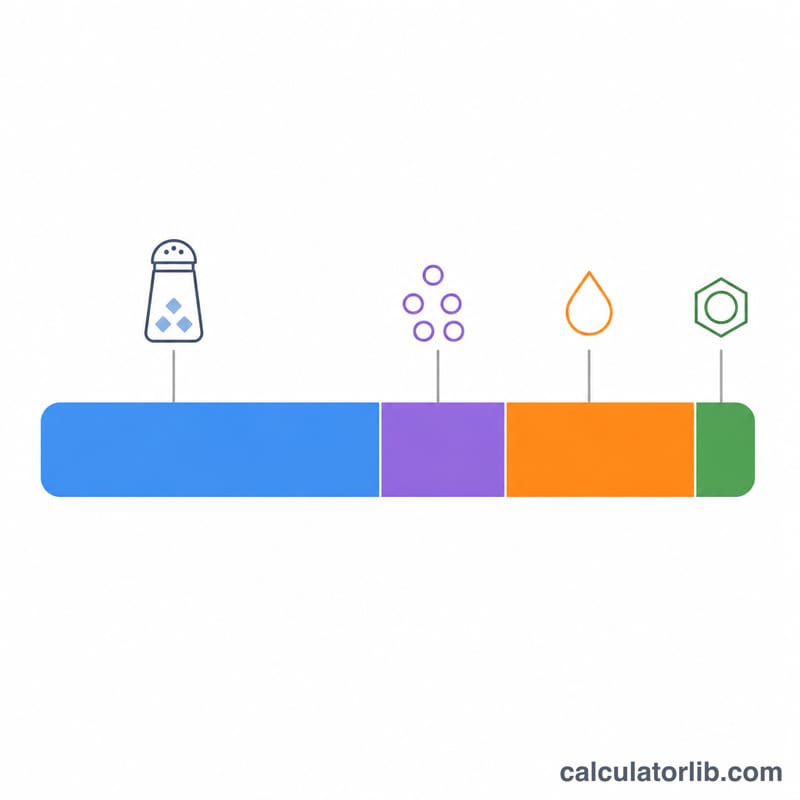
- Osmotic diuresis: \(2 \times (40 + 20) + \frac{400}{2.8} + \frac{2000}{18} = 120 + 142.9 + 111.1 = 374.0\) mOsm/L, of which ≈111 mOsm/L comes from glucose alone — roughly 30% of the total.
Warning: the specific-gravity shortcut breaks in the glucosuria row
Specific gravity responds to the mass and size of dissolved particles, while osmolarity responds only to their number. Glucose is a large, heavy, uncharged molecule: it raises specific gravity far out of proportion to the osmoles it contributes. A urine containing 2000 mg/dL (2 g/dL) of glucose can measure a specific gravity well above 1.015 on the dipstick or refractometer, which the bedside constant would translate into more than 400 mOsm/L — roughly 7% higher than the 374 mOsm/L the solute equation gives. The same distortion occurs with iodinated radiocontrast, mannitol, dextran and heavy proteinuria. Whenever any of these are present, use the solute method (or a measured osmolality) and treat the SG estimate as unreliable.
FAQ
How accurate is the specific gravity shortcut? Reasonable for ordinary urine, but heavy molecules such as glucose, protein, radiocontrast and dextran raise specific gravity far more than they raise osmolarity, so the estimate is falsely high in those settings.
What is a normal value? Healthy kidneys span roughly 50 to 1200 mOsm/kg. Below about 300 mOsm/L suggests water excess or impaired concentrating ability; above 600 mOsm/L suggests appropriate antidiuretic hormone action and water conservation.
Osmolarity or osmolality? Osmolarity is per litre of solution, osmolality per kilogram of water. In dilute urine the two are numerically close, so the estimate is usually compared directly against a laboratory osmolality.