What is TPN osmolarity?
Total parenteral nutrition (TPN) is a sterile mixture of dextrose, amino acids, lipid emulsion, electrolytes and other additives given intravenously. Its osmolarity, the number of osmoles of solute per liter of solution, determines how irritating it is to veins. This calculator estimates osmolarity from the per-liter concentration of each component. It is a bedside estimate only and does not replace pharmacy compounding software or clinical judgment.
How to use the calculator
Enter the concentration of dextrose, amino acids and lipid in grams per liter, and sodium, potassium, calcium and magnesium in mEq per liter. If your order is written for the whole bag, divide each amount by the final volume in liters first. The tool returns total mOsm/L, a breakdown by source, and a note on whether the value is within the commonly cited peripheral limit of about 900 mOsm/L.
The formula explained
Each component is multiplied by an approximate osmolar factor:
$$\text{Osm} = 5D + 10A + 1.5L + 2(\text{Na} + \text{K}) + 1.4\,\text{Ca} + \text{Mg}$$Here \(D\) is dextrose in g/L (about 5 mOsm per gram), \(A\) is amino acids in g/L (about 10 mOsm per gram), and \(L\) is lipid in g/L (about 1.5 mOsm per gram). Sodium and potassium are counted at 2 mOsm per mEq because each is paired with an anion, calcium gluconate at 1.4 and magnesium sulfate at 1.
Worked example
Take 100 g/L dextrose, 40 g/L amino acids, 20 g/L lipid, 40 mEq/L sodium, 30 mEq/L potassium, 5 mEq/L calcium and 8 mEq/L magnesium.
$$\text{Osm} = 500 + 400 + 30 + 80 + 60 + 7 + 8 = 1085\ \text{mOsm/L}$$This exceeds 900 mOsm/L, so central access would typically be needed.
Osmolar Contribution Factors by Component
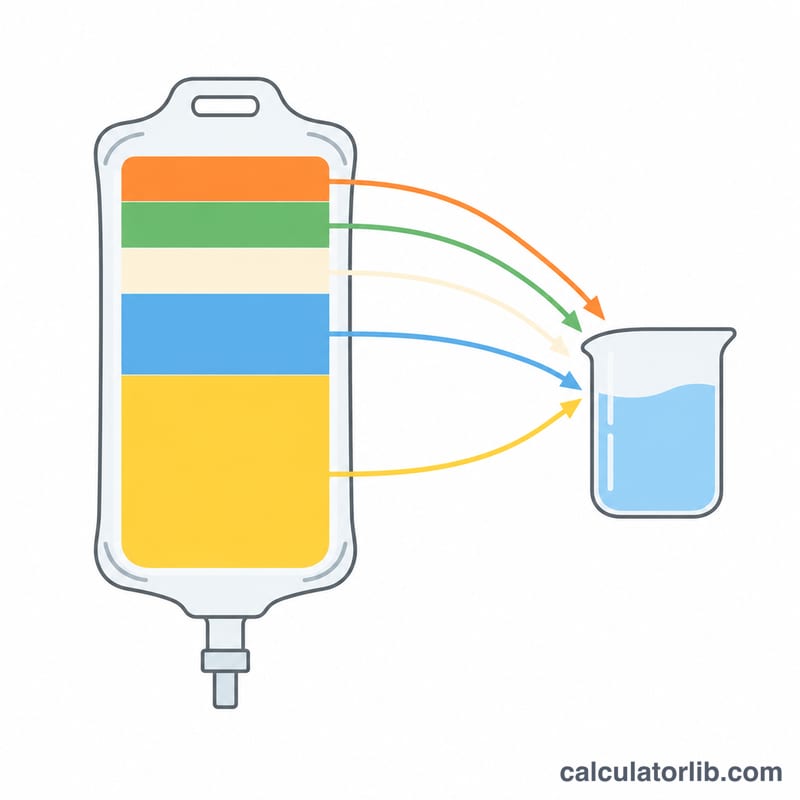
This calculator estimates osmolarity by adding up the approximate contribution of each ingredient per litre of final admixture. The factors below are the ones built into the formula.
| Component | Input unit | Approx. mOsm per unit | Basis |
|---|---|---|---|
| Dextrose | g/L | 5 | About 5 mOsm per gram of dextrose monohydrate |
| Amino acids | g/L | 10 | About 10 mOsm per gram of crystalline amino acid solution |
| Lipid emulsion | g/L | 1.5 | Lipid particles add little osmolarity, but glycerin in the emulsion adds some |
| Sodium | mEq/L | 2 | 1 mEq of Na plus its accompanying anion (e.g. chloride or acetate) gives about 2 mOsm |
| Potassium | mEq/L | 2 | 1 mEq of K plus its accompanying anion gives about 2 mOsm |
| Calcium (as gluconate) | mEq/L | 1.4 | Calcium gluconate dissociates incompletely, so the figure is below 2 |
| Magnesium (as sulfate) | mEq/L | 1 | Approximate figure for magnesium sulfate |
Caveat: these factors are approximations. Actual osmolarity varies with the specific products, salt forms, amino acid formulations, lipid emulsion type, additives and final volume. Measured values or pharmacy compounding software may differ from this estimate.
Interpreting Your Result
The result is an estimate of total solute concentration in mOsm/L. For comparison, normal plasma osmolarity is about 285–295 mOsm/L, so any TPN formulation is hypertonic to blood to some degree.
- About 900 mOsm/L is a commonly cited upper limit for peripheral venous administration in many guidelines.
- Some institutions use lower cutoffs, for example about 600–900 mOsm/L, depending on local policy, vein condition and expected duration.
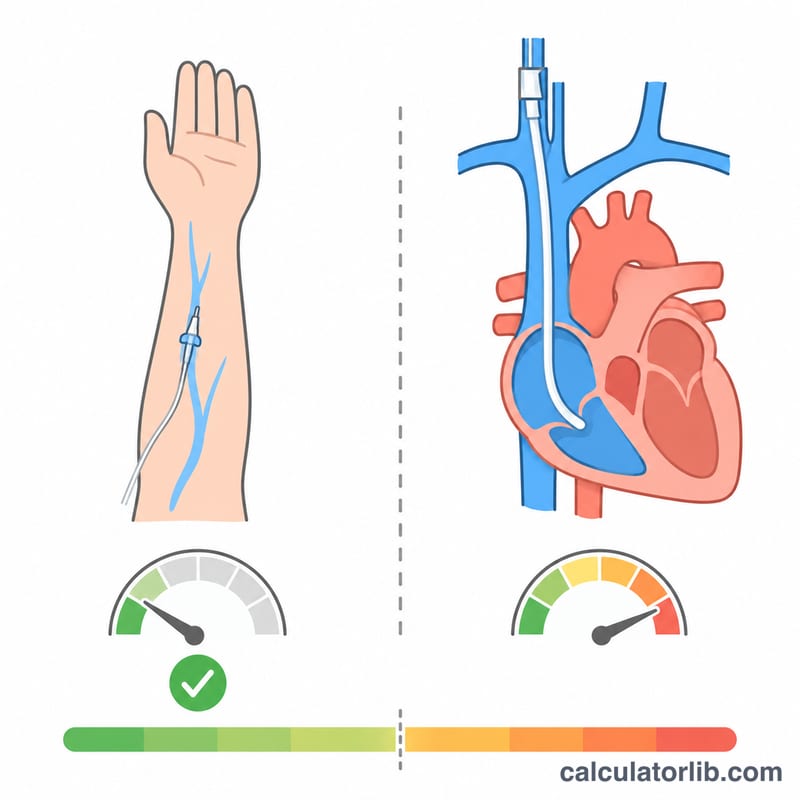
- Higher osmolarity is linked with a higher risk of phlebitis and vein irritation in small peripheral veins.
- Above the threshold, central venous access is typically used, because blood flow in large central veins dilutes the solution quickly.
Protocols vary between institutions and countries, and osmolarity is only one factor in choosing an access route (others include duration of therapy, venous access and patient condition). This tool gives general information, not medical advice. Formulation and route decisions belong to the pharmacy and clinical nutrition team.
Example TPN Formulations Compared
The formulations below are illustrative only, not orders or recommendations. Each total uses \(\text{Osm} = 5D + 10A + 1.5L + 2(\text{Na}+\text{K}) + 1.4\,\text{Ca} + \text{Mg}\) and is compared with the 900 mOsm/L peripheral threshold.
| Formulation | Dextrose (g/L) | Amino acids (g/L) | Lipid (g/L) | Na / K (mEq/L) | Ca / Mg (mEq/L) | Total (mOsm/L) | vs 900 mOsm/L |
|---|---|---|---|---|---|---|---|
| A. Low-dextrose, peripheral-style | 70 | 30 | 20 | 35 / 20 | 4 / 4 | 799.6 | Below the limit (peripheral range) |
| B. Borderline | 100 | 30 | 20 | 35 / 20 | 4 / 4 | 949.6 | Above the limit (central typical) |
| C. Mid-range central | 150 | 40 | 30 | 40 / 30 | 5 / 8 | 1350 | Above the limit (central) |
| D. High-dextrose central | 250 | 50 | 40 | 50 / 40 | 5 / 8 | 2005 | Well above the limit (central) |
Worked check for formulation A: \(5(70) + 10(30) + 1.5(20) + 2(35+20) + 1.4(4) + 4 = 350 + 300 + 30 + 110 + 5.6 + 4 = 799.6\) mOsm/L.
Worked check for formulation C: \(5(150) + 10(40) + 1.5(30) + 2(40+30) + 1.4(5) + 8 = 750 + 400 + 45 + 140 + 7 + 8 = 1350\) mOsm/L.
Formulation B shows how raising dextrose from 70 to 100 g/L adds 150 mOsm/L and moves a mix past the commonly cited peripheral limit. Dextrose and amino acids are the main drivers of osmolarity. These examples are estimates, and real formulations must be prepared and verified by qualified pharmacy and clinical staff.
FAQ
Is this the exact osmolarity?
No. Factors are approximations, and real values vary with the products used, additives and volume displacement.
What is the peripheral limit?
Many guidelines cite about 900 mOsm/L, though institutional protocols differ.
Does lipid matter much?
Lipid adds little osmolarity compared with dextrose and amino acids, which is why lipid emulsions are relatively peripheral-friendly.