What this calculator does
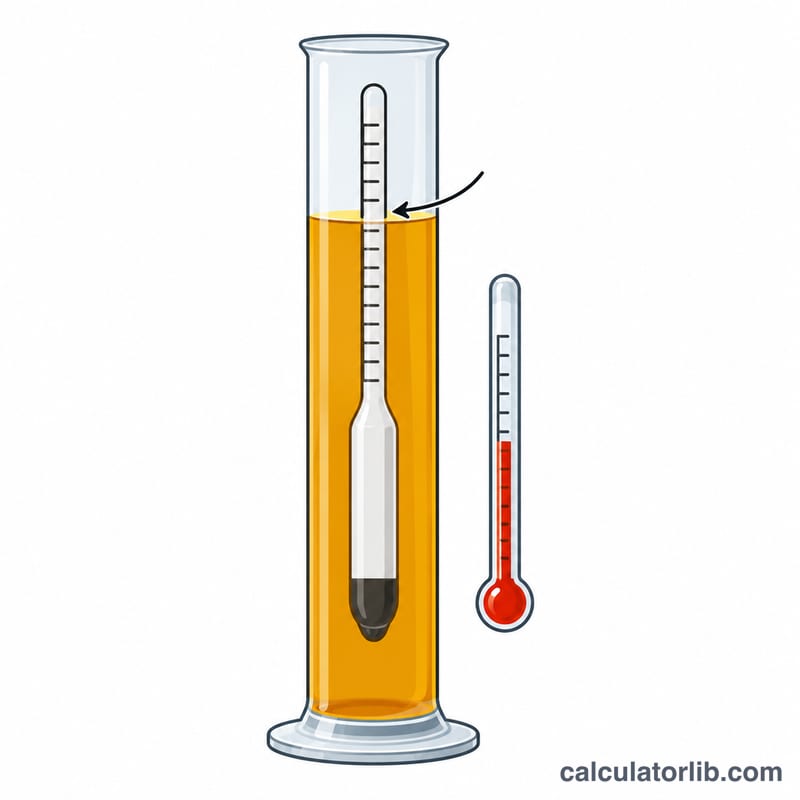
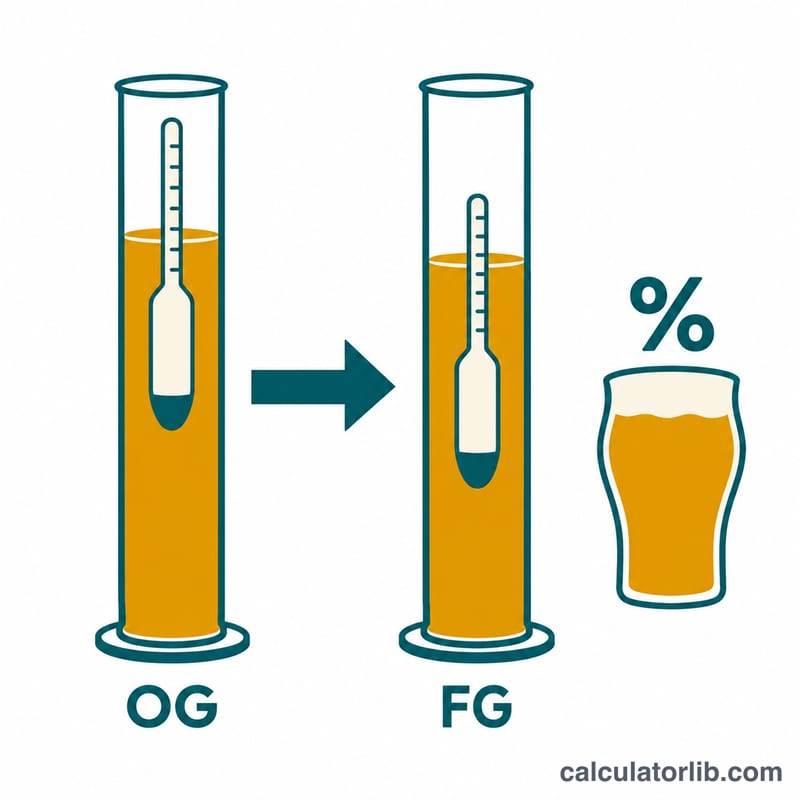
This calculator estimates the alcohol by volume (ABV) of homebrew beer from your original gravity (OG) and final gravity (FG) hydrometer readings. Hydrometers are calibrated for a specific temperature, usually 60 °F (15.6 °C) or 68 °F (20 °C). If your wort or beer sample is warmer or cooler, the reading is off, so this tool corrects each reading before computing ABV.
How to use it
Enter your OG and FG, choose Fahrenheit or Celsius, enter the calibration temperature printed on your hydrometer, and enter the sample temperature at each reading. Pick the simple formula for typical beers or the advanced formula for stronger beers above about 6% ABV.
The formulas explained
Each reading is corrected by the ratio of a water density polynomial at the sample temperature to the same polynomial at the calibration temperature (temperatures in °F):
$$SG_{c} = SG \times \frac{ p(T_{s}) }{ p(T_{cal}) }$$The simple ABV formula is:
$$\text{ABV} = (OG_{c} - FG_{c}) \times 131.25$$The advanced formula is:
$$\text{ABV} = \frac{76.08\,(OG_{c} - FG_{c})}{1.775 - OG_{c}} \times \frac{FG_{c}}{0.794}$$Apparent attenuation is \((OG_{c} - FG_{c}) / (OG_{c} - 1) \times 100\).
Worked example
Take OG = 1.060 and FG = 1.012, with all samples at the calibration temperature so no correction applies:
$$\text{ABV} = (1.060 - 1.012) \times 131.25 = 6.30\%$$Attenuation is \(0.048 / 0.060 \times 100 = 80\%\).
Water Density Polynomial and Calibration Constants
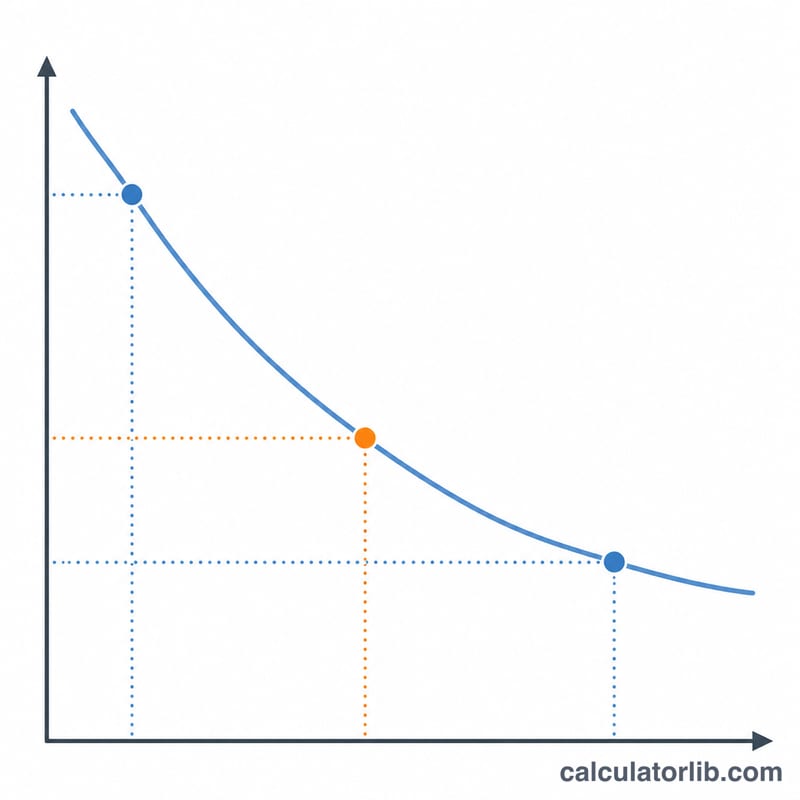
Hydrometers are calibrated to read correctly at one specific liquid temperature. At any other temperature the liquid's density differs, so the reading must be corrected. The calculator uses a fourth-order-free cubic fit of water density as a function of temperature, with T in °F:
$$\rho(T) = 1.00130346 - 0.000134722124\,T + 0.00000204052596\,T^2 - 0.00000000232820948\,T^3$$
The corrected gravity is the measured reading multiplied by the ratio of the density at the sample temperature to the density at the calibration temperature:
$$G_c = G \cdot \frac{ \rho(T_{\text{sample}})}{ \rho(T_{\text{cal}})}$$
| Constant | Value | Notes |
|---|---|---|
| Common calibration temperature (US/imperial) | 60 °F (15.6 °C) | Printed on many hydrometers sold to homebrewers |
| Common calibration temperature (metric) | 68 °F (20 °C) | Used on many lab-style and European hydrometers |
| °C to °F conversion | °F = °C × 9/5 + 32 | Applied first if you enter temperatures in °C |
| ρ(60 °F) | ≈ 1.000063 | From the polynomial above |
| ρ(68 °F) | ≈ 1.000847 | From the polynomial above |
| ρ(80 °F) | ≈ 1.002393 | From the polynomial above |
| Simple-formula factor | 131.25 | ABV (%) = (OG − FG) × 131.25 |
Check your hydrometer's printed calibration temperature and enter it as the calibration temperature; do not assume 60 °F or 68 °F.
Typical Gravity and ABV Ranges by Beer Style
The table lists approximate ranges for common styles, based on the BJCP (Beer Judge Certification Program) 2015 style guidelines. Individual beers can fall outside these ranges.
| Style | OG | FG | ABV (%) |
|---|---|---|---|
| American light lager | 1.028–1.040 | 0.998–1.008 | 2.8–4.2 |
| American pale ale | 1.045–1.060 | 1.010–1.015 | 4.5–6.2 |
| American IPA | 1.056–1.070 | 1.008–1.014 | 5.5–7.5 |
| Irish stout | 1.036–1.044 | 1.007–1.011 | 4.0–4.5 |
| Belgian tripel | 1.075–1.085 | 1.008–1.014 | 7.5–9.5 |
| American imperial stout | 1.075–1.115 | 1.018–1.030 | 8.0–12.0 |
Ale yeasts typically reach an apparent attenuation of about 70–80%, where apparent attenuation = (OG − FG) / (OG − 1) in gravity points. For example, OG 1.050 and FG 1.010 gives 40/50 = 80%. If your result is far outside this range, recheck your readings, temperature and calibration setting.
Temperature Correction and Formula Comparison
All scenarios use a hydrometer calibrated at 60 °F. The correction factor for a sample at 80 °F is ρ(80)/ρ(60) = 1.002393 / 1.000063 ≈ 1.002330. The "advanced" column uses the widely used formula ABV = 76.08 × (OG − FG) / (1.775 − OG) × (FG / 0.794), applied to the corrected gravities; the simple column uses 131.25 × (OG − FG). Values are rounded.
| Scenario | Raw OG / FG | Sample temp | Corrected OG / FG | Simple ABV | Advanced ABV |
|---|---|---|---|---|---|
| A. Standard beer, sample at calibration temp | 1.050 / 1.010 | 60 °F | 1.050 / 1.010 | 5.25% | 5.34% |
| B. Same raw readings, warm sample | 1.050 / 1.010 | 80 °F | 1.0524 / 1.0124 | 5.26% | 5.38% |
| C. High-gravity beer, at calibration temp | 1.090 / 1.018 | 60 °F | 1.090 / 1.018 | 9.45% | 10.25% |
| D. High-gravity beer, warm sample | 1.090 / 1.018 | 80 °F | 1.0925 / 1.0204 | 9.47% | 10.34% |
Worked check for scenario B (simple formula)
$$OG_c = 1.050 \times 1.002330 = 1.05245, \quad FG_c = 1.010 \times 1.002330 = 1.01235$$
$$\text{ABV} = (1.05245 - 1.01235) \times 131.25 = 0.04009 \times 131.25 \approx 5.26\%$$
What the comparison shows
- A warm sample raises the corrected gravity itself (here by about 0.0024), but because OG and FG are both shifted, the ABV changes by only about 0.01–0.02 percentage points.
- If only one reading is warm, for example a hot FG sample, the error is larger, so enter each temperature separately.
- For high-gravity beers, the simple formula under-reads compared with the advanced one: about 9.45% versus 10.25% for OG 1.090 and FG 1.018, a gap of roughly 0.8 points. The two formulas agree more closely for beers below about 6% ABV.
FAQ
Does temperature really matter? Yes. A 68 °F sample on a 60 °F hydrometer reads about 0.001 too low, which shifts ABV by a small but noticeable amount.
Which formula should I choose? The simple formula is fine for most beers; the advanced one is more accurate for high-gravity beers.
Is this exact? It is an estimate. Fermentation with adjuncts or alcohol in the sample affects the real value.