What is the Paper Weight Calculator?
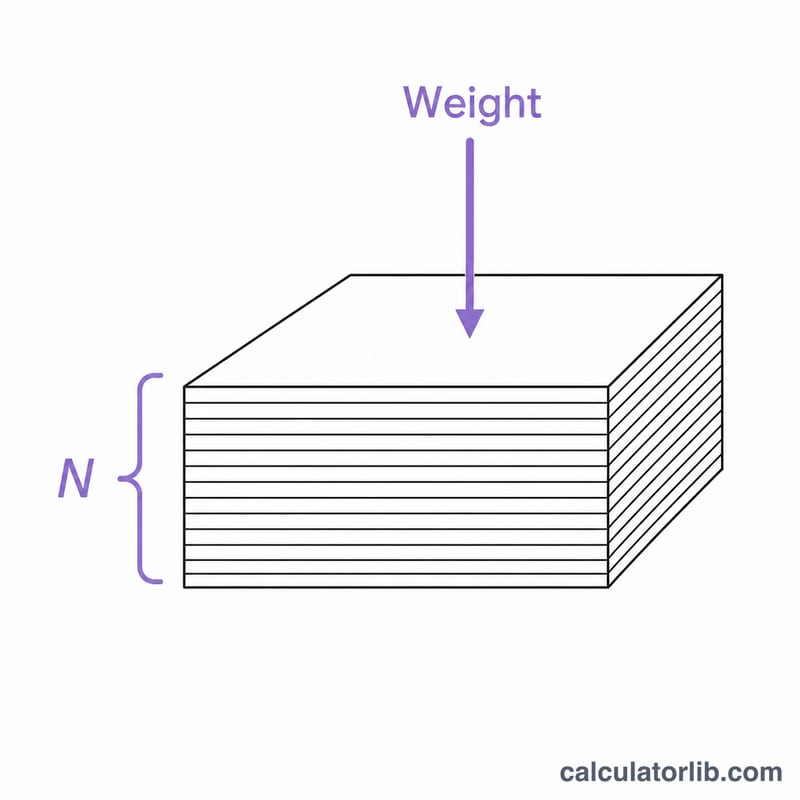
This calculator works out how much a stack or ream of paper weighs from three simple inputs: the dimensions of a single sheet, the paper's grammage in grams per square metre (gsm), and the number of sheets. It is useful for shipping estimates, postage, printing jobs, and figuring out whether a parcel of documents will exceed a weight limit.
How to use it
Enter the sheet length and width in metres (for example, A4 is 0.297 m × 0.210 m), the grammage printed on the paper packaging (commonly 80 gsm for office paper), and how many sheets you have. The result shows the total weight in grams and kilograms, plus the weight of a single sheet.
The formula explained
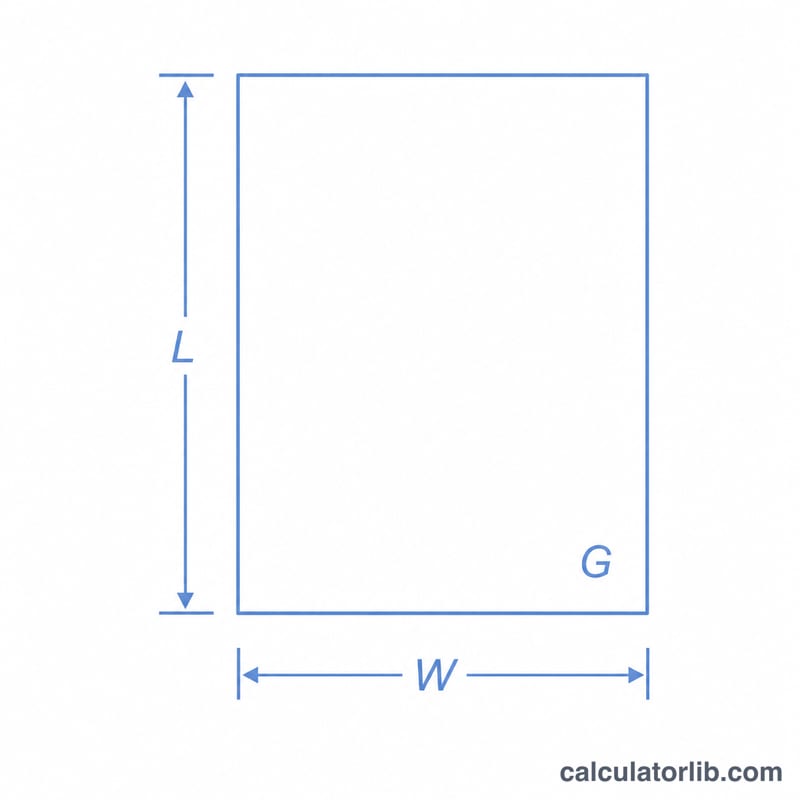
Grammage (gsm) is defined as the mass of one square metre of the paper. So the area of a sheet in square metres multiplied by the grammage gives the weight of that sheet in grams. Multiply by the number of sheets to get the total:
$$\text{Weight (g)} = \text{Length (m)} \times \text{Width (m)} \times \text{Grammage (gsm)} \times \text{Sheets}$$
Worked example
A standard ream of 500 A4 sheets at 80 gsm: $$0.297 \times 0.210 \times 80 \times 500 = 2494.8 \text{ g}$$ or about 2.49 kg. Each sheet weighs roughly 4.99 g.
Standard Paper Sizes (ISO A and B Series) in Metres
The calculator needs length and width in metres. The table converts the ISO 216 sizes (used in most of the world) and common North American sizes (US Letter, Legal, Tabloid) from millimetres. Area is length × width in m². One sheet weighs its area × grammage, so the area column is the number to multiply by gsm.
| Size | Dimensions (mm) | Length × Width (m) | Area (m²) |
|---|---|---|---|
| A0 | 1189 × 841 | 1.189 × 0.841 | 0.99995 (≈1) |
| A1 | 841 × 594 | 0.841 × 0.594 | 0.49955 |
| A2 | 594 × 420 | 0.594 × 0.420 | 0.24948 |
| A3 | 420 × 297 | 0.420 × 0.297 | 0.12474 |
| A4 | 297 × 210 | 0.297 × 0.210 | 0.06237 |
| A5 | 210 × 148 | 0.210 × 0.148 | 0.03108 |
| A6 | 148 × 105 | 0.148 × 0.105 | 0.01554 |
| A7 | 105 × 74 | 0.105 × 0.074 | 0.00777 |
| B4 (ISO) | 353 × 250 | 0.353 × 0.250 | 0.08825 |
| B5 (ISO) | 250 × 176 | 0.250 × 0.176 | 0.04400 |
| US Letter | 279.4 × 215.9 | 0.2794 × 0.2159 | 0.06032 |
| US Legal | 355.6 × 215.9 | 0.3556 × 0.2159 | 0.07677 |
| US Tabloid | 431.8 × 279.4 | 0.4318 × 0.2794 | 0.12064 |
Note: A-series and B-series sizes are defined by ISO 216. Letter, Legal and Tabloid are US/Canadian customary sizes (8.5 × 11, 8.5 × 14 and 11 × 17 inches). Areas are rounded to five decimals.
Ream Weight by Paper Size and Grammage
A ream here means 500 sheets. The weight is \(\text{Area (m}^2\text{)} \times \text{gsm} \times 500\). For A4 that is \(0.297 \times 0.210 \times 500 = 31.185\ \text{m}^2\) of paper per ream, so 80 gsm gives \(31.185 \times 80 = 2494.8\) g. For example, A4 at 80 gsm, 500 sheets: 2494.8 g (2.4948 kg). A3 is twice the area of A4, so its ream is twice as heavy: 62.37 m² × 80 = 4989.6 g.
| gsm | A5 (g / kg) | A4 (g / kg) | A3 (g / kg) |
|---|---|---|---|
| 70 | 1087.8 / 1.088 | 2182.95 / 2.183 | 4365.9 / 4.366 |
| 80 | 1243.2 / 1.243 | 2494.8 / 2.495 | 4989.6 / 4.990 |
| 90 | 1398.6 / 1.399 | 2806.65 / 2.807 | 5613.3 / 5.613 |
| 100 | 1554 / 1.554 | 3118.5 / 3.119 | 6237 / 6.237 |
| 120 | 1864.8 / 1.865 | 3742.2 / 3.742 | 7484.4 / 7.484 |
| 160 | 2486.4 / 2.486 | 4989.6 / 4.990 | 9979.2 / 9.979 |
| 250 | 3885 / 3.885 | 7796.25 / 7.796 | 15592.5 / 15.593 |
These figures cover the paper only. Packaging (wrapper, carton, pallet) adds extra weight, and real paper may differ slightly because gsm tolerances and moisture content vary.
FAQ
What units should I use? Use metres for length and width and gsm (g/m²) for grammage. If your sheet is in millimetres, divide by 1000 first.
What is gsm? Grams per square metre — the standard measure of paper density. Higher gsm means thicker, heavier paper.
Does this work for any paper size? Yes, as long as you enter the correct length and width in metres, the formula works for any rectangular sheet.