What Is the Hammock Hang Calculator?
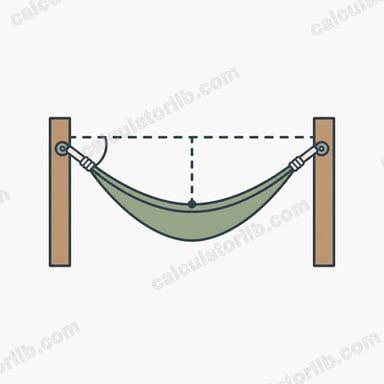
Getting a comfortable, safe hammock hang is all about geometry. This calculator turns three things you can measure — the distance between your two anchors, the hang angle of the straps, and your body weight — into the numbers you actually need: how high to attach the straps, how much the hammock will sag in the middle, and how much force pulls on each anchor.
How to Use It
Measure the distance between your two trees or posts and enter it in feet. Pick a hang angle — most hammock campers aim for the widely recommended 30° strap angle, which balances comfort and tension. Enter your body weight and the height off the ground you want to sit at (around 1.5 ft is typical for easy entry). The calculator returns the anchor height to attach your straps, the resulting center sag, and the tension per anchor.

The Formula Explained
The hammock forms a shallow V. With a strap angle \(\theta\) measured from horizontal, the center drops by $$\text{Sag} = \frac{\text{Distance (ft)}}{2}\tan\theta$$ below the anchor points. To keep your seat at the desired height, the anchors must sit at $$H = \text{Sag} + \text{Sit Height (ft)}$$ above the ground. The suspension tension follows from statics: each line supports half your weight vertically, so $$T = \frac{\text{Weight (lb)}}{2\,\sin\theta}$$ Shallower angles (smaller \(\theta\)) feel flatter but multiply tension dramatically.
Worked Example
Anchors 12 ft apart, 30° hang angle, 180 lb body, 1.5 ft sit height. $$\text{Sag} = \frac{12}{2}\times \tan 30° = 6 \times 0.5774 = 3.46\ \text{ft}$$ $$H = 3.46 + 1.5 = 4.96\ \text{ft}$$ $$T = \frac{180}{2} \div \sin 30° = \frac{90}{0.5} = 180\ \text{lb per anchor}$$

Hang Angle Comparison: Sag, Anchor Height and Tension
This table uses one fixed setup: anchors 12 ft apart, a 180 lb load and a 1.5 ft sit height. The hang angle θ is measured from horizontal at the suspension line. Sag is \(\frac{d}{2}\tan\theta\), anchor height is sag + 1.5 ft, and tension per anchor is \(\frac{W}{2\sin\theta}\).
| Angle | Center sag (ft) | Anchor height (ft) | Tension per anchor (lb) |
|---|---|---|---|
| 10° | 1.06 | 2.56 | 518 |
| 15° | 1.61 | 3.11 | 348 |
| 20° | 2.18 | 3.68 | 263 |
| 25° | 2.80 | 4.30 | 213 |
| 30° | 3.46 | 4.96 | 180 |
| 35° | 4.20 | 5.70 | 157 |
| 40° | 5.03 | 6.53 | 140 |
Worked check at 30°: sag = \(6 \times \tan 30° = 6 \times 0.5774 = 3.46\) ft; anchor height = \(3.46 + 1.5 = 4.96\) ft; tension = \(\frac{180}{2 \times 0.5} = 180\) lb.
A flatter hang (smaller angle) needs lower anchors but sharply raises tension. At 10° the load on each anchor is nearly three times the body weight. These numbers assume a static load and ignore dynamic loading, such as sitting down hard, bouncing or a second person.
Practical Hanging Tips
- Aim for about 30°. It gives a comfortable lay and keeps tension per anchor roughly equal to your body weight, as the table shows.
- Attach straps at the calculated height. Measure up from the ground to the anchor height the calculator gives, and mark it before you hang.
- Use tree-friendly straps. Choose straps at least 3/4 in wide, ideally 1 in or wider, to spread pressure and protect the bark. Avoid rope or thin cord wrapped directly around a trunk.
- Check the ratings. The strap, carabiner and suspension should each be rated above the calculated tension, with a generous safety margin. Dynamic loads can be well above static weight.
- Allow for stretch and dynamic loads. Straps, ropes and hammock fabric stretch and the hang will drop a little. Sitting or flopping in applies more force than lying still, so ease in gently.
- Pick healthy, living trees. Choose trunks that are sturdy and free of dead limbs, rot or loose bark. Avoid dead or leaning trees.
- Re-measure after settling. Once you have loaded the hammock, check the sag and angle again and adjust if the hang has changed.
This is general information, not professional safety advice. Always follow your equipment manufacturer's rated limits.
FAQ
Why is 30° recommended? It gives a comfortable lie-flat sag without producing excessive tension on your gear and trees.
What happens at small angles? A tight, near-horizontal hang (e.g. \(10°\)) can multiply tension to several times body weight, stressing straps and anchors.
Is the height exact? It's a close geometric estimate; fabric stretch and ridgeline setup may require small adjustments in the field.