
What is the Clay Shrinkage Calculator?
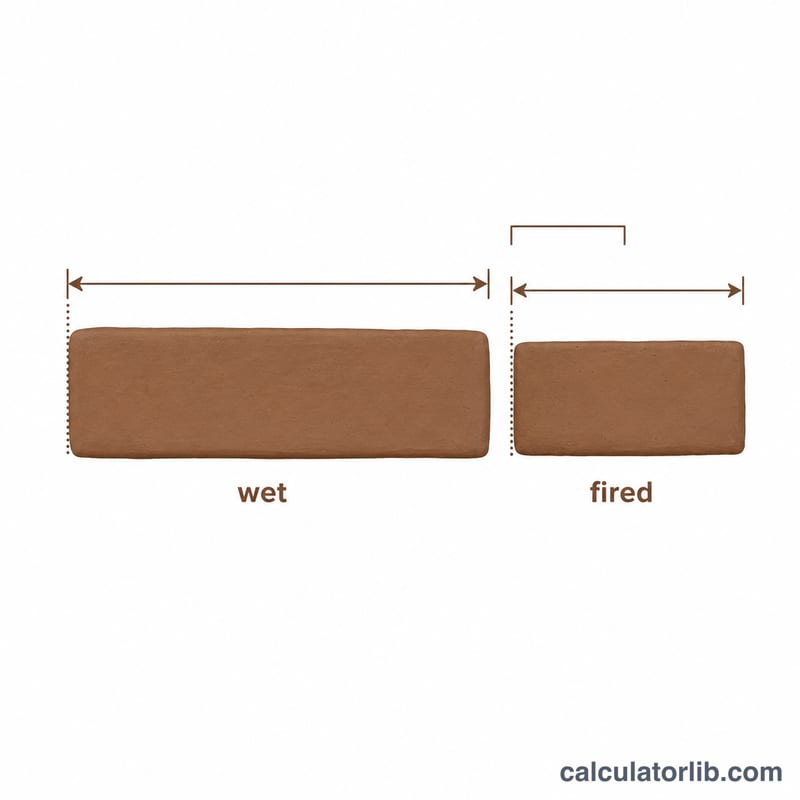
Clay shrinks as it dries and again when fired in the kiln. The total linear shrinkage compares the size of a freshly thrown or formed piece (wet/plastic state) to its size after firing. Knowing this percentage lets potters and ceramicists make pieces the right finished size — essential for lids, tiles, dinnerware that must stack, and joints that must fit. This tool works two ways: measure shrinkage of a test bar, or predict the fired size of a new piece from a known clay body shrinkage rate.
How to use it
To find the shrinkage rate, choose "Find shrinkage rate", enter the wet size you measured before drying and the size after firing. To predict a fired size, choose "Find fired size", enter the wet size and your clay body's known shrinkage percentage. Use a consistent measurement (a 100 mm test bar marked before drying is the pottery standard).
The formula explained
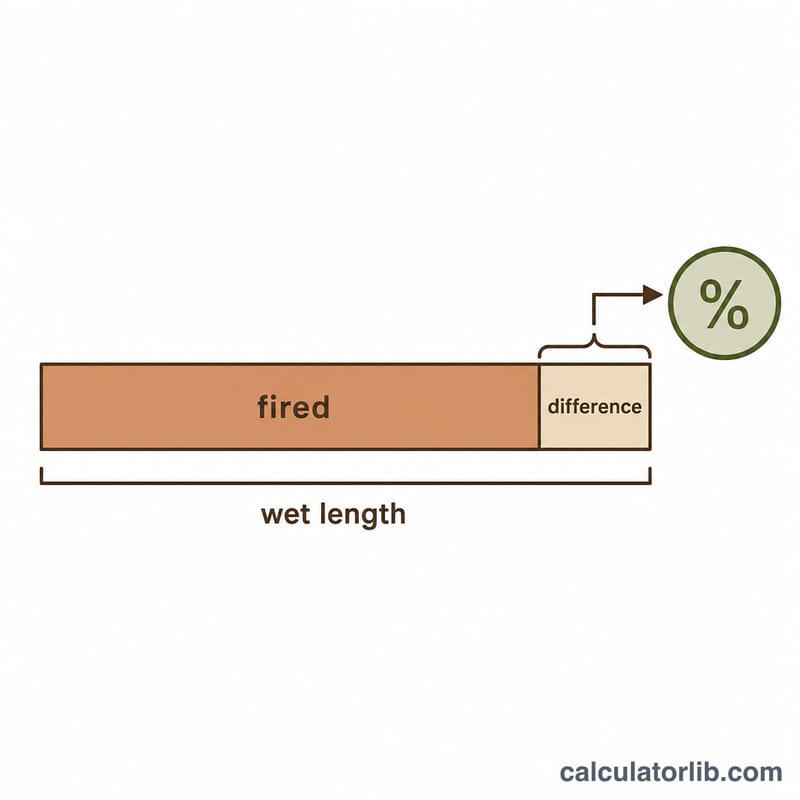
Shrinkage percentage is the change in length divided by the original wet length, expressed as a percent:
$$\text{Shrinkage} = \frac{\text{Wet} - \text{Fired}}{\text{Wet}} \times 100\%$$
Rearranged, the fired size equals \(\text{Fired} = \text{Wet} \times \left(1 - \frac{\text{Shrinkage \%}}{100}\right)\). Most stoneware and porcelain bodies shrink between 10% and 15% total.
Worked example
You scribe a 100 mm line on a wet slab. After firing it measures 88 mm. Shrinkage $$= \frac{100 - 88}{100} \times 100 = \textbf{12\%}$$ If you later want a fired plate exactly 250 mm wide with this clay, make it \(250 \div (1 - 0.12) \approx 284\) mm wet.
FAQ
Is this drying or firing shrinkage? Measured wet-to-fired, it captures total shrinkage (drying plus firing) combined.
Does higher firing temperature increase shrinkage? Yes — firing the same clay hotter (higher cone) generally increases shrinkage as the body vitrifies.
What units should I use? Any consistent unit works; the percentage is the same whether you measure in mm, cm, or inches.