
What this calculator does
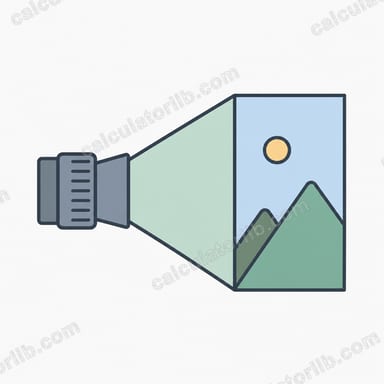
This tool computes a camera's angle of view (field of view) and the physical "shooting range" it captures at a given subject distance. From the lens focal length, the sensor (film) dimensions and the distance to your subject, it returns the horizontal, vertical and diagonal angles of view plus the captured width, height, diagonal and area. The geometry is pure optics and applies anywhere in the world — there is no country-specific scope.
How to use it
Enter the lens focal length in millimetres, pick a sensor format preset (or type custom sensor width and height in mm), then enter the subject distance and choose its unit (m, cm, mm or km). The presets are 35mm full frame (36 × 24), APS-C (23.6 × 15.6), Micro 4/3 (17.3 × 13) and 1 inch (13.2 × 8.8). The result shows the angular coverage and the real-world rectangle the frame covers at that distance.
The formula explained
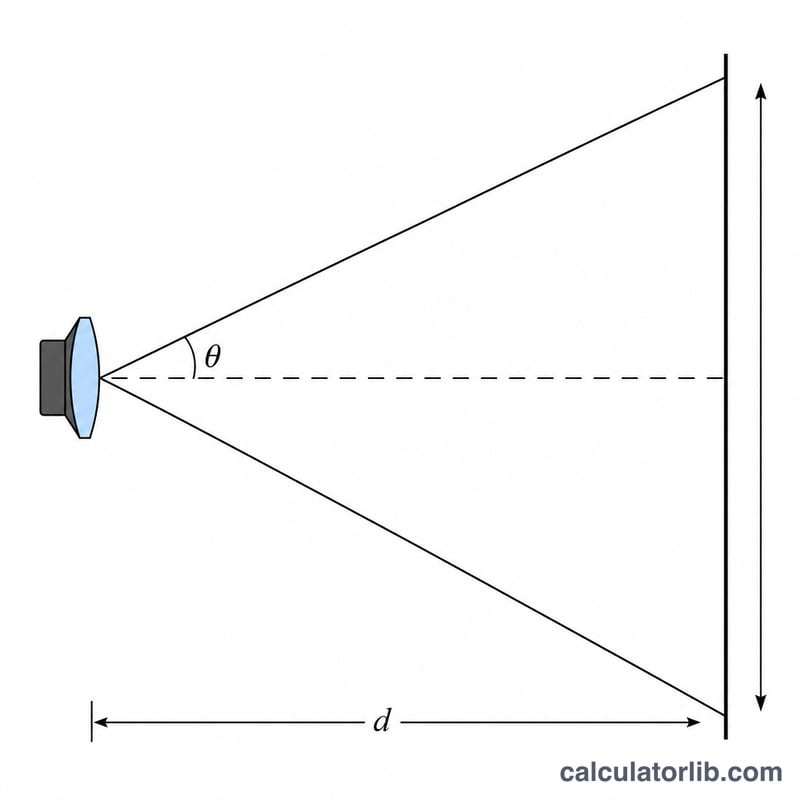
For a thin-lens / pinhole model, the angle of view along an edge of physical length d for focal length f is \(\theta = 2\cdot\arctan(d / 2f)\). At subject distance L, similar triangles give the captured size \(= L \cdot d / f\). The diagonal sensor length is \(\text{diag} = \sqrt{\text{width}^2 + \text{height}^2}\). All lengths are reduced to consistent units (the calculator works in metres). This standard photographic approximation ignores lens distortion, pupil magnification and focus breathing.
$$\theta_H = 2\arctan\!\left(\frac{\text{Sensor W (mm)}}{2\,\text{Focal (mm)}}\right), \qquad W = \frac{\text{Distance}\cdot\text{Sensor W}}{\text{Focal}}$$ $$\text{where}\quad \left\{ \begin{aligned} \theta_V &= 2\arctan\!\left(\frac{\text{Sensor H (mm)}}{2\,\text{Focal (mm)}}\right) \\ H &= \frac{\text{Distance}\cdot\text{Sensor H}}{\text{Focal}} \\ \text{Area} &= W \times H \end{aligned} \right.$$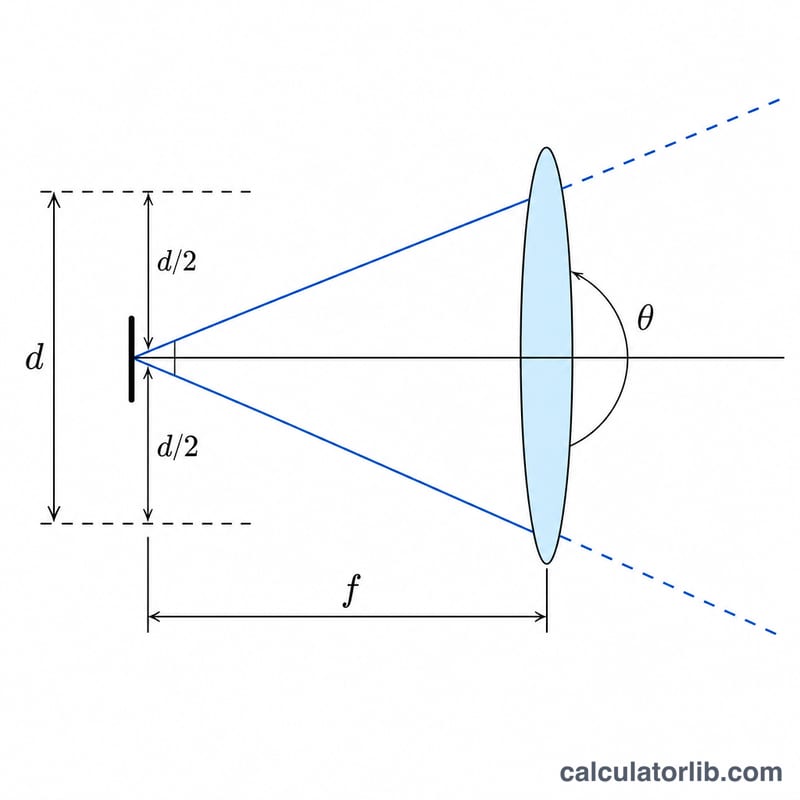
Worked example
A 50 mm lens on a full-frame sensor (36 × 24 mm) at 3 m: the horizontal angle \(= 2\cdot\arctan(36 / 100) = 39.6\degree\), vertical \(= 27.0\degree\), diagonal \(= 46.8\degree\). The captured area is \(3 \times 0.036 / 0.050 = 2.16\) m wide by \(3 \times 0.024 / 0.050 = 1.44\) m tall — about 3.11 m².
FAQ
Does a longer focal length give a wider or narrower view? Narrower. Angle of view shrinks as focal length grows, so a telephoto lens captures a smaller area at the same distance.
Why are there three angles? A rectangular sensor has a horizontal edge, a vertical edge and a diagonal, each with its own angle of view. The diagonal angle is the largest and is often quoted as "the" angle of view.
Is the captured size exact? It is the standard thin-lens estimate. Real lenses introduce distortion and focus breathing, so treat the numbers as a close practical approximation.