
What is the Beer Goggles Effect Calculator?
This is a light-hearted, novelty calculator based on a tongue-in-cheek formula publicized in 2005 by a research group associated with the University of Manchester, commissioned for an eyewear and optometry public-relations study. The idea — the so-called "beer goggles effect" — describes the everyday observation that other people can appear more attractive as alcohol consumption rises and viewing conditions deteriorate. It is pseudo-scientific fun, not real science.
How to use it
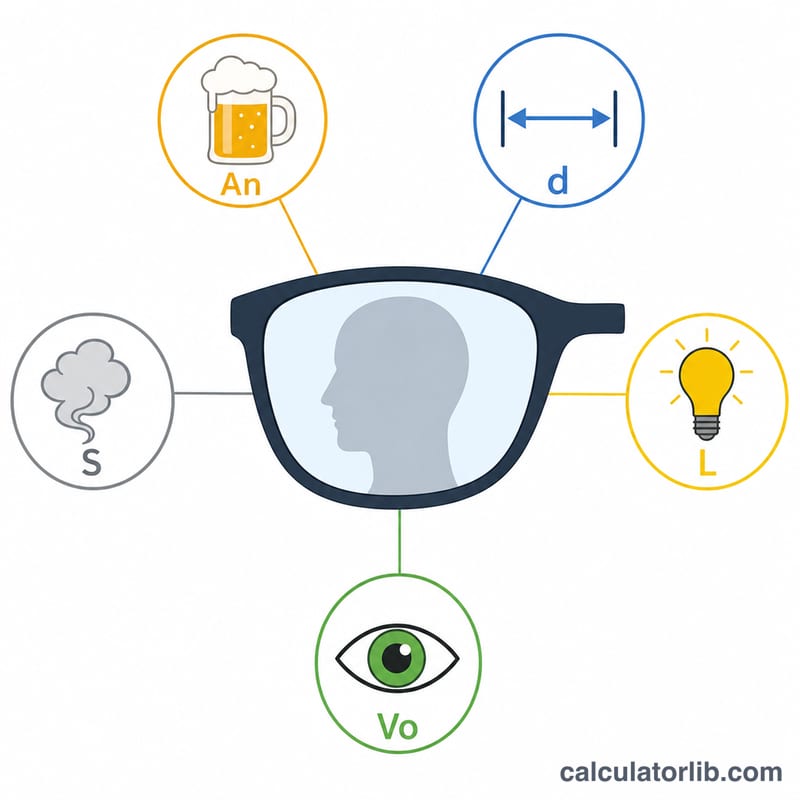
Enter five values: the volume of beer consumed in millilitres (about 568 mL per UK pint), the distance to the person in metres, a smokiness/haze score from 0 (clear air) to 10 (very smoky), the light shining on the person in candela (darkness around 1, normal indoor light around 150), and your eyesight as a decimal visual-acuity value where 1.0 is normal 20/20 vision. The calculator returns a single score on a 1-100 scale plus a plain-English interpretation.
The formula explained
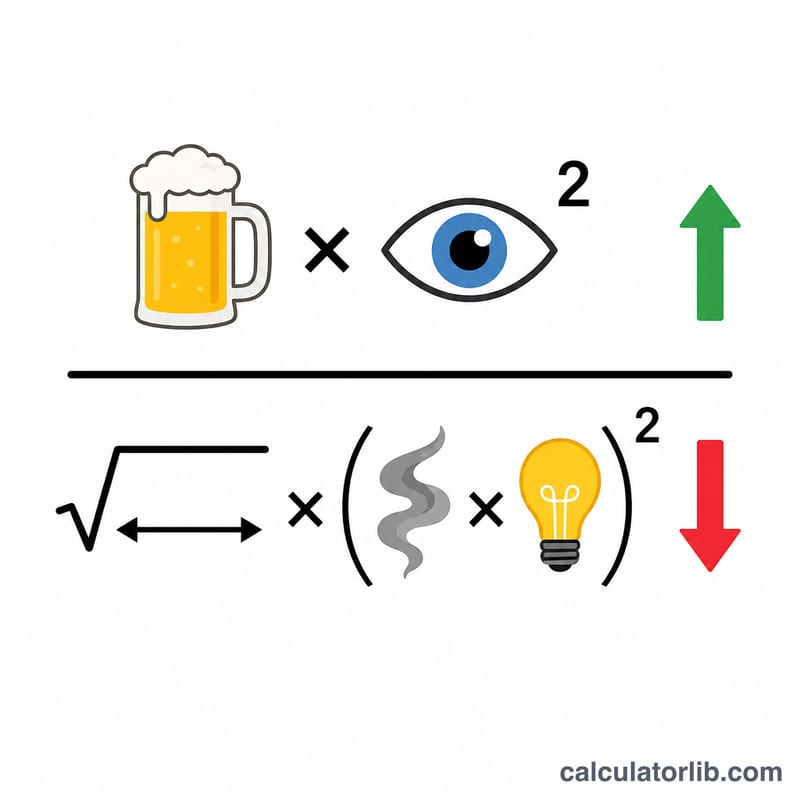
The score is computed as $$\beta = \frac{\text{An} \cdot \text{Vo}^{2}}{\sqrt{\text{d}} \cdot \left(\text{S} \cdot \text{L}\right)^{2}}$$ The numerator grows with more alcohol and (counter-intuitively) sharper eyesight; the denominator grows with greater distance, a smokier room, and brighter light. To avoid dividing by zero, smokiness and lighting are clamped to a minimum of 1 and distance to a small positive value. The raw result is then clamped to the published 1-100 range: anything below 1 shows as 1 (no effect) and anything above 100 shows as 100 (maximum effect).
Worked example
Using \(\text{An} = 3000\) mL, \(\text{d} = 2\) m, \(\text{S} = 7\), \(\text{L} = 100\), \(\text{Vo} = 1.0\): numerator \(= 3000 \times 1 = 3000\); \(\text{S} \times \text{L} = 700\), squared \(= 490000\); \(\sqrt{2} \approx 1.41421\); denominator \(\approx 692{,}965\); \(\beta \approx 0.0043\). Because that is below 1, the displayed score is 1 — no beer-goggle effect.
FAQ
Is this scientifically real? No. It is a novelty PR formula for entertainment, with no medical, diagnostic, or safety meaning.
Why does better eyesight increase the score? That is a quirk of the published equation, which we keep faithfully rather than "fix".
Can it tell me if I'm safe to drive? Absolutely not. It says nothing about intoxication or fitness to drive. Never drink and drive.