
What is the Beer Pong Calculator?
Planning a beer pong tournament and not sure how much beer to buy? This calculator estimates the total amount of beer required based on how many cups sit on each table, how much beer goes in each cup, how many tables are running, and how many games will be played. It returns the total in fluid ounces, plus handy equivalents in 12 oz cans and gallons so you can shop with confidence.
How to use it
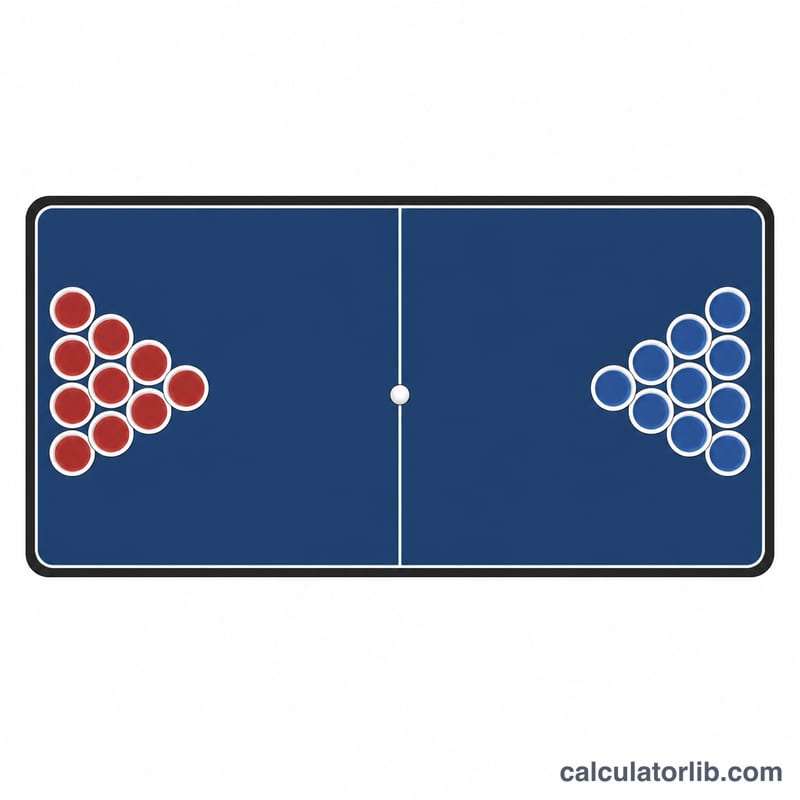
Enter the four values: Cups per table (a classic setup uses 10 cups per side, so 10–20 total), Beer per cup in ounces (most players pour about 2 oz per cup), the Number of tables at your party, and the total Games played you expect across the night. Hit calculate and you'll see the total beer needed.
The formula explained
The math is a straightforward multiplication:
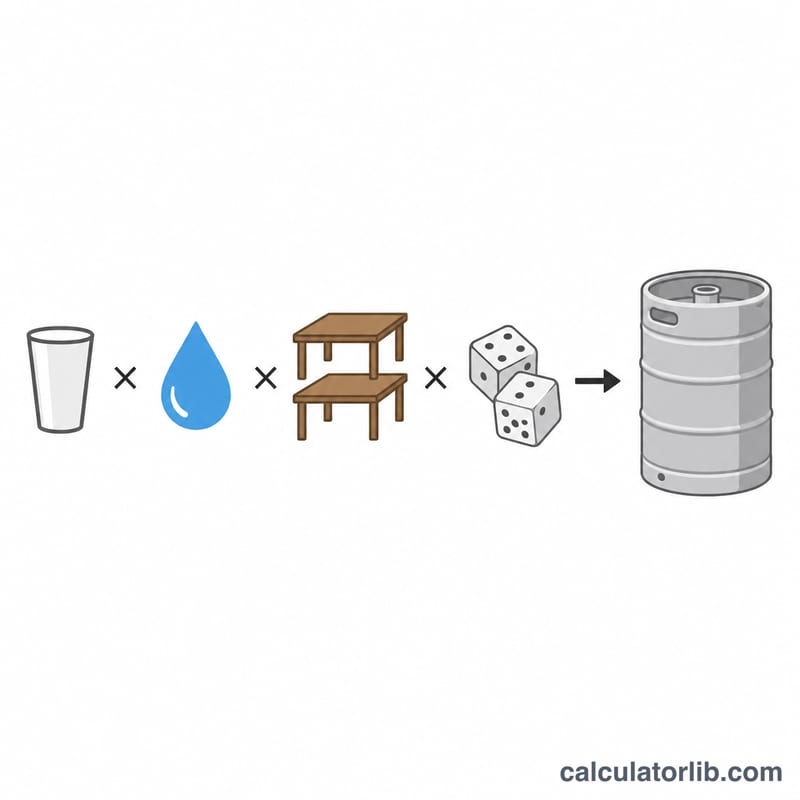
$$\text{Total Beer} = \text{Cups} \times \text{Beer per Cup} \times \text{Tables} \times \text{Games}$$
Each game refills every cup once, so multiplying cups by beer-per-cup gives the beer per game per table. Scaling by tables and games gives the grand total. We then divide by 12 to estimate standard cans and by 128 to estimate gallons.
Worked example
Suppose you run 10 cups per table at 2 oz each, on 2 tables, for 5 games: $$10 \times 2 \times 2 \times 5 = 200 \text{ oz}.$$ That's about 16.7 twelve-ounce cans, or roughly 1.56 gallons of beer.
How Much Beer to Buy
The calculator estimates the beer that actually goes into the cups. Real parties always use more, so shop with a buffer:
- Add a 10–20% buffer for spills, re-racks, foam, and people sipping between games. Multiply your total by 1.1–1.2. For example, a 12.5-gallon estimate becomes roughly 13.8–15 gallons of beer to purchase.
- Round up to whole cases. Beer is sold in cases of 24 cans (288 oz ≈ 2.25 gallons). Buy whole cases so you are not short mid-tournament.
- Compare to keg sizes when buying in volume:
- Cornelius ("Corny") keg — about 5.0 gallons
- Quarter barrel ("pony keg") — about 7.75 gallons (≈ 82 twelve-oz servings)
- Half barrel (full keg) — about 15.5 gallons (≈ 165 twelve-oz servings)
- Plan for non-drinkers and hydration. Many guests will not drink full game volumes, and you should always provide water, soda, or a non-alcoholic option. It is common (and safer) to dedicate one set of cups to water for rinsing the ball or for designated non-drinkers.
This is general party-planning information, not professional or medical advice. Drink responsibly, never serve minors, and arrange safe rides home.
Beer Volume Conversions
Use these conversions to translate the calculator's total ounces into packaging and keg sizes. All values are based on US fluid ounces (1 US gallon = 128 fl oz).
| Unit | Fluid Ounces | Gallons | 12 oz Servings |
|---|---|---|---|
| 12 oz can | 12 | 0.094 | 1 |
| 16 oz pint | 16 | 0.125 | 1.33 |
| 1 gallon | 128 | 1.0 | 10.7 |
| 24-can case | 288 | 2.25 | 24 |
| Cornelius (Corny) keg | 640 | 5.0 | 53 |
| Quarter barrel (pony keg) | 992 | 7.75 | 82 |
| Half barrel (full keg) | 1,984 | 15.5 | 165 |
To convert any total: divide ounces by 12 for cans, by 128 for gallons, by 288 for cases, or by 1,984 for half kegs. For example, 6,400 oz ÷ 128 = 50 gallons, which is just over three half barrels.
FAQ
How much beer per cup is normal? Casual games use 1–2 oz per cup; competitive setups may use more. Adjust the field to taste.
Does this account for spillage or drinking between games? No — it estimates the beer poured into cups only. Add a buffer of 10–20% for spills and side drinking.
How many cups in a standard rack? Ten cups per side in a triangle, so a full table holds 20 cups if you count both ends.