
What Is the Binoculars Range Calculator?
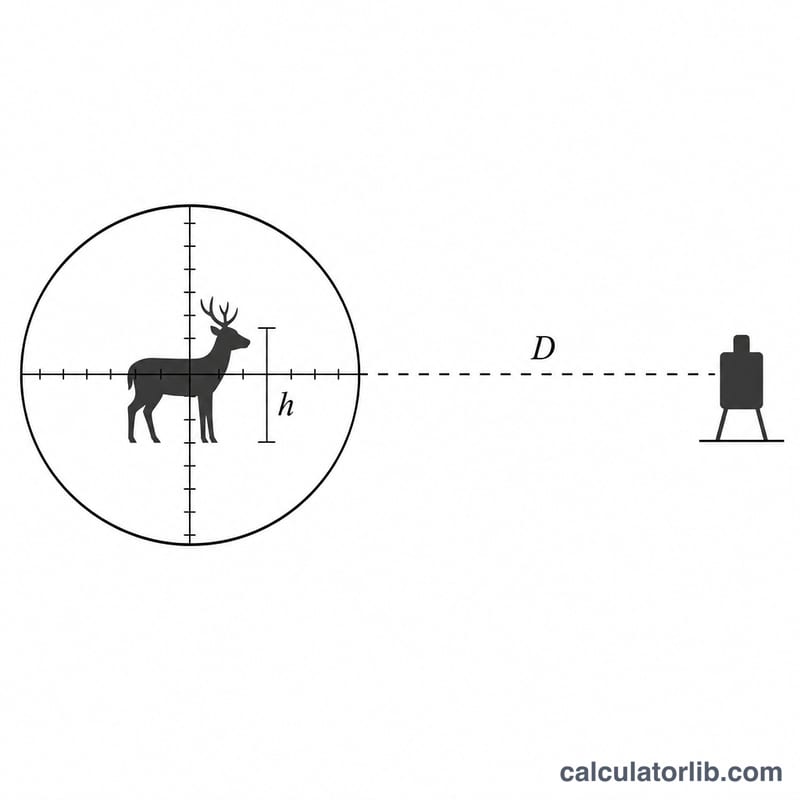
The Binoculars Range Calculator estimates how far away a target is using the mil reticle found in many tactical or marine binoculars. By comparing an object of known physical size against the angular size it occupies on the reticle (measured in milliradians, or "mils"), you can quickly work out the distance — no laser rangefinder required. This technique, called mil ranging, is widely used by hunters, sport shooters, mariners, and military observers.
How to Use It
Enter the real-world size of the target in meters (its height or width, whichever you are measuring). Then enter the angular size you read off the reticle in mils. The calculator returns the estimated distance in both meters and yards. For accuracy, measure the object dimension that aligns with your reticle scale, and read the mil value as precisely as the reticle allows.
The Formula Explained
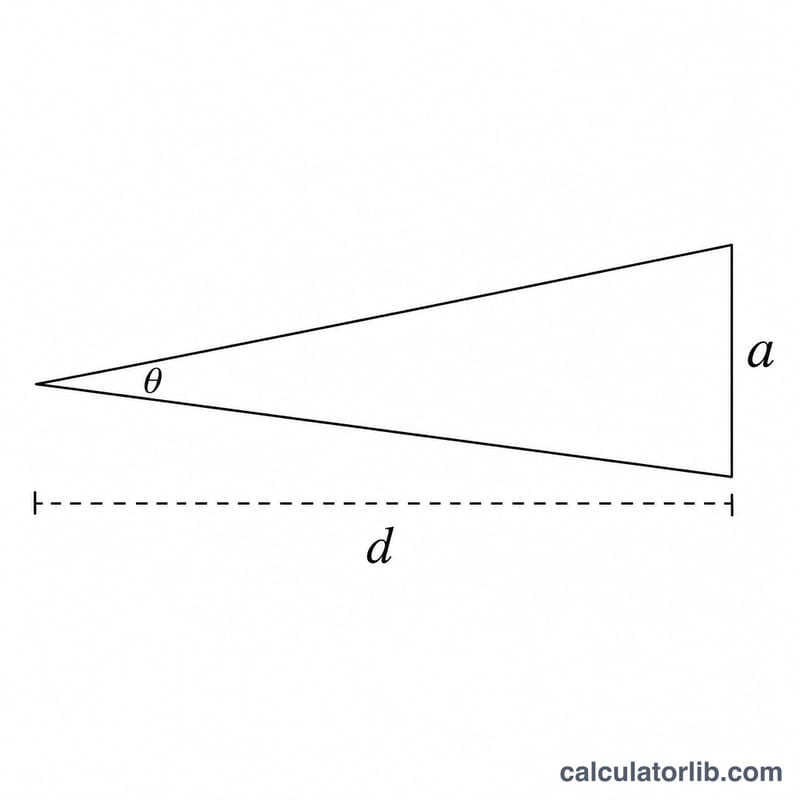
One milliradian subtends 1 meter at a distance of 1000 meters. So the distance equals the object size divided by the mils it covers, multiplied by 1000:
$$\text{Distance (m)} = \frac{\text{Object Size (m)}}{\text{Angular Size (mils)}} \times 1000$$
This works because the mil is an angular unit and the relationship between size, angle, and distance is linear for the small angles involved.
Worked Example
Suppose you are observing a person who is 1.8 m tall, and they span 5 mils on your reticle. $$\text{Distance} = \frac{1.8}{5} \times 1000 = 0.36 \times 1000 = \textbf{360 meters}$$ or about 393.7 yards. If the same person measured 3 mils, the distance would be \(\frac{1.8}{3} \times 1000 = 600\) meters.
Typical Target Sizes for Mil Ranging
Accurate mil ranging depends on knowing the true physical size of your target. Measure the dimension (height or width) that you intend to bracket with the reticle, then divide by the observed angular size in mils and multiply by 1000 to get the range in meters:
$$\text{Distance (m)} = \frac{\text{Object Size (m)}}{\text{Angular Size (mils)}} \times 1000$$
The table below lists commonly used reference targets and representative sizes. Real objects vary, so treat these as starting estimates and refine with local knowledge where possible.
| Reference Target | Dimension | Typical Size (m) |
|---|---|---|
| Average adult person | Standing height | 1.8 |
| Average adult person | Head to waist | 1.0 |
| Standard doorway | Height | 2.0 |
| Interior ceiling (residential) | Floor to ceiling | 2.4 |
| Passenger car | Length | 4.5 |
| Passenger car | Height | 1.5 |
| Light truck / SUV | Height | 1.8 |
| Telephone / utility pole | Exposed height | 11.0 |
| Highway lane | Width | 3.7 |
| Single-story building wall | Eave height | 3.0 |
| Soccer goal | Width | 7.32 |
For example, a person 1.8 m tall subtending 4 mils gives a distance of \(\frac{1.8}{4}\times1000=\) 450 meters.
Key Terms
- Milliradian (mil)
- An angular unit equal to one-thousandth of a radian. At a distance of 1000 units, an object spanning 1 true milliradian subtends exactly 1 unit (e.g. 1 meter at 1000 meters). This direct relationship is what makes mils ideal for range estimation.
- Reticle
- The aiming pattern etched or projected inside the optic. A mil reticle includes calibrated dots or hash marks spaced at known angular intervals (typically whole and half mils) so the observer can measure how many mils a target subtends.
- Angular size
- The apparent size of an object as seen from the observer, expressed as an angle rather than a linear distance. The farther away an object is, the smaller its angular size for a fixed physical size.
- Subtend
- To span or cover a given angle. Saying a target "subtends 4 mils" means the target's measured dimension fills 4 mil marks in the reticle.
- Mil ranging
- The technique of estimating distance by dividing an object's known physical size by its angular size in mils and multiplying by 1000, giving range in the same length units as the object size.
- NATO mil vs true milliradian
- The mathematical (true) milliradian divides a full circle into \(2\pi \times 1000 \approx 6283\) mils. The NATO/military mil divides the circle into exactly 6400 mils for convenient gunnery math. The two differ by less than 2%, so most reticles are built around the true milliradian, but the distinction matters for precise artillery and azimuth work.
FAQ
What is a mil? A milliradian is an angular unit; 1 mil subtends 1 meter at 1000 meters. Note that some reticles use a slightly different "mil" definition, so check your optics.
Do I have to use meters? The formula assumes object size in meters to return meters. The calculator also converts the result to yards for convenience.
Why is my estimate off? Small errors in reading the mil value cause large distance errors at long range. Use a stable rest and the finest reticle gradation available, and double-check the object's true size.