
What Is the EV Range Calculator?
This tool estimates how far an electric vehicle can travel on a single charge using two core numbers: the battery's energy capacity in kilowatt-hours (kWh) and the car's energy consumption in watt-hours per mile (Wh/mi). It also lets you set a usable-battery percentage so the estimate reflects real-world driving rather than a perfect 0–100% drain.
How to Use It
Enter your battery capacity (found on the spec sheet, e.g. 75 kWh), your efficiency in Wh per mile (typical EVs range from 220 to 350 Wh/mi), and the usable percentage of the pack. Many drivers keep usage between 10% and 90% to protect battery longevity, which is roughly 80% usable. Press calculate to see the estimated range, usable energy, and your miles-per-kWh efficiency.
The Formula Explained
Range is simply usable energy divided by the energy needed per mile. First, usable energy = battery × (usable% ÷ 100). Then convert efficiency from Wh/mi to kWh/mi by dividing by 1000. Finally, Range = usable kWh ÷ kWh per mile. A lower Wh/mi figure means a more efficient car and a longer range.
$$\text{Range (mi)} = \frac{\text{Battery (kWh)} \times \dfrac{\text{Usable (\%)}}{100}}{\dfrac{\text{Efficiency (Wh/mi)}}{1000}}$$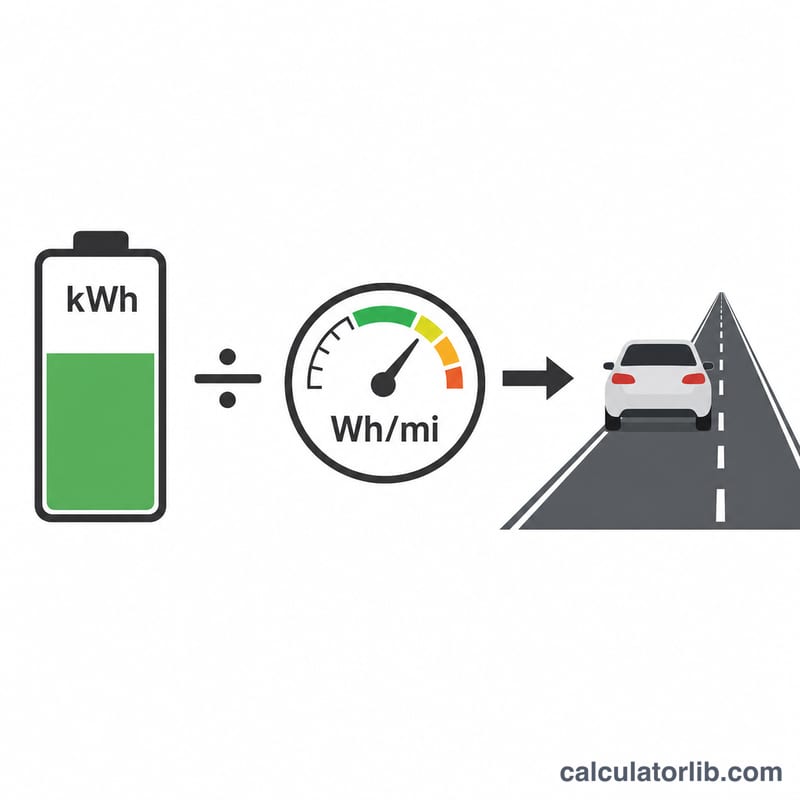
Worked Example
Suppose a car has a 75 kWh battery, consumes 280 Wh/mi, and you use 100% of the pack. Consumption = \(280 \div 1000 = 0.28\) kWh/mi. Range = \(75 \div 0.28 \approx 267.9\) miles. That matches typical EPA-style estimates for a mid-size electric sedan.
$$\text{Range} = \frac{75 \times \dfrac{100}{100}}{\dfrac{280}{1000}} = \frac{75}{0.28} \approx 267.9 \text{ mi}$$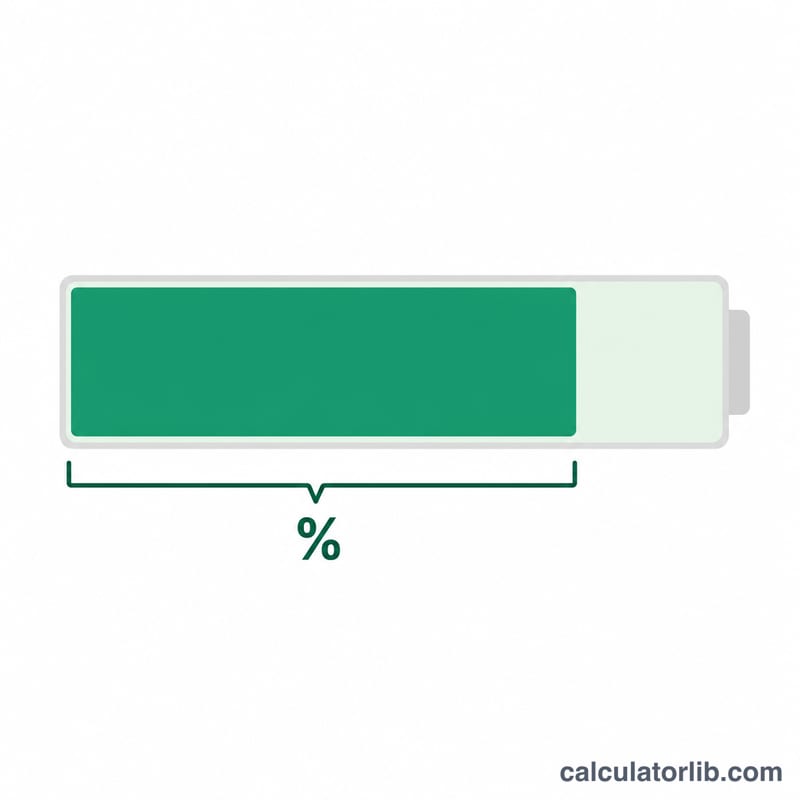
FAQ
Why use Wh per mile? It is the standard EV efficiency unit in the US (the EV equivalent of MPG). Lower is better.
Does weather affect range? Yes — cold temperatures, highway speeds, and climate control can raise consumption by 15–40%. Increase your Wh/mi input to model this.
Should I use 100% usable battery? For maximum theoretical range, yes. For everyday planning and battery health, 80–90% gives a more practical figure.