
What Is the Fuel Needed for Trip Calculator?
This calculator estimates how much fuel a journey will consume based on the distance you plan to travel and your vehicle's fuel economy. It works with any consistent set of units — miles and miles-per-gallon, or kilometres and kilometres-per-litre — as long as your economy figure uses the same distance unit you entered. Optionally, enter the price per unit of fuel and the tool will also give you the estimated cost of the trip.
How to Use It
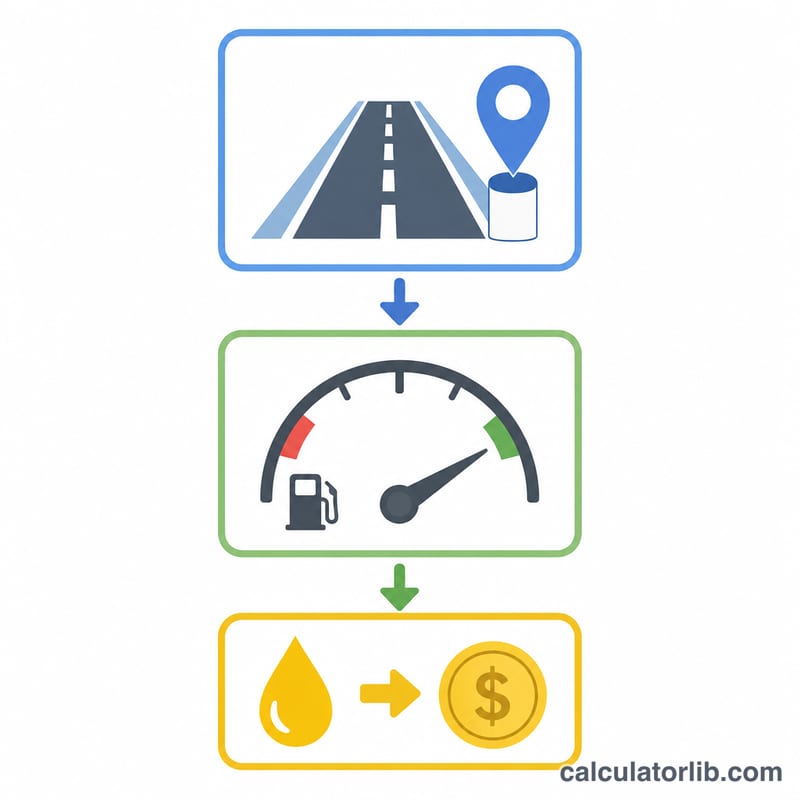
Enter the total trip distance, then your vehicle's fuel economy expressed as distance travelled per unit of fuel (for example, 12 km per litre or 35 miles per gallon). If you want a cost estimate, add the fuel price per unit. The result shows the fuel required and, when a price is provided, the total fuel cost.
The Formula Explained
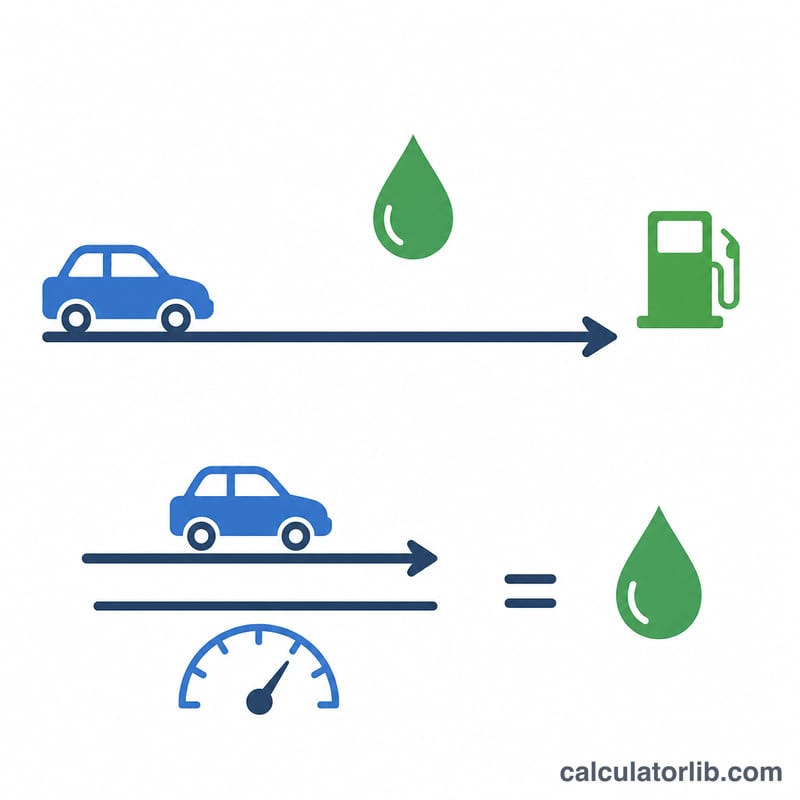
The core relationship is simple: $$\text{Fuel} = \frac{\text{Distance}}{\text{Fuel Economy}}$$. Fuel economy tells you how far you travel on one unit of fuel, so dividing the trip distance by it gives the number of units needed. The cost extension multiplies that fuel by the price per unit.
Worked Example
Suppose you are driving 300 km and your car returns 12 km per litre. Fuel needed = $$300 \div 12 = 25 \text{ litres}$$. If fuel costs $1.80 per litre, the trip costs $$25 \times 1.80 = \$45.00$$.
FAQ
What units should I use? Any consistent pair. If economy is in miles per gallon, enter distance in miles and you'll get gallons.
What if my economy is given as litres per 100 km? Convert it first: economy in km/L = \(100 \div (\text{L per 100 km})\).
Does this account for traffic or terrain? No — it gives an ideal estimate. Add a buffer of 10–15% for hills, heavy loads, or stop-and-go traffic.