
What Is the Fuel Needed for Trip Calculator?
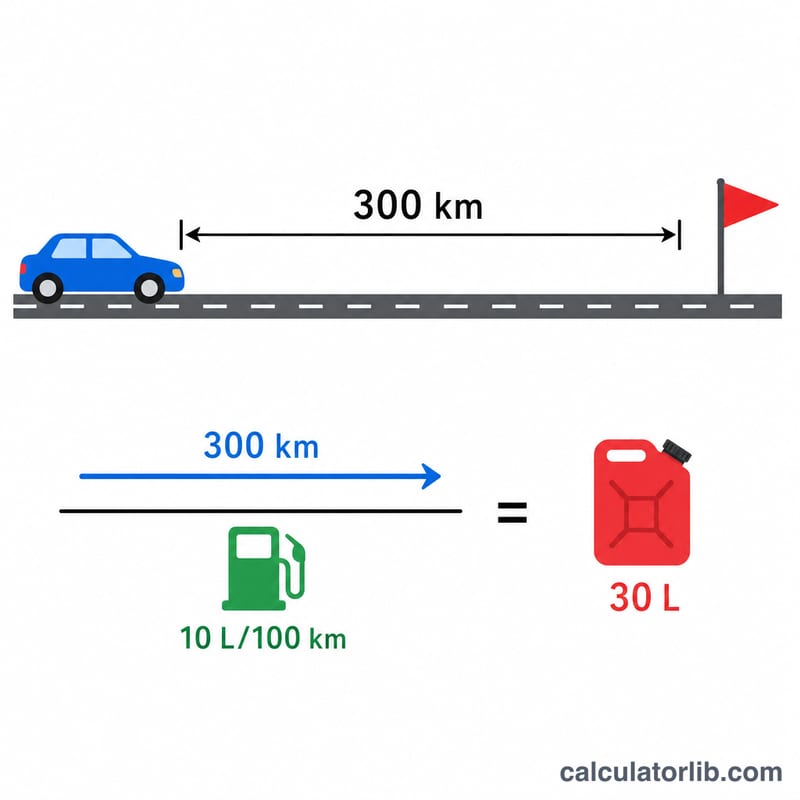
This calculator estimates how much fuel you will burn on a journey and what it will cost. It works for any unit system: enter distance in kilometres or miles and your fuel efficiency in the matching units — kilometres per litre or miles per gallon — and the result comes back in litres or gallons accordingly.
How to Use It
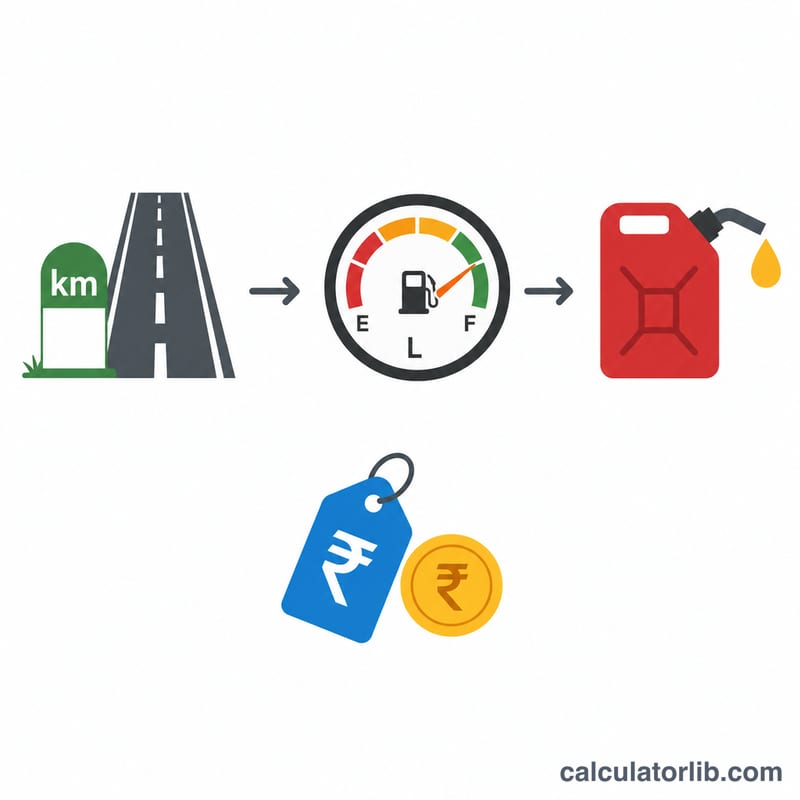
Enter three values: the trip distance, your vehicle's fuel efficiency (how far it travels per unit of fuel), and optionally the fuel price per unit. The tool divides distance by efficiency to find the fuel needed, then multiplies by the price to estimate your trip cost. Keep your units consistent — if distance is in miles, use miles per gallon and you'll get gallons.
The Formula Explained
The core relationship is simple:
$$\text{Fuel Used} = \frac{\text{Distance}}{\text{Fuel Efficiency}}$$
Efficiency expressed as "distance per unit of fuel" (km/L or mpg) sits in the denominator, so higher efficiency means less fuel. The cost is then $$\text{Fuel Used} \times \text{Price}$$
Worked Example
Suppose you are driving 500 km in a car that does 12 km per litre, with fuel costing 1.50 per litre. Fuel needed = $$500 \div 12 = 41.67 \text{ litres}$$ Cost = $$41.67 \times 1.50 = 62.50$$ So you'd budget about 41.67 litres and 62.50 in fuel.
FAQ
Can I use miles and gallons? Yes. Enter distance in miles and efficiency in miles per gallon, and the answer is in gallons.
My car shows L/100km, not km/L — what do I do? Convert first: \(\text{km/L} = 100 \div (\text{L/100km})\). For example \(8 \text{ L/100km} = 12.5 \text{ km/L}\).
Does this account for traffic or terrain? No. It's a baseline estimate using your stated efficiency. Hills, traffic, and air conditioning increase real consumption, so add a margin.