
What Is the g/L to Molarity Calculator?
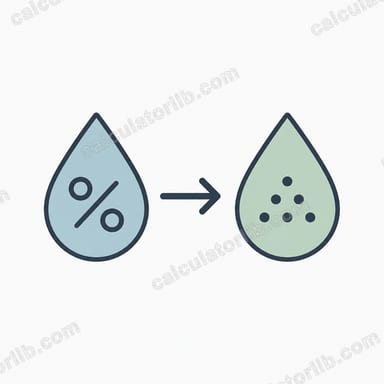
This calculator converts a mass concentration expressed in grams per liter (g/L) into molarity, the standard chemistry unit of concentration measured in moles per liter (mol/L, also written M). Because molarity counts the number of molecules rather than their total mass, you need to know the molar mass (molecular weight) of the substance to make the conversion. This is a universal chemistry tool and applies anywhere.
How to Use It
Enter the concentration of your solution in grams per liter, then enter the molar mass of the dissolved compound in grams per mole. The calculator divides the two and returns the molarity in mol/L, plus a convenient millimolar (mM) value for dilute solutions. Molar masses can be found on a chemical's label or calculated by summing the atomic weights of each element in the formula.
The Formula Explained
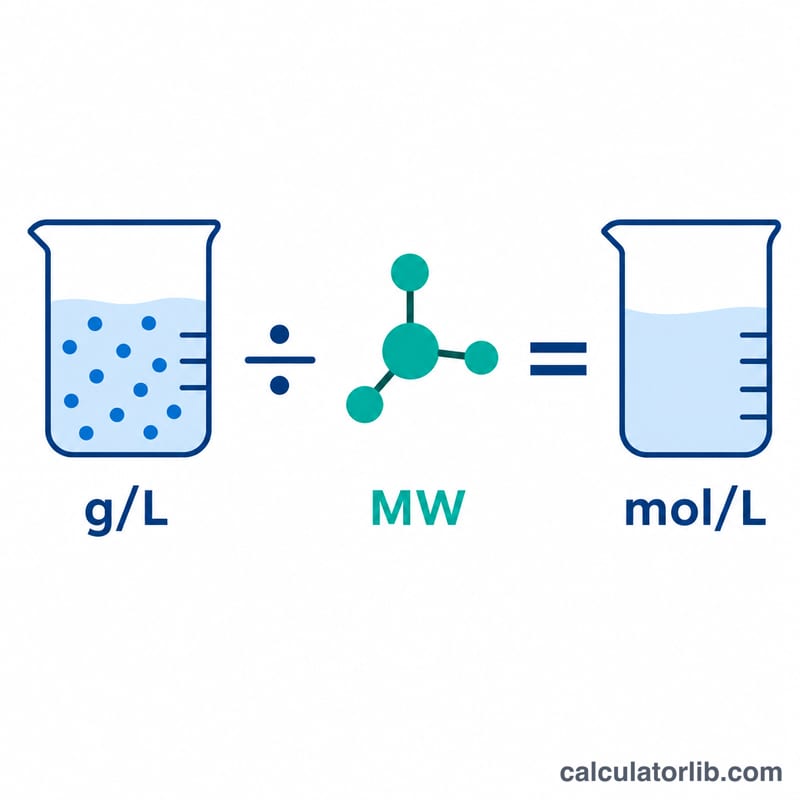
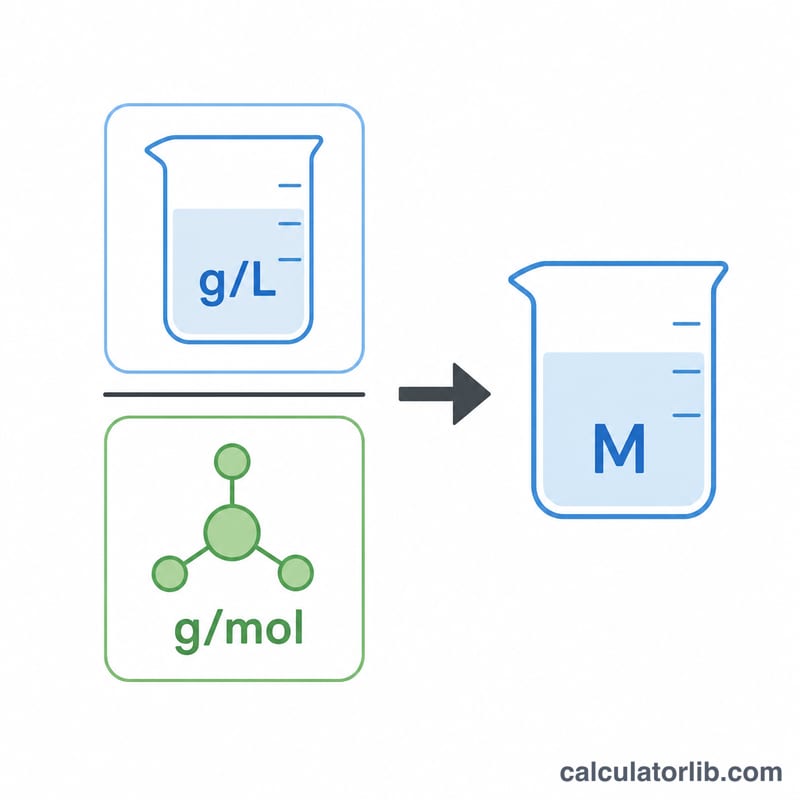
The conversion uses a single relationship: $$\text{M} = \frac{\text{g/L}}{\text{MW}}$$ The numerator is how many grams of solute sit in one liter of solution, and the molar mass tells you how many grams make up one mole. Dividing converts mass into moles, giving moles per liter.
Worked Example
Suppose you dissolve sodium chloride (NaCl) to a concentration of 10 g/L. NaCl has a molar mass of about 58.44 g/mol. $$\text{Molarity} = \frac{10}{58.44} = 0.1711 \text{ mol/L}$$ or roughly 171.1 mM. That is a typical physiological-strength salt solution.
FAQ
What is molar mass? It is the mass of one mole of a substance in grams, equal to the sum of the atomic masses of all atoms in its formula.
How do I convert molarity back to g/L? Multiply molarity by molar mass: \(\text{g/L} = \text{M} \times \text{MW}\).
Why show millimolar? Many biological and lab solutions are dilute, so mM (one-thousandth of a mole per liter) is a more readable unit.