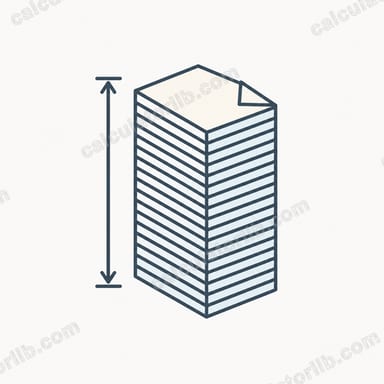
What Is the Paper Thickness Calculator?
This tool estimates the total height (or thickness) of a stack of paper. Whether you are filling a binder, mailing a thick document, or sizing a storage box, knowing how tall a ream or pile of pages will be is genuinely useful. It works for any paper, card, or sheet material as long as you know the caliper (the thickness of one sheet).
How to Use It
Enter the number of sheets, the caliper of a single sheet, and choose the unit of that caliper (millimeters, microns, or inches). The calculator multiplies the two values and reports the total stack thickness in millimeters, centimeters, and inches.
Typical office paper (80 gsm) has a caliper of roughly 0.1 mm (100 microns) per sheet, so a 500-sheet ream is about 50 mm (5 cm) tall.
The Formula Explained
The math is simple multiplication: $$\text{Stack thickness} = \text{number of sheets} \times \text{caliper per sheet}$$. The only subtlety is units. Caliper is often quoted in microns (\(\mu m\)) or thousandths of an inch ("points"), so the calculator converts your input to millimeters first (\(1 \text{ micron} = 0.001 \text{ mm}\), \(1 \text{ inch} = 25.4 \text{ mm}\)) before multiplying.

Worked Example
Suppose you have 250 sheets with a caliper of 0.12 mm each. $$\text{Stack thickness} = 250 \times 0.12 = 30 \text{ mm} = 3 \text{ cm} \approx 1.18 \text{ inches}.$$ A box that is 4 cm deep would comfortably hold the stack.
Typical Paper Caliper by Type and Weight
Caliper is the thickness of a single sheet. The grammage values below (gsm, grams per square metre) follow the ISO metric convention used in most of the world; the thousandths-of-an-inch column reflects the "point"/"mil" convention common in North American printing. All figures are typical ranges, not standards — two sheets of the same 120 gsm stock can differ by 20% or more in thickness depending on brand, fibre, calendering and finish. Coated stock is noticeably thinner per gsm than uncoated or bulky offset, because calendering and the clay coating compress the sheet.
| Paper / board | Typical grammage | Caliper (µm) | Caliper (mm) | Caliper (in) |
|---|---|---|---|---|
| Tracing paper / onionskin | 40–60 gsm | ~50 | 0.05 | 0.002 |
| Newsprint | 45–50 gsm | ~70 | 0.07 | 0.003 |
| Copy / bond paper | 75–80 gsm | ~100 | 0.10 | 0.004 |
| Premium office / letterhead | 90–100 gsm | 110–130 | 0.11–0.13 | 0.004–0.005 |
| Heavy inkjet / presentation | 120 gsm | ~150 | 0.15 | 0.006 |
| Light cover / flyer stock | 160 gsm | ~200 | 0.20 | 0.008 |
| Cover stock | 200 gsm | ~250 | 0.25 | 0.010 |
| Card stock | 250 gsm | ~300 | 0.30 | 0.012 |
| Heavy card stock | 300 gsm | ~350 | 0.35 | 0.014 |
| Folding boxboard | 350 gsm | ~400 | 0.40 | 0.016 |
| Glossy photo paper | 240–300 gsm | 250–300 | 0.25–0.30 | 0.010–0.012 |
| Corrugated, single-wall E-flute | — | ~1500 | ~1.5 | ~0.059 |
Measure instead of guessing. The most reliable caliper for a specific stock is the one you measure yourself: square up a stack of exactly 100 sheets, press it lightly flat, measure the stack height with a ruler or caliper, and divide by 100. A 100-sheet stack reading 11 mm gives \(11 \div 100 = 0.11\) mm per sheet. Using 100 sheets turns a sub-millimetre measurement into an easy one and averages out sheet-to-sheet variation. If your stock has a published caliper on the ream wrapper or spec sheet, use that figure in preference to a table value.
Stack Height Across Common Scenarios
Each row multiplies a sheet count by a caliper, following \(\text{height} = \text{sheets} \times \text{caliper}\). All heights are uncompressed, loose-stack figures: a stack squeezed into a clamp, a binder or a shrink-wrapped ream settles measurably shorter as air between the sheets is driven out, so treat these as the upper bound and allow a few percent of margin when sizing an enclosure.
| Sheets | Caliper | Height (mm) | Height (cm) | Height (in) | Practical note |
|---|---|---|---|---|---|
| 100 | 0.10 mm (80 gsm copy) | 10 | 1.0 | 0.39 | A typical chapter print-out; sits comfortably in a 25 mm (1 in) D-ring binder with room for dividers. |
| 250 | 0.12 mm (90 gsm) | 30 | 3.0 | 1.18 | Already past a 25 mm binder's safe capacity — step up to 38 mm (1.5 in). |
| 500 (one ream) | 0.10 mm (80 gsm copy) | 50 | 5.0 | 1.97 | The familiar ream height; needs a 50 mm (2 in) binder, which realistically holds a ream only without dividers. |
| 1000 | 0.10 mm (80 gsm copy) | 100 | 10.0 | 3.94 | Two reams. Exceeds every common ring binder; use a box, archive file or two volumes. |
| 500 | 0.13 mm (100 gsm premium) | 65 | 6.5 | 2.56 | The same page count on heavier stock is 30% taller — a 50 mm binder will not close. |
| 50 | 0.30 mm (250 gsm card) | 15 | 1.5 | 0.59 | A deck of invitations or menu cards; fits a 25 mm binder box or a standard card mailer. |
| 200 | 0.25 mm (photo paper) | 50 | 5.0 | 1.97 | Only 200 prints, yet as tall as a full ream — photo stock is roughly 2.5× copy paper per sheet. |
Two points worth carrying away. First, sheet count alone tells you very little: 200 photo prints and 500 copy sheets occupy the same 50 mm. Second, printer and copier input trays, mail slots and ring binders are all rated by height, not by page count, so convert to height before deciding what fits. Many office printer cassettes are built around one ream (about 50 mm) of 80 gsm paper; loading the same visual "half tray" of 300 gsm card can overfill the stack-height limit and misfeed. Binder capacities are nominal ring diameters, and the usable stack is typically 10–20% less than the stated size once covers and dividers are accounted for.
FAQ
What is caliper? Caliper is the thickness of a single sheet of paper, usually measured with a micrometer and quoted in microns or thousandths of an inch.
How do I find caliper if I only know paper weight? Caliper and gsm are related but not identical because they depend on density. As a rough guide, standard 80 gsm office paper is about 0.1 mm thick.
Does this account for binding or compression? No. It gives the loose, uncompressed stack height. A tightly bound or pressed stack may be slightly shorter.