

What Is Contribution Margin?
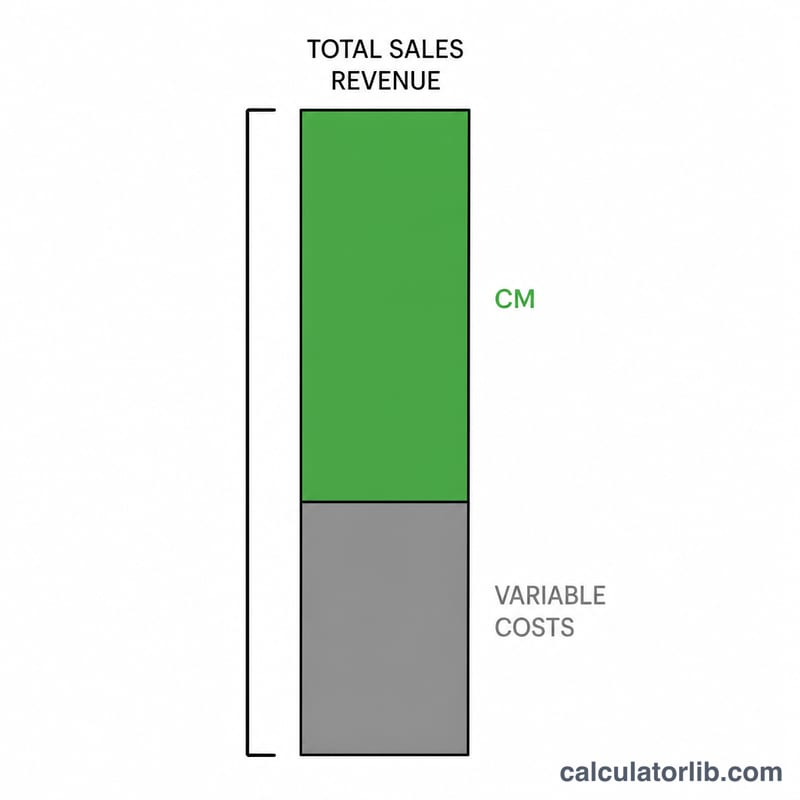
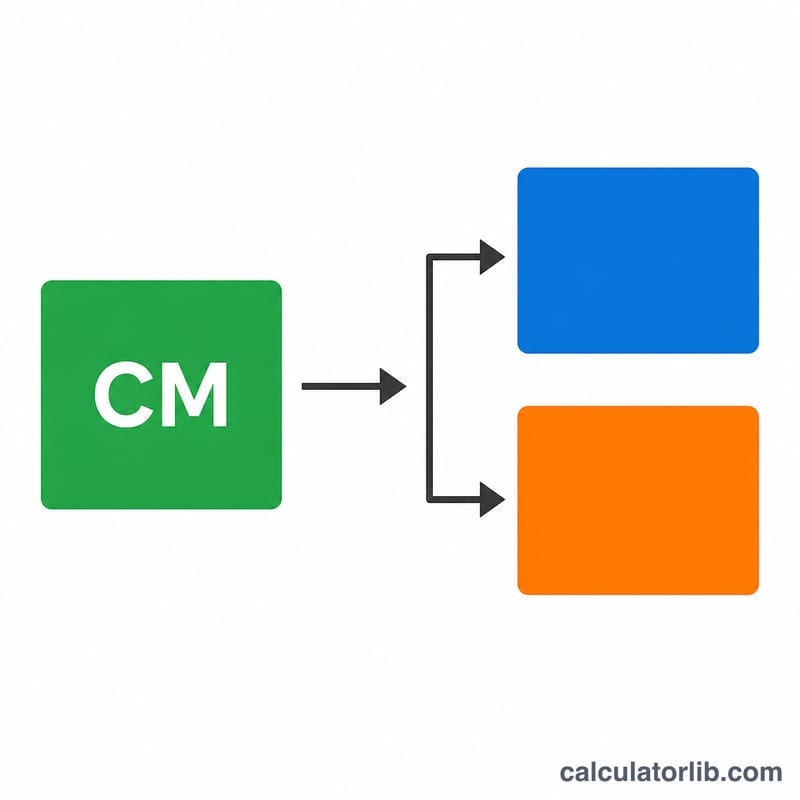
Contribution margin is the amount of sales revenue that remains after subtracting variable costs. It represents the money "contributed" toward covering fixed costs and generating profit. It is one of the most important metrics in managerial accounting and break-even analysis, helping businesses understand how each sale impacts the bottom line.
How to Use This Calculator
Enter your total sales revenue and your total variable costs (costs that change with the level of production or sales, such as materials, direct labor, and shipping). The calculator returns your contribution margin in dollars and the contribution margin ratio as a percentage.
The Formula Explained
The contribution margin is simply Sales Revenue − Variable Costs. The contribution margin ratio divides that figure by sales revenue and multiplies by 100 to express it as a percentage. A higher ratio means a greater share of each sales dollar is available to cover fixed costs and profit.
Formula: $$\text{CM Ratio} = \frac{\text{Sales Revenue} - \text{Variable Costs}}{\text{Sales Revenue}} \times 100$$
Worked Example
Suppose a company has $10,000 in sales revenue and $4,000 in variable costs. The contribution margin is $$\$10{,}000 - \$4{,}000 = \$6{,}000$$ The contribution margin ratio is $$\$6{,}000 \div \$10{,}000 \times 100 = 60\%$$ This means 60 cents of every sales dollar contributes to fixed costs and profit.
FAQ
What is a good contribution margin ratio? It varies by industry, but a higher ratio is generally better. Service businesses often have very high ratios, while retailers may run lower.
What counts as a variable cost? Costs that scale with output — raw materials, packaging, sales commissions, and direct labor are typical examples. Rent and salaries are usually fixed costs and are excluded here.
How is contribution margin different from gross profit? Gross profit subtracts cost of goods sold (which can include some fixed costs), while contribution margin subtracts only variable costs.