
What Is the Tree Height Calculator?
This tool estimates the height of a tree (or any tall object) using basic trigonometry. By standing a known horizontal distance away and measuring the angle from your eye up to the top of the tree, you can work out its height without climbing or special equipment. It's widely used by foresters, arborists, landscapers, and curious hikers.
How to Use It
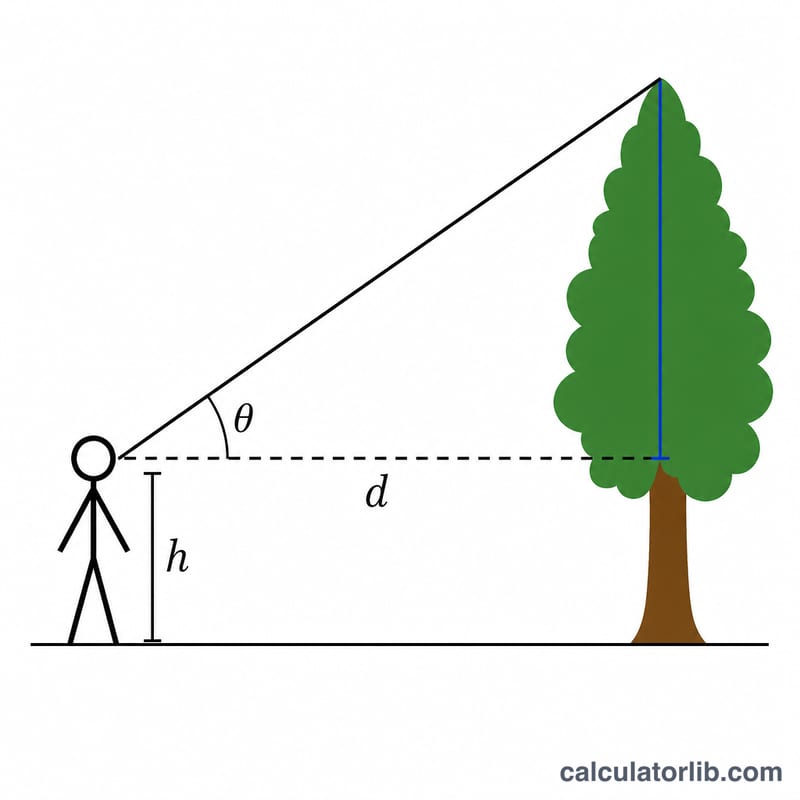
Stand a comfortable distance from the base of the tree on level ground. Measure that horizontal distance (in meters). Using a clinometer, a smartphone inclinometer app, or a protractor with a weighted string, sight the very top of the tree and read the angle of elevation in degrees. Finally, enter your eye height — the distance from the ground to your eyes. Press calculate and the tool returns the full tree height.
The Formula Explained
The calculation uses the right-triangle relationship:
$$\text{Height} = \text{Distance} \times \tan(\text{angle}) + \text{Eye Height}$$
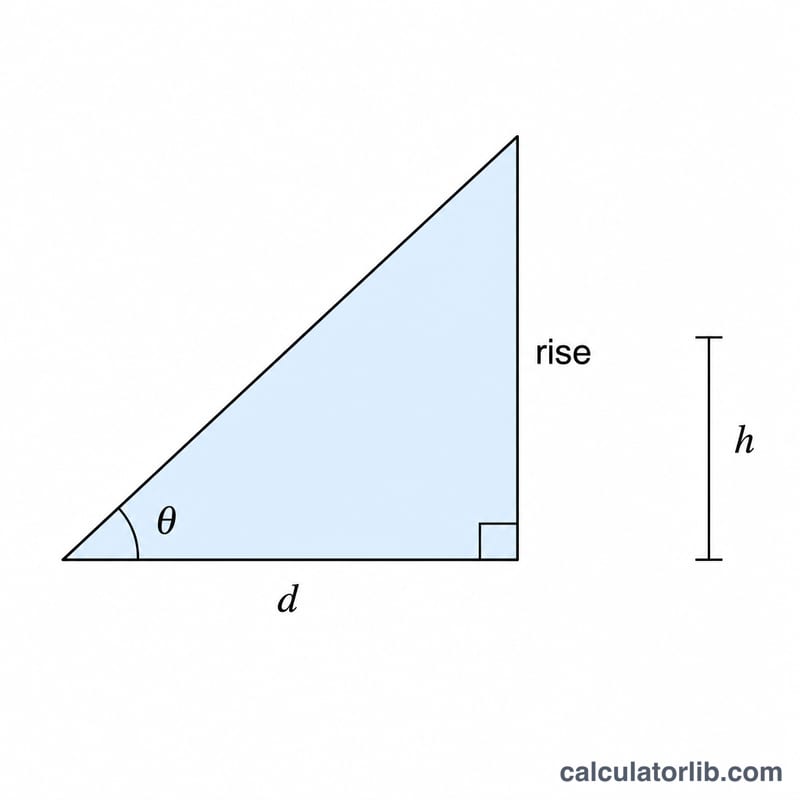
The horizontal distance and the line of sight to the treetop form a right triangle. The vertical leg — how far the top rises above your eye — equals the distance multiplied by the tangent of the elevation angle. Adding your eye height converts that "above-eye" measurement into the true height from the ground.
Worked Example
Suppose you stand 20 m from a tree, measure a 30° angle to the top, and your eyes are 1.6 m above the ground. Then the height above eye level is $$20 \times \tan(30°) = 20 \times 0.57735 = 11.547 \text{ m}.$$ Adding your 1.6 m eye height gives a total height of about 13.15 m.
FAQ
Does the ground need to be flat? For best accuracy, yes — the formula assumes the tree base is at the same level as your feet. On a slope, measure separate angles to the top and base.
What units should I use? Any consistent unit works. If you enter distance and eye height in feet, the result is in feet.
What angle is too steep? Avoid angles above ~89° because the tangent grows extremely large and small measurement errors become huge errors.