
What is the Byte Conversion Calculator?
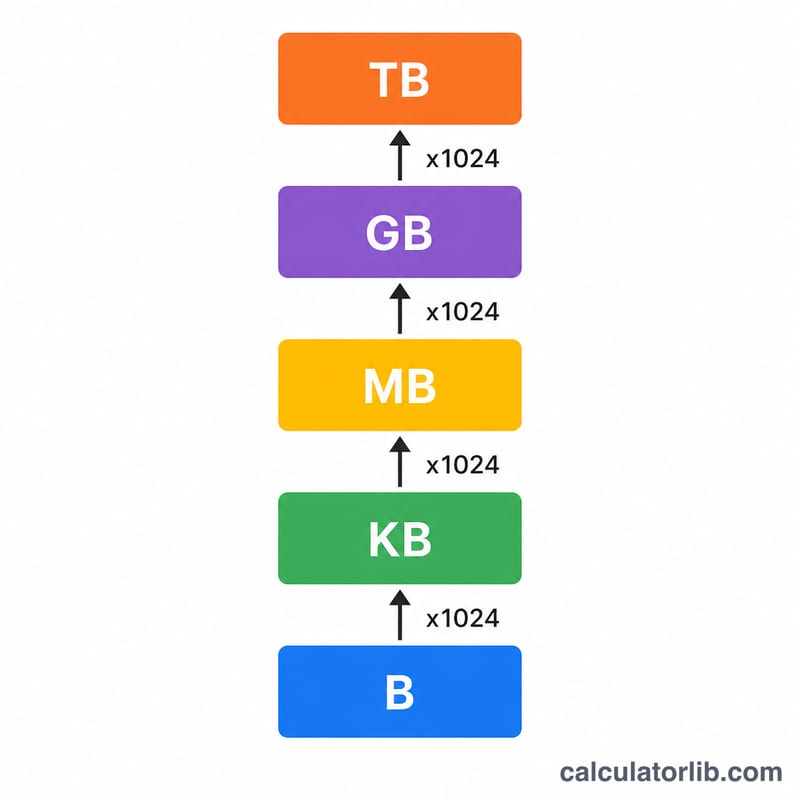
This tool converts a digital storage amount between bytes (B), kilobytes (KB), megabytes (MB), gigabytes (GB) and terabytes (TB). It uses the binary convention, where each step up multiplies by 1024 (2¹⁰) rather than 1000. This matches how operating systems and memory hardware typically report file and disk sizes.
How to use it
Enter a numeric value, choose the unit you are converting from, then pick the unit you want the answer in. The calculator instantly shows the converted value and the equivalent in raw bytes. You can convert up or down the scale — from tiny byte counts to multi-terabyte storage figures.
The formula explained
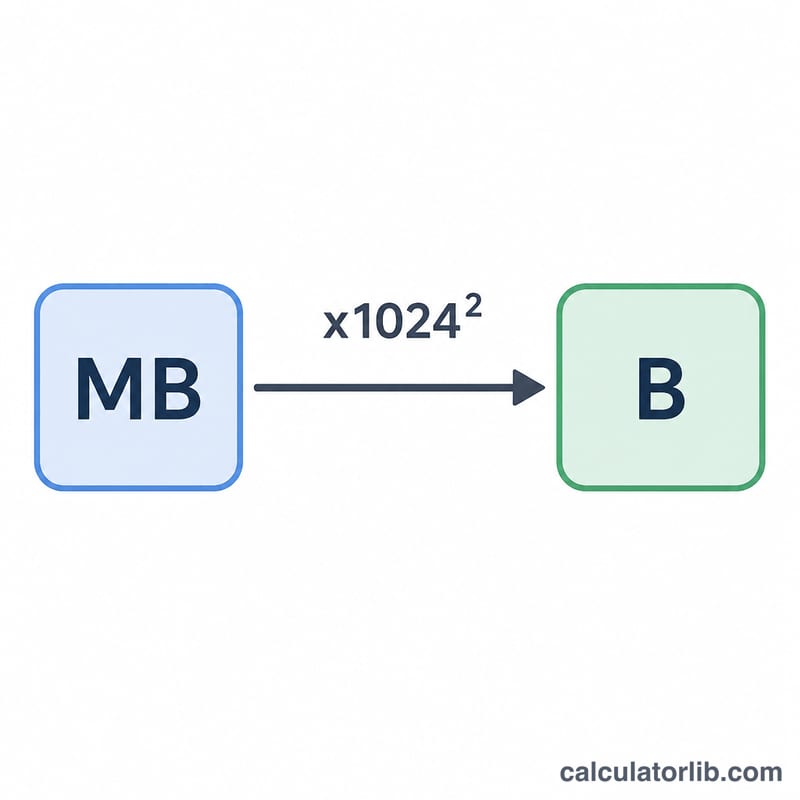
Each unit is assigned an exponent: B=0, KB=1, MB=2, GB=3, TB=4. The value is first turned into bytes by multiplying by 1024 raised to the source exponent, then divided by 1024 raised to the target exponent:
$$\text{target} = \text{value} \times \frac{1024^{\text{fromExp}}}{1024^{\text{toExp}}}$$
This is equivalent to multiplying by \(1024^{\text{fromExp} - \text{toExp}}\), so converting upward (e.g. MB → GB) divides, and converting downward (e.g. MB → KB) multiplies.
Worked example
Convert 1024 KB to MB. KB has exponent 1, MB has exponent 2. So: $$1024 \times \frac{1024^1}{1024^2} = \frac{1024 \times 1024}{1{,}048{,}576} = \frac{1{,}048{,}576}{1{,}048{,}576} = 1 \text{ MB}$$ The equivalent in bytes is 1,048,576 B.
Definitions & Glossary
- Bit (b)
- The smallest unit of digital information — a single binary digit, either 0 or 1. Network and connection speeds are usually quoted in bits per second (e.g. Mbps).
- Byte (B)
- A group of 8 bits, \(1\text{ B} = 8\text{ bits}\). The byte is the standard unit for measuring file sizes and storage capacity.
- Kilobyte (KB) / Kibibyte (KiB)
- In decimal (SI) usage, 1 KB = 1,000 bytes (\(1000^1\)). In binary usage, 1 KiB = 1,024 bytes (\(1024^1\)). Many operating systems label the binary quantity simply "KB".
- Megabyte (MB) / Mebibyte (MiB)
- Decimal: 1 MB = 1,000,000 bytes (\(1000^2\)). Binary: 1 MiB = 1,048,576 bytes (\(1024^2\)).
- Gigabyte (GB) / Gibibyte (GiB)
- Decimal: 1 GB = 1,000,000,000 bytes (\(1000^3\)). Binary: 1 GiB = 1,073,741,824 bytes (\(1024^3\)).
- Terabyte (TB) / Tebibyte (TiB)
- Decimal: 1 TB = 1,000,000,000,000 bytes (\(1000^4\)). Binary: 1 TiB = 1,099,511,627,776 bytes (\(1024^4\)).
- Binary vs decimal (SI) convention
- The SI (decimal) convention uses powers of 1000 with prefixes kilo-, mega-, giga-, tera-. The IEC binary convention uses powers of 1024 with prefixes kibi-, mebi-, gibi-, tebi- (KiB, MiB, GiB, TiB) to remove ambiguity. This calculator converts using binary \(1024\) factors, matching how most operating systems report storage.
FAQ
Does this use 1024 or 1000? It uses 1024 (binary). Drive manufacturers often use 1000 (decimal SI), which is why a "500 GB" drive shows as less in your OS.
Are these the same as KiB, MiB, GiB? Yes — the strict IEC names for binary units are kibibyte, mebibyte and gibibyte, but most software still labels them KB, MB and GB.
Can I convert bits? This calculator works in bytes; to convert from bits, divide by 8 first (\(1 \text{ byte} = 8 \text{ bits}\)).