
What this calculator does
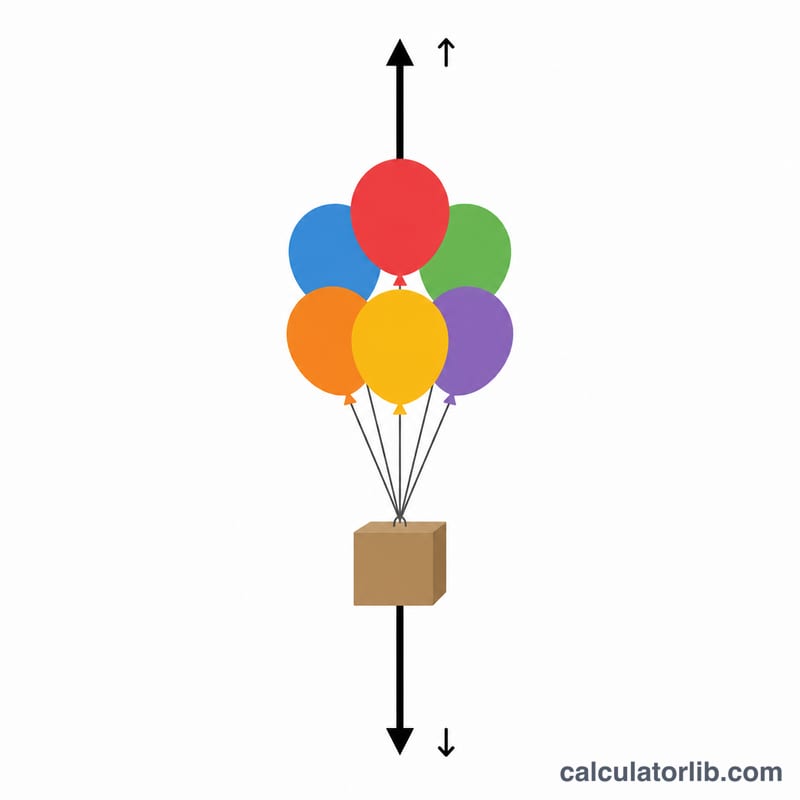
The Helium Balloons Calculator estimates how many helium-filled balloons you need to lift a given weight — a party prop, a small camera rig, or just to satisfy your curiosity. It uses Archimedes' principle of buoyancy: a balloon floats because the helium inside it is lighter than the air it displaces.
How to use it
Enter the weight you want to lift in grams, the balloon's diameter in centimetres, and the densities of air and helium in grams per litre. The calculator computes the balloon's volume, the net lift each balloon provides, and rounds the total count up to the next whole balloon (you can't inflate a fraction of one).
The formula explained
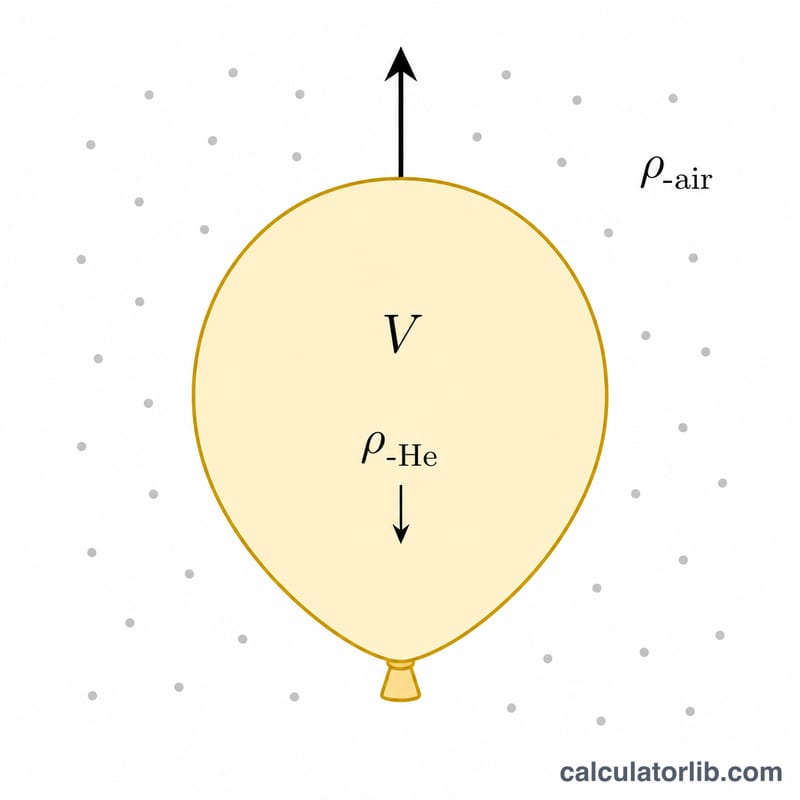
A spherical balloon of diameter d has volume \(V = \frac{4}{3}\cdot\pi\cdot r^{3}\), where \(r = d/2\). Converting cm³ to litres (÷1000) gives the volume in litres. Each litre of displaced air weighs about 1.225 g, while a litre of helium weighs about 0.1786 g, so the net lift per litre is the difference, roughly 1.046 g/L. Multiply by the balloon volume to get lift per balloon, then divide the weight by that lift: $$\text{Balloons} = \frac{\text{weight}}{V \times (\rho_{\text{air}} - \rho_{\text{He}})}$$
Worked example
For a 28 cm balloon: \(r = 14\) cm, $$V = \frac{4}{3}\cdot\pi\cdot 14^{3} \approx 11{,}494 \text{ cm}^3 \approx 11.49 \text{ L}$$ Net lift per litre = \(1.225 - 0.1786 = 1.0464\) g/L, so each balloon lifts ≈ 12.03 g. To lift 100 g you need \(100 \div 12.03 \approx 8.3\), rounded up to 9 balloons.
FAQ
Does the balloon's own weight matter? Yes — heavy latex or foil and the string reduce net lift. Add their mass to the weight you want to lift for accuracy.
Why use 1.225 g/L for air? That is standard air density at sea level and 15 °C. Higher altitude or temperature lowers it and reduces lift.
Are the results exact? They are a close physics estimate; real-world factors like balloon stretch, leakage and humidity cause small differences.