What is a mini bike torque converter gear ratio?
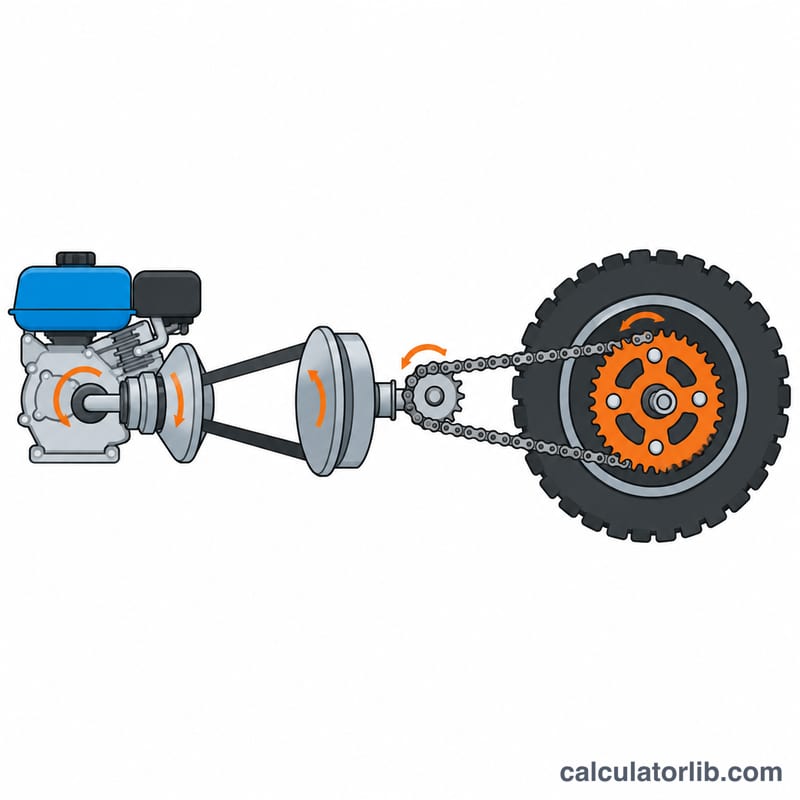
A torque converter (a belt-driven CVT such as a Comet TAV2 or similar) continuously varies the ratio between the engine and the chain output. At launch it sits in a low (high-torque) ratio, and as engine speed rises it shifts toward a high (overdrive-like) ratio. The overall ratio your rear wheel sees is the converter ratio multiplied by the chain reduction from the converter output sprocket to the axle sprocket.
How to use this calculator
Enter the converter low and high ratios from your manufacturer (written as engine : output), the tooth counts of the converter output sprocket and axle sprocket, your tire diameter in inches and the engine RPM you expect when the converter is fully shifted. The tool returns the overall low and high ratios, wheel RPM and estimated speeds.
The formulas
The chain final drive ratio is the axle teeth divided by the driver teeth, and the overall ratio multiplies that by the converter ratio:
$$R_{total} = R_{conv} \times \frac{N_{axle}}{N_{driver}}$$
Speed in mph, with \(D\) the tire diameter in inches, follows from wheel RPM and tire circumference:
$$v = \frac{\text{RPM}}{R_{total}} \times \pi D \times \frac{60}{63360}$$

Worked example
Take a converter of 3.5:1 low and 0.9:1 high, a 12-tooth driver, a 60-tooth axle sprocket, 13 in tires and 3600 RPM.
$$R_{final} = \frac{60}{12} = 5$$
$$R_{low} = 3.5 \times 5 = 17.5, \quad R_{high} = 0.9 \times 5 = 4.5$$
$$v = \frac{3600}{4.5} \times \pi \times 13 \times \frac{60}{63360} \approx 30.94\,\text{mph}$$
Gearing Scenarios: Sprocket and Tire Combinations
The table compares four setups at a fixed 3600 RPM with a 3.5:1 low / 0.9:1 high converter and a 12-tooth driver (output) sprocket. The final ratio is \(G = \text{axle teeth} / \text{driver teeth}\). The overall low and high ratios are the converter ratio multiplied by \(G\). Top speed uses the formula above with the high converter ratio.
| Axle teeth | Tire (in) | Final ratio G | Overall low | Overall high | Top speed (mph) |
|---|---|---|---|---|---|
| 60 | 12 | 5.00:1 | 17.50:1 | 4.50:1 | 28.56 |
| 72 | 12 | 6.00:1 | 21.00:1 | 5.40:1 | 23.80 |
| 60 | 13 | 5.00:1 | 17.50:1 | 4.50:1 | 30.94 |
| 50 | 13 | 4.17:1 | 14.58:1 | 3.75:1 | 37.13 |
Worked example (first row): \(G = 60/12 = 5\), so
$$v_{top} = \frac{3600 \cdot \pi \cdot 12 \cdot 60}{63360 \cdot 0.9 \cdot 5} = \frac{8{,}143{,}008}{285{,}120} \approx 28.56 \text{ mph}$$
Takeaways: a larger axle sprocket gives stronger low-end pull but a lower top speed. A taller tire raises top speed in proportion to its diameter. These figures are theoretical. They assume the converter reaches full high ratio at the stated RPM, with no belt slip, tire squat or load drop.
Typical Mini Bike Gearing Ranges
The values below are approximate and typical. Manufacturer specifications vary, so check the documentation for your converter, engine and sprockets.
| Parameter | Typical range |
|---|---|
| Converter low ratio | about 3.5:1 to 4:1 |
| Converter high ratio | about 0.9:1 to 1:1 |
| Driver (output) sprocket | about 10 to 14 teeth (12 is very common) |
| Axle (driven) sprocket | about 40 to 80 teeth, depending on chain pitch and application |
| Tire diameter | about 10 to 13 in |
| Engine RPM, 6.5 hp 196cc clone engines | about 3600 RPM stock governed; modified or ungoverned engines may peak higher |
Use the governed RPM, or the RPM where your engine makes peak power, as the engine RPM input. Check that the converter's engagement and shift RPM suit that engine. Chain pitch (such as #35 or #40/#41) and sprocket availability also limit which tooth counts you can use.
Key Terms
- Torque converter / CVT
- A belt-driven, continuously variable drive (common on mini bikes) that changes its ratio automatically with engine speed and load, between a low and a high ratio.
- Driver (output) sprocket
- The small sprocket on the converter's output shaft that drives the chain.
- Axle (driven) sprocket
- The larger sprocket on the rear axle that receives the chain drive.
- Final drive ratio
- Axle teeth divided by driver teeth; the reduction in the chain stage.
- Low ratio
- The converter's ratio at launch, when the belt rides at its most reduced position (for example 3.5:1).
- High ratio
- The converter's ratio at full shift, near or below 1:1 (for example 0.9:1).
- Overall ratio
- Converter ratio multiplied by the final drive ratio. It gives the total engine-to-axle reduction at low or high.
- Wheel RPM
- Engine RPM divided by the overall ratio. Multiplying by tire circumference gives speed.
- Engagement RPM
- The engine speed at which the converter's clutch grabs and the bike starts to move.
FAQ
Does belt slip matter? Yes. Real converters slip while engaging, so actual speed is slightly lower than the ideal figure, particularly in low gear.
How do I get more top speed? Use a smaller axle sprocket or a larger driver sprocket, which lowers the final ratio, but expect slower acceleration and more engine load.
Which RPM should I enter? Use the RPM at which the engine makes peak power or the governed maximum, since that is where the converter reaches its high ratio.