What this calculator does
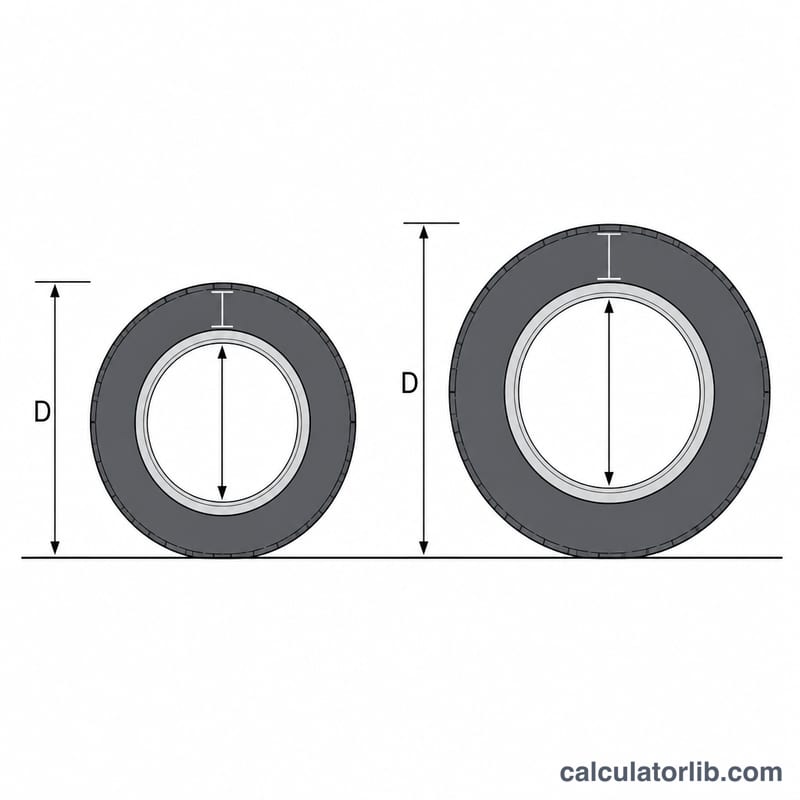
Changing tire size changes your final drive without touching a single gear. A taller tire travels farther per revolution, so the axle turns fewer times per mile and the vehicle behaves as though a numerically lower (taller) gear had been installed. This tool converts both tire codes to an overall diameter, then reports the effective gear ratio you are actually running, the ring-and-pinion ratio that would restore stock performance, the engine RPM change and the speedometer error. It is unit-neutral for speed: enter mph or km/h and the true speed comes back in the same unit.
How to use it
Enter your current axle ratio (for example 3.73), then the original and new tire codes as width in millimetres, aspect ratio in percent and rim diameter in inches. A 265/70R17 is width 265, aspect 70, rim 17. Finally enter a reference speed shown on the speedometer, such as 60.
The formula explained
Overall diameter from a metric tire code, with \(W\) = section width in mm, \(A\) = aspect ratio in percent and \(R_{rim}\) = rim diameter in inches:
$$D = R_{rim} + \frac{2 \times W \times (A/100)}{25.4}$$The sidewall height is counted twice (top and bottom) and divided by 25.4 to convert millimetres to inches. The effective ratio then scales inversely with diameter, while the ratio you would need to buy scales directly with it:
$$R_{eff} = R_{axle} \times \frac{D_{old}}{D_{new}}, \qquad R_{new} = R_{axle} \times \frac{D_{new}}{D_{old}}$$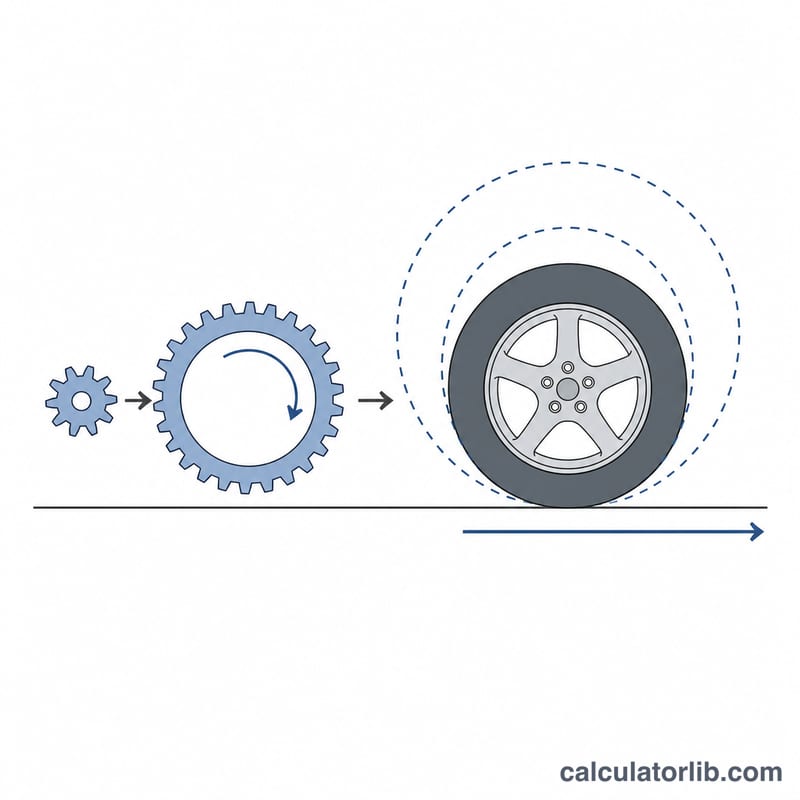
Worked example
Stock 265/70R17 with a 3.73 axle, upgrading to 285/75R17:
$$D_{old} = 17 + \frac{2 \times 265 \times 0.70}{25.4} = 31.61\,\text{in}$$$$D_{new} = 17 + \frac{2 \times 285 \times 0.75}{25.4} = 33.83\,\text{in}$$$$R_{eff} = 3.73 \times \frac{31.61}{33.83} = 3.48$$The truck now feels like it has 3.48 gears, engine RPM drops about 6.6% at any road speed, and a re-gear to \(R_{new} = 3.99\) (a 4.10 in practice) brings back the original punch. At an indicated 60 the true speed is about 64.2.
Common Ring-and-Pinion Ratios Available
The calculator's \(R_{\text{rec}} = R_{\text{stock}} \cdot F\) is a continuous number — 3.99, 4.49, 3.18 — but ring-and-pinion sets are only cut in discrete ratios. Round your computed figure toward the nearest ratio actually produced for your axle:
| Range | Ratios commonly offered | Typical use |
|---|---|---|
| Tall / highway | 2.73, 3.08, 3.21, 3.31, 3.42 | Stock-height passenger cars and light trucks, fuel-economy gearing |
| Mid | 3.55, 3.73, 3.90, 4.10 | Factory tow packages; restoring stock feel after a 1–2 in tire increase |
| Low / off-road | 4.30, 4.56, 4.88 | 33–35 in tires on a vehicle originally geared in the 3.5–4.1 range |
| Very low | 5.13, 5.38, 5.71 (and 6.17 in some axles) | 37 in and larger tires, rock-crawling, heavy drag |
Practical notes on choosing from this list:
- Nearest available, not exact. A computed 3.99 is served by a stocked 3.90 or 4.10; a computed 4.49 by 4.56. Being one step off changes cruise RPM by roughly 2–3%, which is normally imperceptible. If your figure falls between two ratios, the numerically higher gear favours acceleration, torque multiplication and towing; the lower gear favours quieter, more economical highway cruising.
- Availability depends on the axle model. Not every number above exists for every differential. A ratio offered for one axle family may simply never have been cut for another, and advertised ratios are themselves rounded — a "4.10" may really be 41:10 = 4.100 in one axle and 4.11 (37:9) in another.
- Carrier breaks matter. Most axles split their ratio range across two or more carrier (differential case) castings, because a numerically higher ring gear needs the ring sitting closer to the carrier centreline. Crossing that break means the new gear set will not bolt to your existing carrier. A well-documented example is the Dana 44, whose carrier break falls between 3.73 and 3.92: ratios of 3.73 and numerically lower use the "2-series" (thin) carrier, while 3.92 and numerically higher use the "3-series" (thick) carrier. Front Dana axles additionally come in low-pinion and high-pinion (reverse-cut) forms, and gear sets are not interchangeable between them. Always confirm the carrier break and pinion orientation for your specific axle before ordering.
- Match front and rear. On a part-time or full-time four-wheel-drive vehicle, front and rear ring-and-pinion ratios must be identical, so both axles must be able to accept the ratio you pick.
This is general technical guidance; ratio availability, carrier breaks and installation specifications vary by axle manufacturer and model year, so verify against the gear manufacturer's current catalogue for your axle.
Metric Tire Codes vs Inch Tire Sizes
Two sizing systems appear on the same shelf. A metric code such as 285/75R17 gives section width in millimetres, aspect ratio as a percentage of that width, and rim diameter in inches — so the overall diameter has to be calculated. A flotation (inch) code such as 33x12.50R17 states it directly:
$$\underbrace{33}_{\text{overall diameter, in}} \times \underbrace{12.50}_{\text{section width, in}} \ R\ \underbrace{17}_{\text{rim diameter, in}}$$Because the first number is the diameter, an inch-sized tire needs no sidewall formula at all. In this calculator you can enter it by putting the diameter in the rim field and zeros in the width and aspect fields: \(D = 31 + \frac{2 \cdot 0 \cdot 0}{25.4} = 31\) in. The bridge between the two systems is the single factor 25.4 mm per inch — so 12.50 in × 25.4 = 317.5 mm, which rounds to the nearest produced section width of 315, and 10.50 in × 25.4 = 266.7 mm → a 265 section.
| Flotation (inch) size | Nominal diameter from the code (in) | Closest metric equivalent | Metric diameter from \(D = \text{Rim} + 2W(A/100)/25.4\) (in) |
|---|---|---|---|
| 31x10.50R15 | 31.0 | 265/75R15 | 30.65 |
| 32x11.50R15 | 32.0 | 285/75R15 | 31.83 |
| 33x12.50R17 | 33.0 | 285/75R17 | 33.83 |
| 33x12.50R20 | 33.0 | 285/60R20 | 33.46 |
| 35x12.50R17 | 35.0 | 315/70R17 | 34.36 |
| 35x12.50R20 | 35.0 | 315/60R20 | 34.88 |
| 37x12.50R17 | 37.0 | 315/75R17 | 35.60 |
Read the table in either direction, but read it as an approximation: the pairings are the nearest commonly produced sizes, not identities. Note how the last row differs by about 1.4 in — flotation labels are nominal and are usually rounded up to the half-inch, while the metric calculation is a geometric figure derived from the printed code. Neither is the molded diameter: a real tire's measured overall diameter depends on the rim width it is mounted on, inflation pressure and load, and most tires measure slightly under their calculated figure. Tire manufacturers publish a specification sheet with the actual measured overall diameter for each size on a given measuring rim; for a borderline gearing or clearance decision, use that measured number in the calculator instead of the code-derived one.
Flotation inch sizing is a convention of the North American light-truck and off-road market; in most other markets light-truck tires are sold only in LT-metric or metric codes, so you may need to work from the metric column alone.
FAQ
Why is my speedometer wrong after bigger tires? The sensor counts axle revolutions and assumes the stock rolling circumference, so a 7% taller tire makes the display read roughly 7% low.
Should I pick the exact calculated ratio? No. Ring-and-pinion sets come in fixed steps, so choose the closest available ratio at or just above the number shown.
Does tire pressure or load matter? Slightly. Real rolling diameter under load is usually 1-3% less than the nominal size, which affects both tires similarly and largely cancels out in the ratio.