What this calculator does
Sod is sold by the square foot, the square yard, the roll, the slab or the pallet, so the first thing any supplier asks is how much ground you need to cover. This calculator turns simple tape-measure numbers into every figure you need to place an order: total square feet, square yards, and the whole number of rolls or slabs to buy. All lengths are entered in feet, so one square yard equals 9 square feet.
How to use it
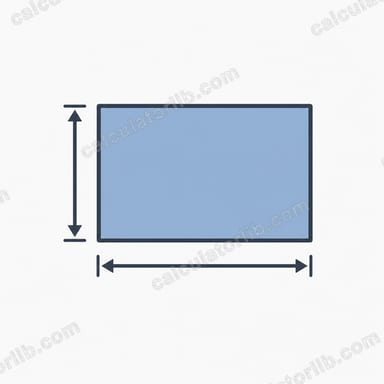
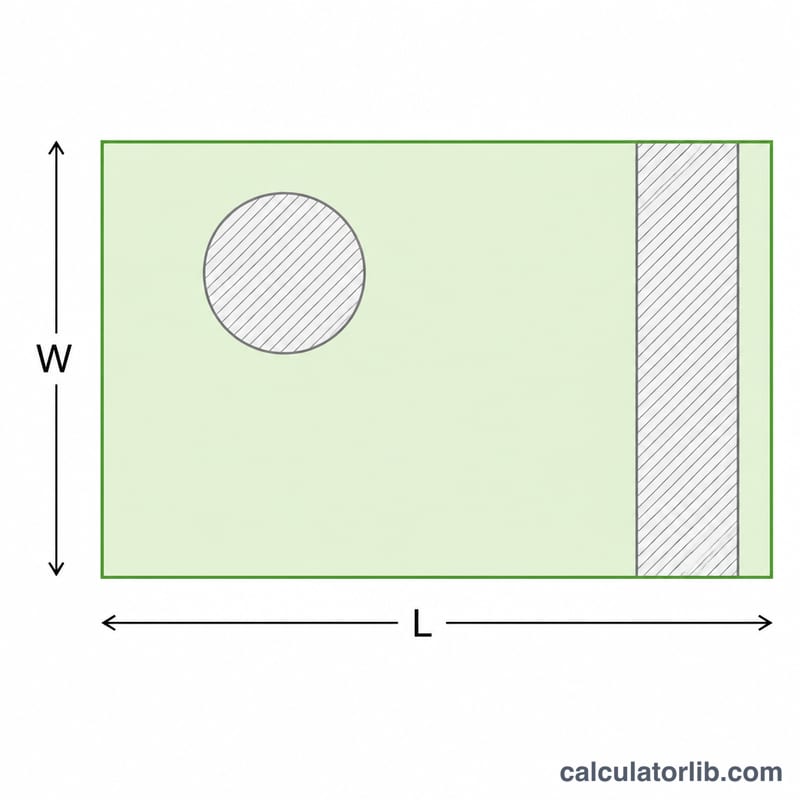
Measure the lawn at its longest and widest points and enter both in feet. If the lawn is an irregular shape, break it into rectangles, run the calculator once per rectangle and add the results. Use the exclude field for anything inside your measurement that will not be sodded, such as a patio, a driveway apron, a tree ring or planting beds. A waste allowance of 5-10% covers trimming along curves, slopes and odd corners; use the higher end for a lawn with lots of edges. Finally, set the coverage of the product your supplier sells: 10 sq ft for a 2 ft × 5 ft roll, 9 sq ft for a 3 ft × 3 ft slab, or 450 sq ft to count pallets instead.
The formula
With \(L\) = length in feet, \(W\) = width in feet, \(E\) = excluded area in square feet and \(w\) = waste percentage:
$$A_{sod} = (L \times W - E) \times \left(1 + \frac{w}{100}\right)$$The order quantity rounds up, because suppliers do not cut part pieces:
$$N = \left\lceil \frac{A_{sod}}{A_{roll}} \right\rceil$$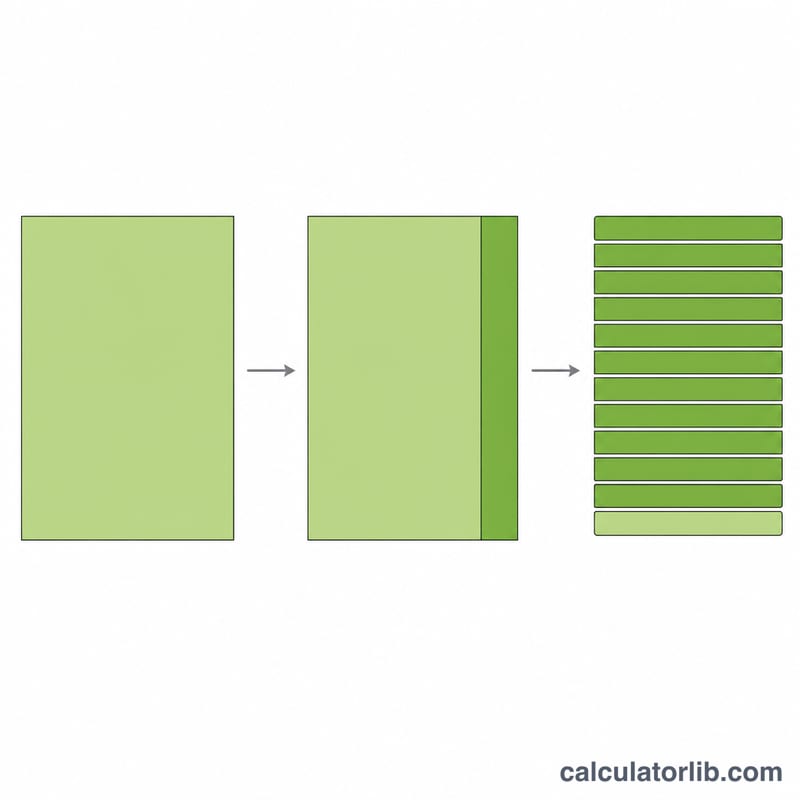
Worked example
A back yard measures 50 ft by 30 ft and contains a 200 sq ft patio. With a 5% waste allowance and 10 sq ft rolls:
$$A_{sod} = (50 \times 30 - 200) \times 1.05 = 1300 \times 1.05 = 1365\,\text{sq ft}$$$$Y = \frac{1365}{9} = 151.67\,\text{sq yd} \qquad N = \left\lceil \frac{1365}{10} \right\rceil = 137\ \text{rolls}$$Area Unit Conversions for Sod Orders
Sod is quoted by the square foot, the square yard, the piece or the pallet depending on the supplier, and a lawn plan may be drawn in metric. These factors let you move between all of them without re-measuring.
| From | Equals | Also equals |
|---|---|---|
| 1 sq yd | 9 sq ft | 0.8361 sq m |
| 1 sq ft | 0.1111 sq yd | 0.0929 sq m |
| 1 sq m | 10.764 sq ft | 1.196 sq yd |
| 1 acre | 43,560 sq ft | 4,840 sq yd |
Quick reference: common lawn sizes
Rolls below are standard 10 sq ft hand rolls; pallets assume 450 sq ft per pallet. Neither figure includes a waste allowance.
| Lawn area (sq ft) | Square yards | Square metres | 10 sq ft rolls | 450 sq ft pallets |
|---|---|---|---|---|
| 500 | 55.6 | 46.5 | 50 | 1.11 |
| 1,000 | 111.1 | 92.9 | 100 | 2.22 |
| 2,000 | 222.2 | 185.8 | 200 | 4.44 |
| 5,000 | 555.6 | 464.5 | 500 | 11.11 |
The conversion itself is a single division — square feet to square yards is
$$A_{\text{yd}^2} = \frac{A_{\text{ft}^2}}{9} = \frac{2{,}000}{9} \approx 222.2\ \text{sq yd}$$Comparing prices fairly
A price per square yard looks nine times larger than the same price per square foot, so the two can only be compared after dividing by 9. Sod quoted at 4.50 per square yard works out to \(4.50 \div 9 = 0.50\) per square foot; sod quoted at 0.42 per square foot is \(0.42 \times 9 = 3.78\) per square yard, which is the cheaper material. Do the same with delivery: a flat delivery fee spread over a 450 sq ft pallet adds far more per square foot on a small order than on a large one, so compare the total landed cost for your area, not the headline unit price.
Ordering and Installation Recommendations
Turning the calculated area into an order
- Round up to whole pieces, never down. Sod is cut, not poured — a result of 98.2 rolls means 99 rolls. Where a supplier only sells by the pallet, round up to the next full pallet; most growers will not break a pallet, and a short order stops the job mid-install.
- Pick the waste allowance to match the shape. Use about 5% for a plain rectangle with straight edges. Use 10–15% where there are curved beds, tree islands, slopes, or many small cut-ins around paths and utility covers — every curve forces a trim, and the off-cut is usually unusable.
- Measure irregular lawns as separate rectangles. Break an L-shape, a side yard and a strip along the drive into individual rectangles, run each through the calculator, and add the areas. For a triangular corner, measure it as a rectangle and halve it; for a rough curve, take the average width across several points. Subtract patios, decks, pools and planting beds using the exclusion input rather than guessing a lower total.
- Add 1–2 spare pieces on purpose. A second delivery for three missing rolls costs far more than the rolls themselves, because you pay the trip fee again. Order a couple of extra pieces for patching and for the spots where the first row did not line up.
Worked example
A back lawn measures 40 ft × 25 ft and contains a 100 sq ft patio. With a 10% allowance for the curved bed along one edge and standard 10 sq ft hand rolls:
$$A_{\text{sod}} = (40 \times 25 - 100) \times \left(1 + \frac{10}{100}\right) = 900 \times 1.10 = 990\ \text{sq ft}$$That is 990 sq ft, or 110 sq yd, which comes to \(\lceil 990 \div 10 \rceil = 99\) rolls — about 2.2 pallets at 450 sq ft each, so order 3 pallets if the supplier will not split one, and expect to have roughly 350 sq ft spare to return or share.
Timing and handling
- Have the soil ready before the sod arrives. Clear old turf and debris, loosen the top few inches, add amendments if needed, and grade smooth — finishing about one sod-thickness below walks and driveways so the laid lawn sits flush. Lightly moisten the soil just before laying; sod should never go onto dry, dusty ground.
- Install within about 24 hours of harvest — the same day in hot or windy weather. Sod is a living, rootless crop sitting on a pallet; stacked rolls heat up internally and can yellow or die within a day or two in summer heat.
- Keep pallets shaded and moist until each piece is laid. Park them out of direct sun, mist the exposed edges, and work from one pallet at a time instead of spreading everything out to dry.
- Stagger the seams in a brick pattern. Start against a long straight edge, butt the pieces tightly end to end without overlapping or stretching them, and offset each row so the joints do not line up. On a slope, lay rows across the slope rather than up and down, and stake the pieces if it is steep.
- Water deeply as soon as it is down — ideally within the first half hour, section by section rather than waiting for the whole lawn. Soak through the sod and into the soil beneath, then keep both layers damp for the first couple of weeks while the roots knit in, tapering to less frequent, deeper watering as it establishes. Stay off the new lawn as much as possible during that period.
Why the spares matter twice: sod shrinks slightly as it dries after laying, opening thin gaps at the seams. Keeping a few pieces on hand — laid out flat in a shaded spot and watered, not left rolled — lets you fill those gaps and repair any piece that fails, instead of ordering a single roll later from a possibly different batch that will not match in colour or texture.
Local conditions, grass species and supplier practice all vary; where a grower or local extension service gives specific guidance for your region and turf type, follow it over a general rule of thumb.
FAQ
How much waste should I add? Add 5% for a plain rectangle, 10% for curved borders, islands or a steep slope. Running short by a few pieces usually means a second delivery fee, so rounding up is cheap insurance.
How much does one pallet cover? Most growers load 400-500 sq ft per pallet, commonly 450 sq ft. Enter that number as the coverage per piece and the result tells you how many pallets to order.
Does sod shrink after it is laid? Freshly cut sod can shrink slightly as it dries, which widens the seams. That is another reason to keep a small overage and to water the lawn within a few hours of laying it.