What this calculator does
Turf (sod) is sold by area, usually in rolls or slabs of a fixed size. This calculator turns the measurements of your lawn into the area of turf you should order, including an allowance for the strips you lose when trimming around curves, trees and borders. It works in whichever unit you measure in: enter meters and you get square meters, enter feet and you get square feet.
How to use it
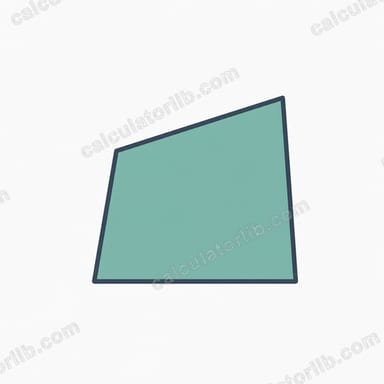
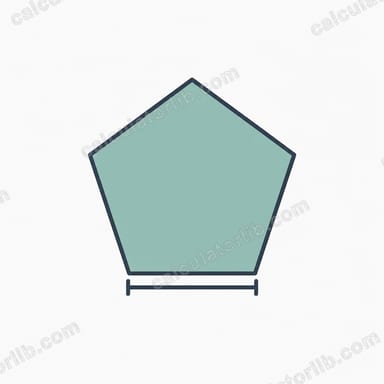
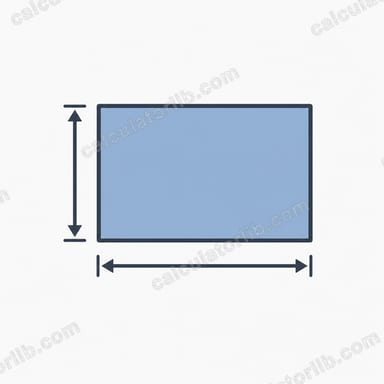
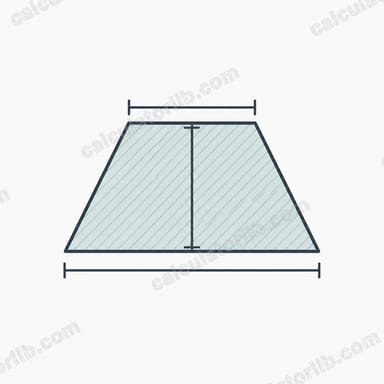
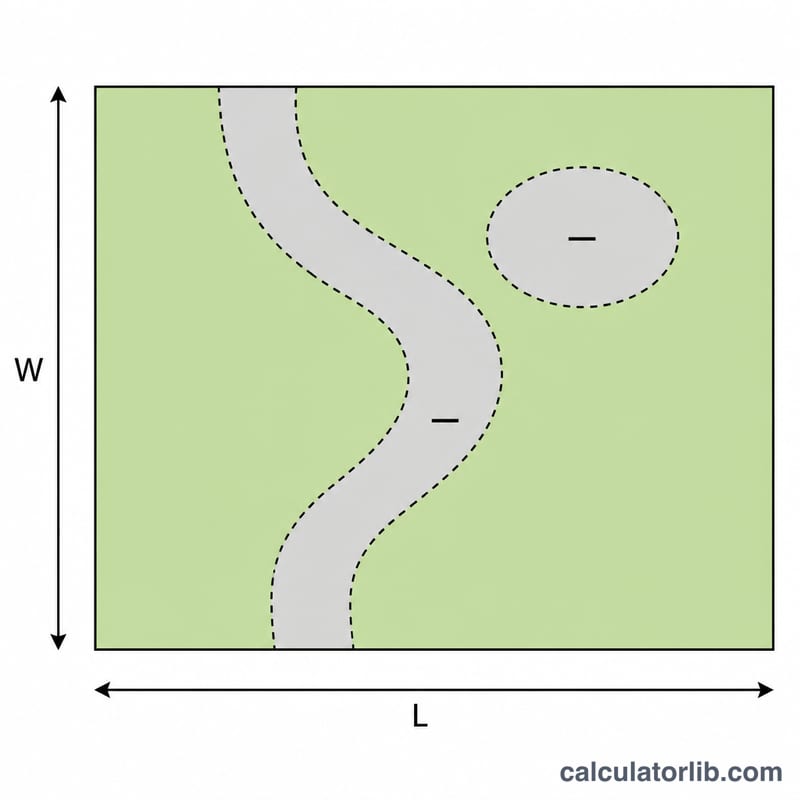
Pick your measurement unit and the shape that best matches the area. For a rectangle enter length and width; for a round lawn enter the diameter; for a triangular corner enter the base and the perpendicular height. Add the area of any patio, path or flower bed you do not want to cover under area to exclude, choose a waste allowance (5-10% is typical, 10-15% for curvy or awkward shapes) and enter the coverage of one roll — a standard roll is often 1 square meter, or about 10 square feet.
The formula
With \(A_{\text{lawn}}\) = area from your dimensions, \(A_{\text{exclude}}\) = deducted area and \(w\) = waste percentage:
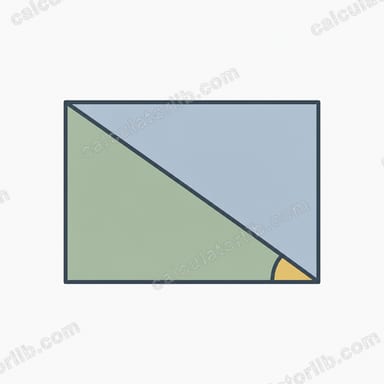
$$A_{\text{order}} = (A_{\text{lawn}} - A_{\text{exclude}}) \times \left(1 + \frac{w}{100}\right)$$Shape areas are \(A = L \times W\) for a rectangle, \(A = \frac{\pi d^{2} }{4}\) for a circle and \(A = \tfrac{1}{2} b h\) for a triangle.
Worked example
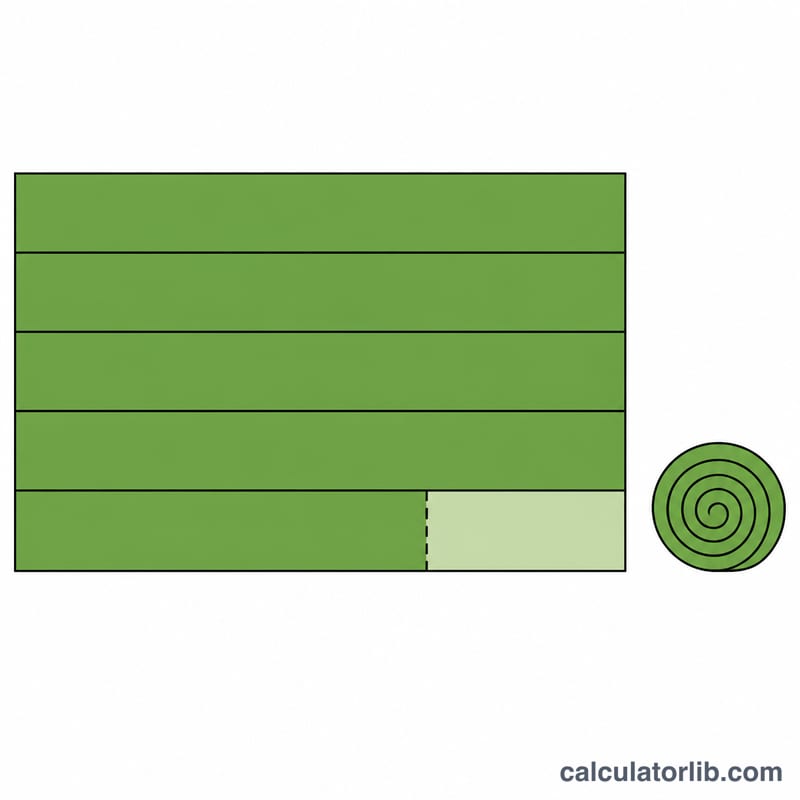
A rectangular lawn 12 m by 8 m contains a 6 m² shed base, and you allow 10% waste:
$$A_{\text{lawn}} = 12 \times 8 = 96\,\text{m}^2$$$$A_{\text{order}} = (96 - 6) \times 1.10 = 99\,\text{m}^2$$With 1 m² rolls that is \(N = \lceil 99 / 1 \rceil = 99\) rolls.
Standard Turf Roll and Slab Sizes
Turf (sod) is cut to a handful of trade-standard formats, and which one you meet depends on the country you are buying in: metric rolls are the norm in the UK and continental Europe, while slabs and wide "big rolls" dominate in the United States and Canada. The table below lists the formats most growers cut, with the coverage of a single piece.
| Format | Typical market | Nominal dimensions | Coverage per piece |
|---|---|---|---|
| Standard hand roll | UK / EU | 1.64 m × 0.61 m | ≈ 1.0 m² |
| Large commercial roll | UK / EU | 2.44 m × 0.61 m | ≈ 1.5 m² |
| Big roll / slab-on-roll | UK / EU | 0.45–0.75 m wide, sold by the linear metre | 0.45–0.75 m² per linear metre |
| Sod slab (rectangle) | US / Canada | 16 in × 24 in | ≈ 2.67 ft² (0.248 m²) |
| Small roll | US / Canada | 2 ft × 5 ft | 10 ft² (0.929 m²) |
| Big roll (machine-laid) | US / Canada | 24–42 in wide × 60–100 ft long | ≈ 120–350 ft² per roll |
Pallet quantities
Turf is delivered on pallets rather than as loose rolls. A pallet of metric hand rolls typically carries about 40–80 m² (roughly 40–80 standard 1 m² rolls, or 27–53 of the 1.5 m² commercial rolls). A US pallet of slabs or small rolls usually holds about 450–700 ft², which is commonly quoted as 50–75 yd². Because pallets are sold whole by most suppliers, it is worth rounding your order up to a pallet boundary rather than ordering a few pieces short.
Worked check
For a rectangular lawn of 11 m × 9 m (99 m² gross) with no deductions and a 5% waste allowance, the order becomes \(99 \times 1.05 = 103.95\ \text{m}^2\). Dividing by the 1.0 m² coverage of a standard hand roll and rounding up gives 104 rolls — about two pallets at 60 m² each.
These dimensions are nominal. Roll length, width and slab size vary between growers, and cut turf shrinks slightly as it dries, so the coverage printed on your supplier's quotation or delivery note should always override this table. Enter that stated figure in the roll-area field before calculating the piece count.
Area Unit Conversions for Turf Ordering
Turf quotations mix units freely: a plan may be drawn in metres, the grower may price per square yard, and the pallet label may read square feet. The factors below are exact or exact to six figures, and are the ones used internationally (SI and the international yard of 0.9144 m, which underpins both US and Imperial customary areas).
| From | Square metres | Square feet | Square yards |
|---|---|---|---|
| 1 m² | 1 | 10.7639 | 1.19599 |
| 1 yd² | 0.836127 | 9 (exact) | 1 |
| 1 ft² | 0.0929030 | 1 | 0.111111 |
| 1 are | 100 | 1,076.39 | 119.599 |
| 1 acre | 4,046.86 | 43,560 (exact) | 4,840 (exact) |
| 1 hectare | 10,000 | 107,639 | 11,959.9 |
Worked conversion
A 99 m² turf order expressed in customary units:
$$99\ \text{m}^2 \times 10.7639 = 1{,}065.6\ \text{ft}^2, \qquad 99\ \text{m}^2 \times 1.19599 = 118.4\ \text{yd}^2$$Checking the second result against the first: \(1{,}065.6 \div 9 = 118.4\ \text{yd}^2\), which agrees.
Converting rolls sold by length
Big rolls are priced by the linear metre or linear foot, not by area, so divide the ordered area by the roll width:
$$L = \frac{A_{\text{total}}}{\text{roll width}} = \frac{103.95\ \text{m}^2}{0.61\ \text{m}} \approx 170.4\ \text{linear metres}$$The same logic in customary units: a 1,210 ft² order on a 30 in (2.5 ft) wide big roll needs \(1210 \div 2.5 = 484\) linear feet.
Imperial worked example
A 30 ft × 40 ft lawn (1,200 ft²) with a 100 ft² patio deducted and a 10% waste allowance gives \((1200 - 100) \times 1.10 = 1{,}210\ \text{ft}^2\). Ordered as 2 ft × 5 ft small rolls at 10 ft² each, that is 121 rolls — close to two US pallets.
Two habits that prevent ordering errors
- Convert the final ordered area, not the raw dimensions. Rounding each length and width before multiplying compounds the error; multiply in the units you measured, apply the deduction and waste, then convert once at the end.
- Match the roll-area unit to the lawn unit. A roll area entered in ft² against a lawn measured in m² will understate the piece count by a factor of about 10.8, so convert the roll coverage first if the supplier quotes it in the other system.
FAQ
How much waste should I allow? Allow about 5% for a simple rectangle, 10% for a lawn with a few beds, and up to 15% when the edges are curved or the area is broken up by trees and paths.
Can I split an odd shape? Yes. Break the lawn into rectangles, triangles and circle segments, run the calculator for each piece and add the results.
Should I round up the roll count? Always. Suppliers sell whole rolls, and a spare roll is far cheaper than a second delivery for one missing strip.