What this calculator does
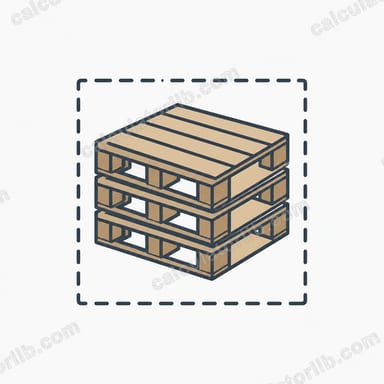
The pallet size calculator works out how many pallets physically fit into a rectangular space: a shipping container, a truck trailer, a storage bay or a plain patch of warehouse floor. It tests both pallet orientations, optionally mixes them to use the leftover strip, then multiplies by the number of stacking layers the ceiling height allows. Pallet geometry is universal, so the tool works with any standard: EUR/EPAL 120 x 80 cm, the North American GMA 48 x 40 in (122 x 102 cm), ISO 120 x 100 cm or a custom size.
How to use it
Enter the internal length, width and usable stacking height of the space in centimetres. Pick a pallet standard (or choose Custom) and enter the loaded pallet height, which is the pallet plus the goods on it. Choose Best fit to let the layout rotate some pallets, or Single orientation if your handling equipment or load plan requires every pallet to face the same way. Use the same unit for every field.
The formula explained
With \(L\) = floor length, \(W\) = floor width, \(H\) = usable height, \(p\) = pallet length, \(w\) = pallet width and \(h\) = loaded pallet height:
$$N_{\text{total}} = \max\left( \left\lfloor \frac{L}{p} \right\rfloor \left\lfloor \frac{W}{w} \right\rfloor, \; \left\lfloor \frac{L}{w} \right\rfloor \left\lfloor \frac{W}{p} \right\rfloor \right) \times \left\lfloor \frac{H}{h} \right\rfloor$$The floor brackets \(\lfloor \; \rfloor\) round down, because half a pallet position is worth nothing. In mixed mode the calculator also tries filling the remaining strip with rotated pallets, which is exactly how a container is loaded in practice.
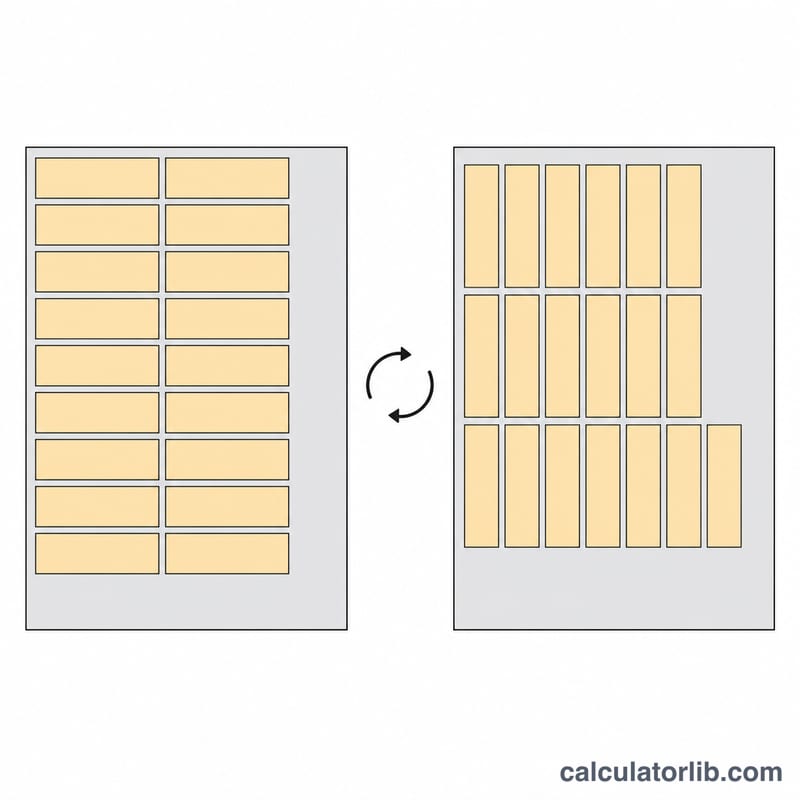
Worked example: EUR pallets in a 40 ft container
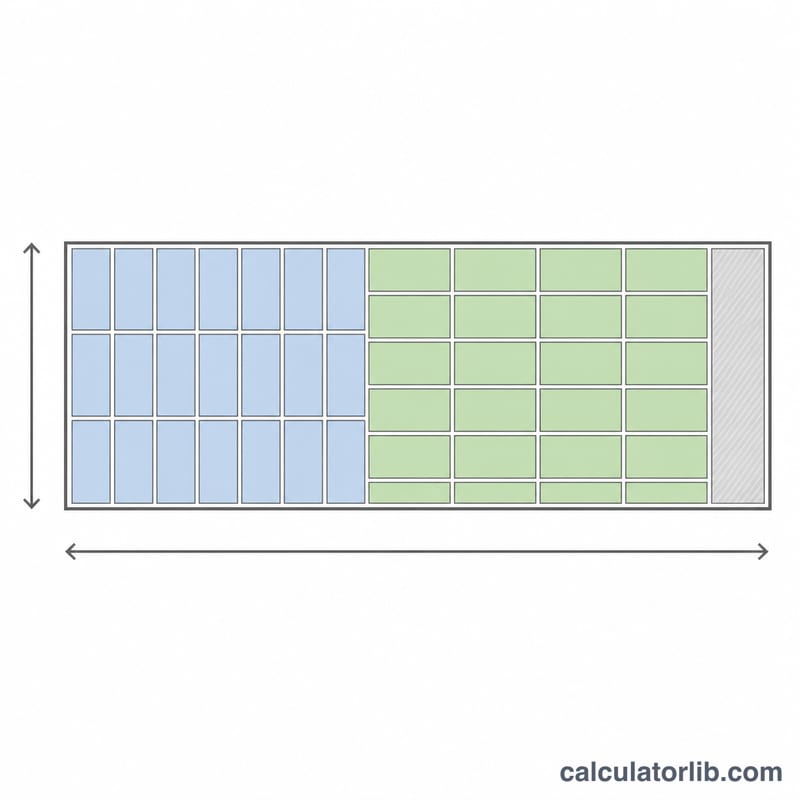
Internal floor 1203 x 235 cm, usable height 239 cm, EUR pallets 120 x 80 cm loaded to 150 cm. Pure lengthwise gives $$\left\lfloor \frac{1203}{120} \right\rfloor \times \left\lfloor \frac{235}{80} \right\rfloor = 10 \times 2 = 20$$ but the mixed pattern turns the pallets sideways in one 120 cm band and keeps a 115 cm band for a rotated row: $$\left\lfloor \frac{1203}{80} \right\rfloor \times 1 + \left\lfloor \frac{1203}{120} \right\rfloor \times 1 = 15 + 10 = 25$$
Only one layer fits (\(\lfloor 239/150 \rfloor = 1\)), so 25 pallets, with utilisation $$U = \frac{25 \times 120 \times 80}{1203 \times 235} \times 100 = 84.89\%$$
Standard Pallet and Container Dimensions
Pallet footprints are set by regional standards, so the same box quantity can require a different layout depending on where the goods ship. The table below lists the most widely used sizes. Load ratings depend on the individual pallet's construction and condition — the EPAL figures are from the EPAL/UIC specification, while the others are typical industry values and should be confirmed against your supplier's data sheet.
| Pallet standard | Footprint (mm) | Footprint (cm) | Typical empty height | Typical load rating | Main region |
|---|---|---|---|---|---|
| EUR / EPAL 1 | 1200 × 800 | 120 × 80 | 144 mm | 1,500 kg safe working load; up to 4,000 kg static on level ground | Europe |
| EUR 2 / EPAL 2 | 1200 × 1000 | 120 × 100 | 162 mm | 1,500 kg safe working load | Europe |
| EUR 3 / EPAL 3 | 1000 × 1200 | 100 × 120 | 144 mm | 1,500 kg safe working load | Europe |
| EUR 6 / EPAL 6 (half pallet) | 800 × 600 | 80 × 60 | 144 mm | roughly 500–1,000 kg (check supplier spec) | Europe (retail, display) |
| GMA 48 × 40 in | 1219 × 1016 | 121.9 × 101.6 | ~130–150 mm | ~1,100–1,400 kg typical | North America |
| ISO 1140 × 1140 mm | 1140 × 1140 | 114 × 114 | ~150 mm | varies by build | ISO 6780 size, common in sea freight |
| JIS T11 1100 × 1100 mm | 1100 × 1100 | 110 × 110 | ~144 mm | ~1,000 kg typical | Japan and much of Asia |
| UK standard 1200 × 1000 mm | 1200 × 1000 | 120 × 100 | ~145–162 mm | ~1,000–1,500 kg typical | United Kingdom |
Note on regional variants: the 1100 × 1100 mm pallet is the Asian (JIS) standard, while Australia's own standard pallet is 1165 × 1165 mm — not 1100 × 1100 mm. A 1200 × 1000 mm pallet is often called an "industrial" or "UK" pallet in Europe and is dimensionally close to, but not identical to, the North American 1219 × 1016 mm GMA pallet.
The second table gives typical internal usable dimensions — the numbers to enter as the area length, width and height. Internal sizes vary by a centimetre or two between manufacturers and container ages, so measure the actual unit when the fit is tight.
| Loading unit | Internal L × W × H (cm) | Floor area | EUR 120 × 80 per tier (strict grid) | Commonly cited floor-load capacity |
|---|---|---|---|---|
| 20 ft dry container | 589 × 234 × 239 | 13.8 m² | 8 | 11 EUR / 9–10 GMA |
| 40 ft dry container | 1203 × 234 × 239 | 28.2 m² | 20 | 25 EUR / 20–21 GMA |
| 40 ft high cube | 1203 × 234 × 269 | 28.2 m² | 20 | 25 EUR / 20–21 GMA (same floor, more stack height) |
| 45 ft high cube | 1355 × 234 × 269 | 31.7 m² | 22 | 27 EUR / 24 GMA |
| 53 ft dry van trailer (North America) | ~1600 × 251 × 272 | 40.2 m² | 34–40 | 26 GMA straight-loaded, 30 GMA turned |
| EU curtainsider / mega trailer | 1360 × 245 × 270 | 33.3 m² | 34 | 33 EUR / 26 industrial (120 × 100) |
Why the last two columns disagree: the "strict grid" column is what a rectangular row-and-column layout yields, and it is what this calculator reports. The commonly cited capacities are achieved by pinwheeling — rotating individual pallets within a block so a long and a short side share the same band of floor — plus very tight tolerances and no wrap bulge. Treat the cited figures as a best case negotiated with an experienced loader, not as a guarantee. Also remember that the door opening is smaller than the box: standard-height ISO container doors are typically about 228–229 cm high and 234 cm wide, and high-cube doors about 258 cm, all lower than the internal height in the table.
Interpreting Floor Utilisation and the Fit Result
The utilisation figure is purely two-dimensional. It compares the footprint of the pallets placed in one tier with the available floor area:
$$U = \frac{N_{\text{layer}} \times p \times w}{L \times W} \times 100\%$$It says nothing about volume (the air above a half-height load is not counted) and nothing about weight. A container can be 100% utilised on the floor and still be half empty by cube, or geometrically perfect and illegal by axle weight.
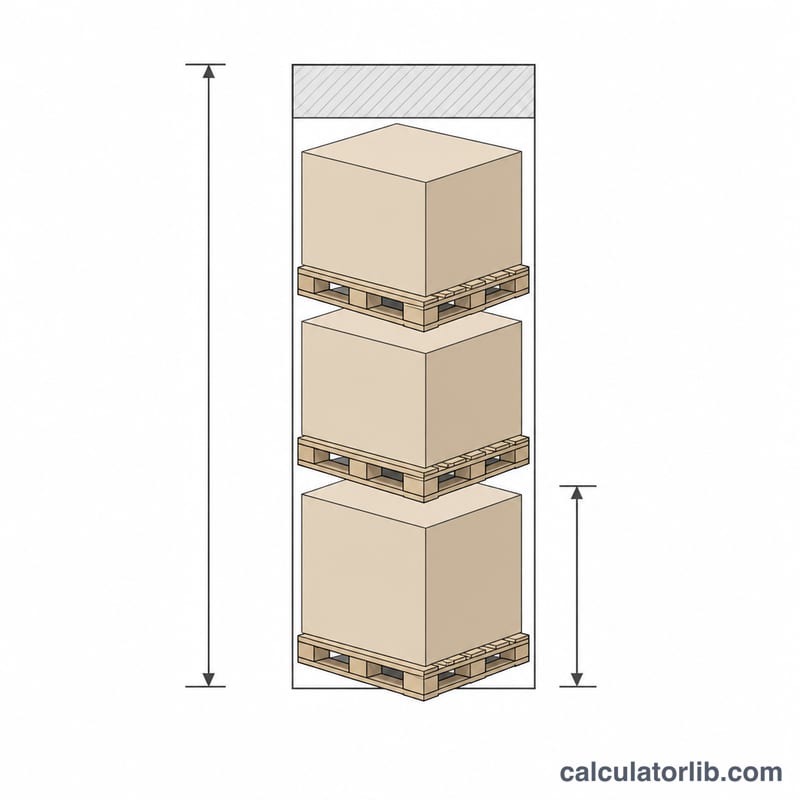
A worked example makes the two-step calculation explicit. For EUR pallets loaded two tiers high in a 40 ft high cube (1203 × 234 × 269 cm) with a loaded pallet height of 130 cm and a single orientation:
$$P_{\text{layer}} = \left\lfloor \frac{1203}{120} \right\rfloor \left\lfloor \frac{234}{80} \right\rfloor = 10 \times 2 = 20$$$$N = 20 \times \left\lfloor \frac{269}{130} \right\rfloor = 20 \times 2 = \mathbf{40}$$So the container takes 40 pallets, at a floor utilisation of 192,000 cm² ÷ 281,502 cm² ≈ 68%. The 269 cm of height only yields a second tier because the loaded pallets are 130 cm — at 140 cm the floor result would halve to 20.
Typical bands. For EUR pallets in an ISO container, a strict grid lands near 68% because two 80 cm widths use only 160 cm of the 234 cm width; mixing orientations or pinwheeling pushes real loads to roughly 80–90% (25 EUR pallets in a 40 ft is about 85%). GMA 121.9 × 101.6 cm pallets sit differently in the same box: two 101.6 cm widths fit with 31 cm to spare, but two 121.9 cm lengths do not fit across the 234 cm width at all, so the grid gives 18 per tier (~79%) and leaves about a metre of unusable length at the door end. Pallets sized for ISO containers (1140 × 1140 mm, or 120 × 100 cm) generally beat North American sizes in sea freight for exactly this reason. Anything above roughly 90% should be treated as suspicious unless a professional load plan confirms it.
A fit result is an upper bound. The geometry is the first filter, not the last. Constraints that routinely reduce the number:
- Payload. A 40 ft container's plated payload is roughly 26–28 t, but national road limits usually bite first — in the United States the federal interstate gross vehicle weight limit of 80,000 lb (36.3 t) can leave under 20 t of cargo on an intermodal chassis, and most EU states cap combinations at 40 t gross (44 t for some intermodal movements). Check the rule for your route, not a generic figure.
- Axle-weight distribution. Even within the gross limit, a dense load concentrated at one end can overload an axle group. Heavy pallets belong low and spread across the length.
- Overhang and wrap bulge. Stretch-wrap and boxes that extend past the deck add a few centimetres per side, which is enough to lose a whole row.
- Door opening. A 269 cm high cube loads through a door around 258 cm, and the forklift needs clearance above the load to set it down.
- Stackability. Double-stacking only works if the lower load is crush-resistant or carried by pallet collars, a cap pallet or a rack system. If the goods cannot take the weight, the layer count is 1 regardless of the height arithmetic.
Weight, not space, is often the binding constraint: a 53 ft trailer that geometrically accepts 30 turned GMA pallets in one tier is already over a typical road weight limit at 700 kg per pallet.
Practical Loading Tips
- Measure the load, not the pallet. Enter the actual footprint of the wrapped unit. Add the real overhang and subtract nothing you cannot verify — in practice, allowing 2–5 cm per dimension for shrink-wrap bulge and box overhang (so 125 × 85 cm for a wrapped EUR pallet) stops a layout that only works on paper.
- Use the door height as your height limit. Measure the internal door opening, not just the internal container height, and keep 5–10 cm of clearance above the load so the forklift can lift off and set down cleanly. For a 40 ft high cube that usually means working to about 250 cm of usable load height, not 269 cm.
- Run the weight check alongside the geometry. Multiply the pallet count by the gross weight per pallet and compare it with the container's plated payload and with the road weight limit on your route. The lower of the two governs. Weight-dense goods (liquids, tiles, paper, metal) almost always hit the limit before the floor runs out.
- Keep heavy pallets low and distributed. Place the heaviest units on the floor tier and spread them along the length so the weight sits over the axles rather than bunched at the doors or the nose. Light, crush-sensitive pallets go on top.
- Choose the orientation to match the handling, not only the maximum count. A mixed or pinwheeled layout fits more pallets, but if the shipment must come off in a defined sequence, is multi-drop, or is handled by a clamp or single-fork setup, a single consistent orientation is usually faster and safer — and the few pallets lost are cheaper than a reworked load.
- Protect the gaps. Any slack left over by the grid becomes movement in transit. Plan for dunnage bags, void fill or load bars, and remember that those take space too.
- Confirm with the carrier before booking. Send your layout and total weight to the carrier or forwarder and ask for their own load plan. They know the actual container or trailer, the local axle rules and the terminal's restrictions; a 10-minute confirmation avoids a refused or re-stuffed load.
Container and trailer dimensions, weight limits and pallet standards differ by country and by operator. The figures used here are typical industry values for ISO containers, EU curtainsiders and North American 53 ft dry vans — always verify against the specific equipment and the regulations that apply on your route.
FAQ
Why 25 and not 20 EUR pallets? Because real loaders rotate part of the load. The 235 cm width takes two 80 cm pallets plus a 75 cm gap, but one 120 cm band plus sideways pallets uses the width far better.
Does it account for weight? No. The result is purely geometric. Always check payload, axle loads and whether the goods can take a pallet stacked on top.
Can I work in inches? Yes, as long as every dimension uses inches. The counts and the utilisation percentage are unit-independent.