What hop utilization means
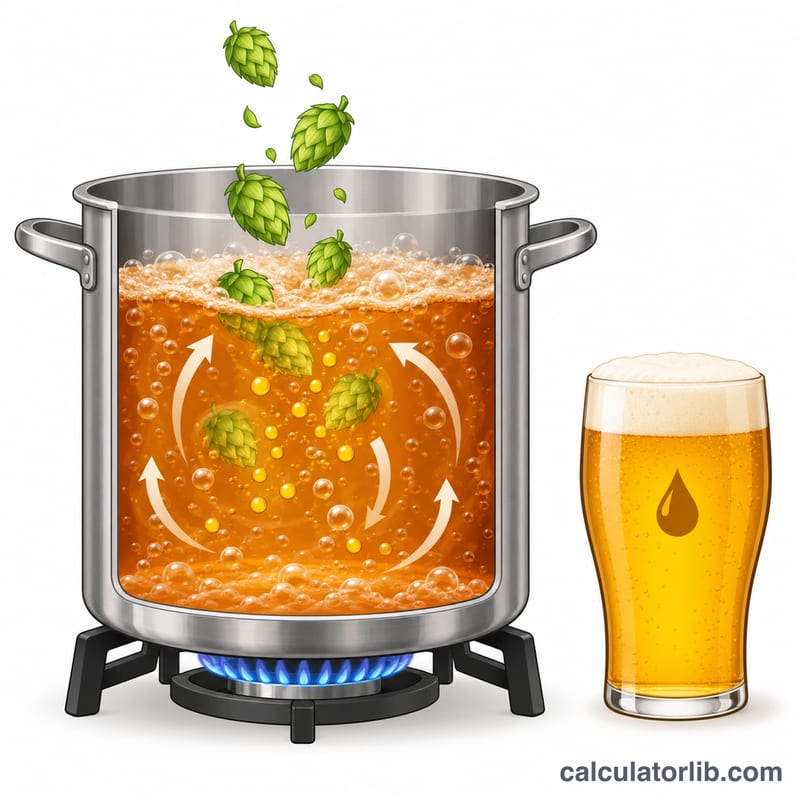
Hop cones carry alpha acids, which are almost insoluble until heat converts them into bitter iso-alpha acids. Utilization is the fraction of the alpha acids you threw in the kettle that survive that conversion and stay dissolved in the finished beer. It is never close to 100 percent: a long 60-minute boil in normal-gravity wort typically reaches only about 23 percent. This calculator uses the Tinseth model, the industry standard for homebrew recipe software, and reports both the utilization percentage and the bitterness it produces.
How to use it
Enter the hop weight in grams, the alpha acid rating printed on the hop package, the time that addition spends in the boil, the batch volume in litres, and the average gravity of the wort during the boil. The tool returns utilization, estimated IBU, and the two factors that multiply together to give utilization, so you can see which one is limiting you.
The formula explained
Tinseth splits utilization into two independent effects. Thicker, sweeter wort suppresses isomerisation, and longer boils extract more:
$$U = 1.65 \times 0.000125^{\,(G-1)} \times \frac{1 - e^{-0.04T}}{4.15}$$Here \(G\) = specific gravity of the boiling wort, \(T\) = boil time in minutes. The bitterness then follows from the mass of alpha acids and the volume they are diluted into:
$$\text{IBU} = \frac{W \times A \times U \times 1000}{V}$$with \(W\) = hop grams, \(A\) = alpha acid as a decimal, \(V\) = litres.
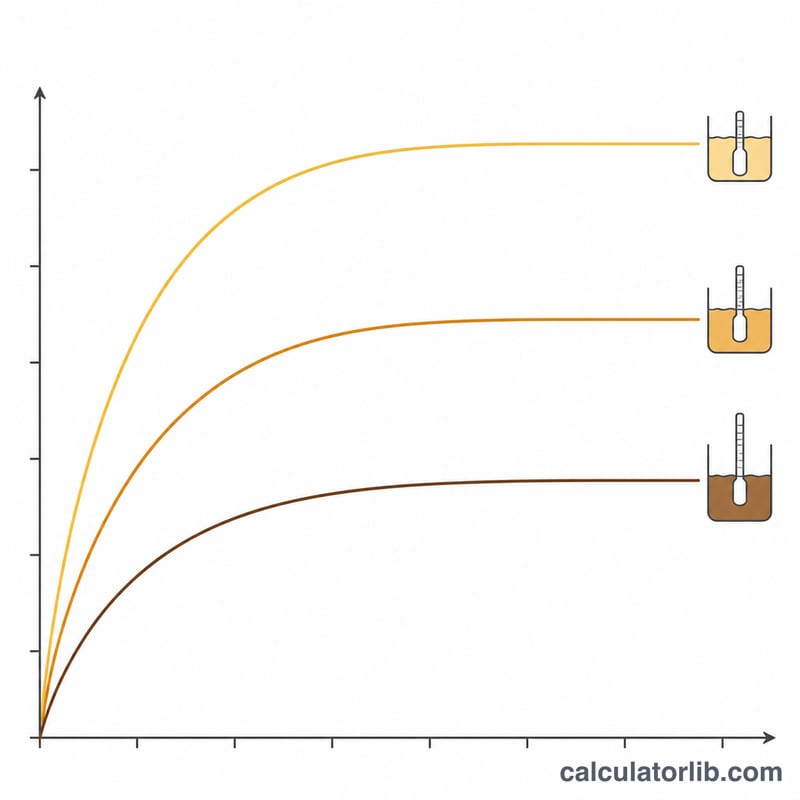
Utilization is the fraction of added alpha acids that actually ends up as dissolved iso-alpha acids. Whirlpool, dry hop and flameout additions contribute far less than this boil model predicts.
Worked example
28 g of 10 percent alpha hops, boiled 60 minutes in 1.050 wort, into a 20 litre batch:
$$U = 1.65 \times 0.000125^{0.05} \times \frac{1 - e^{-2.4}}{4.15} = 1.0528 \times 0.2191 = 0.2307$$$$\text{IBU} = \frac{28 \times 0.10 \times 0.2307 \times 1000}{20} = 32.3$$So about 23.1 percent utilization and roughly 32 IBU.
Typical IBU Ranges by Beer Style
The figures below are the bitterness and original-gravity ranges published in the BJCP 2021 Style Guidelines (Beer Judge Certification Program, a US-based organisation whose guidelines are widely used internationally for homebrew competitions). They describe the judged style, not a legal or national standard — commercial examples regularly sit outside these windows, and other systems (e.g. Brewers Association style guidelines) draw the lines slightly differently.
| Style | Typical IBU | Typical OG (SG) | Approx. BU:GU |
|---|---|---|---|
| American Light Lager | 8–12 | 1.028–1.040 | 0.25–0.35 |
| Weissbier | 8–15 | 1.044–1.052 | 0.18–0.30 |
| Munich Helles | 16–22 | 1.044–1.048 | 0.35–0.47 |
| Saison | 20–35 | 1.048–1.065 | 0.40–0.55 |
| English Bitter (Ordinary/Best) | 25–35 | 1.030–1.048 | 0.70–0.85 |
| Irish Stout | 25–45 | 1.036–1.044 | 0.70–1.05 |
| Czech Premium Pale Lager | 30–45 | 1.044–1.060 | 0.65–0.80 |
| American Pale Ale | 30–50 | 1.045–1.060 | 0.65–0.85 |
| American Stout | 35–75 | 1.050–1.075 | 0.65–1.05 |
| American IPA | 40–70 | 1.056–1.070 | 0.70–1.00 |
| Double IPA | 60–120 | 1.065–1.085 | 0.90–1.45 |
Hitting a target: a worked American IPA addition
A 23 L batch boiled at 1.060 with a single 60-minute charge of 60 g of 11 % alpha acid hops gives \(U = 0.962 \times 0.2191 = 0.2108\) and
$$\text{IBU} = \frac{60 \times 0.11 \times 1000 \times 0.2108}{23} \approx 60.5$$i.e. about 60.5 IBU — the upper half of the American IPA range before any late or whirlpool additions are counted.
Balance: the BU:GU ratio
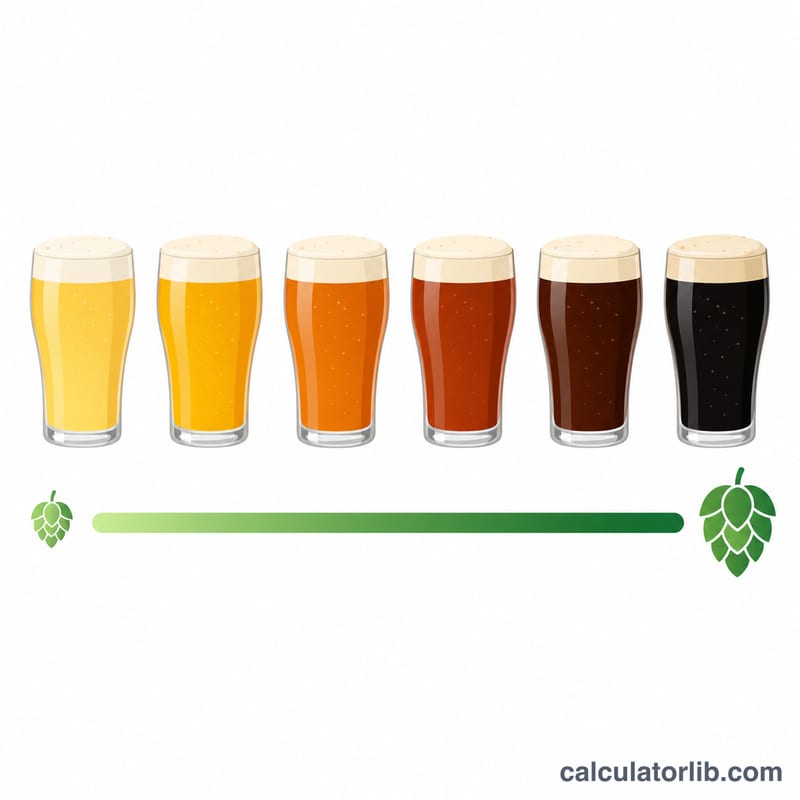
Perceived bitterness depends on how much malt sweetness it has to balance, so brewers compare IBU with gravity points (the last two digits of the original gravity, i.e. \((OG-1)\times 1000\)):
$$\text{BU:GU} = \frac{\text{IBU}}{(OG - 1) \times 1000}$$- ≈ 0.5 — balanced; malt and hops roughly even.
- below 0.4 — malt-forward, sweet-leaning (helles, weissbier, many lagers and malty ales).
- above 0.8 — aggressively bitter, hop-dominant (bitters, IPAs, dry stouts).
So 60 IBU in a 1.070 beer (BU:GU 0.86) tastes far less harsh than the same 60 IBU in a 1.045 beer (BU:GU 1.33). Also remember that IBU is a measure of iso-alpha acid concentration, not of perceived bitterness: water sulphate, roast malt, residual sweetness and carbonation all shift how bitter the finished beer actually tastes.
Hop and Volume Unit Conversions
The Tinseth equation used here is metric: hop weight in grams, batch volume in litres, which makes IBU come out directly in milligrams of iso-alpha acid per litre. If your recipe is written in ounces and US gallons, convert first.
Hop mass
1 oz (avoirdupois) = 28.3495 g, usually rounded to 28.35 g.
| Ounces | Grams |
|---|---|
| 0.5 oz | 14.17 g |
| 1 oz | 28.35 g |
| 1.5 oz | 42.52 g |
| 2 oz | 56.70 g |
| 4 oz | 113.40 g |
Batch volume
1 US liquid gallon = 3.785 L; 1 imperial (UK) gallon = 4.546 L. The two differ by about 20 %, so a recipe labelled only "5 gallons" is ambiguous — check whether it is a US (18.93 L) or UK (22.73 L) source.
| US gallons | Litres |
|---|---|
| 1 | 3.79 |
| 3 | 11.36 |
| 5 | 18.93 |
| 5.5 | 20.82 |
| 6 | 22.71 |
| 10 | 37.85 |
Gravity: specific gravity and degrees Plato
A convenient approximation used throughout brewing is
$$^{\circ}\mathrm{P} \approx \frac{(SG - 1) \times 1000}{4}$$| Specific gravity | Gravity points | Approx. °P (÷4 rule) |
|---|---|---|
| 1.030 | 30 | 7.5 |
| 1.040 | 40 | 10.0 |
| 1.050 | 50 | 12.5 |
| 1.060 | 60 | 15.0 |
| 1.070 | 70 | 17.5 |
| 1.080 | 80 | 20.0 |
The ÷4 rule is a linear approximation; the exact sugar tables give slightly lower values at high gravity (1.060 is nearer 14.7 °P), so for the bigness factor always enter specific gravity rather than a Plato-derived estimate. Enter gravity as 1.050, not 50 or 12.5.
Alpha acid percentage
Alpha acid is printed on the hop package as a percentage and must become a decimal fraction inside the mass term: 5 % → 0.05, 8.5 % → 0.085, 12 % → 0.12, 16 % → 0.16. This calculator takes the percentage itself (e.g. 12) and divides by 100 internally. Always use the figure from the current lot's analysis — alpha acid drifts between harvest years and drops with warm or oxygen-exposed storage.
Why the IBU result needs no unit conversion
IBU is defined as a concentration — milligrams of iso-alpha acid per litre of beer — so it is unit-independent and the same number is quoted worldwide. What matters is that mass and volume are consistent: grams divided by litres, with the factor 1000 converting grams to milligrams. Mixing ounces with litres (or grams with gallons) silently scales the result by 28.35 or 3.785 and is the single most common source of nonsensical IBU numbers.
FAQ
Why does my utilization drop in a big stout? The bigness factor falls as gravity rises, so the same hop charge in 1.080 wort yields noticeably fewer IBU than in 1.040 wort.
Does a 5-minute addition add bitterness? Very little. At 5 minutes the boil time factor is about 0.044, roughly a fifth of the 60-minute value, which is why late hops are for aroma.
Do pellets change the answer? Pellets usually give around 10 percent more utilization than whole cones. Many brewers apply a correction factor to the result rather than changing the model.