What this calculator does
International Bitterness Units (IBU) measure the concentration of isomerized alpha acids in finished beer, roughly in milligrams per liter. This tool estimates IBU with the Tinseth model, the most widely used equation in homebrewing software. It is a universal brewing calculation and applies to any recipe in metric units, regardless of country.
How to use it
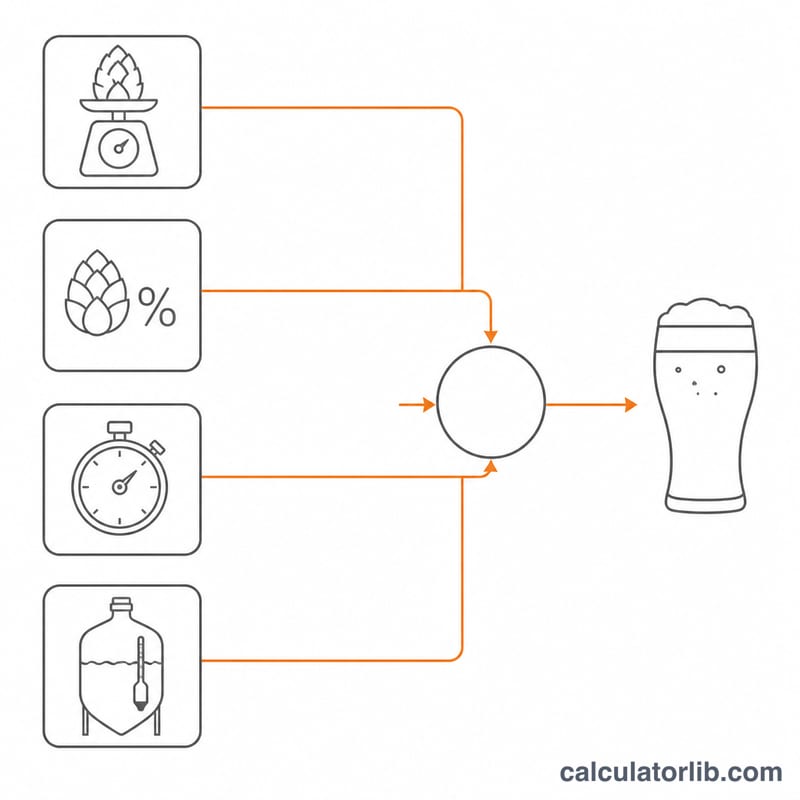
Enter the hop weight in grams, the alpha acid percentage printed on the hop package, the time the addition boils, the finished batch volume in liters, and the average specific gravity of the wort during the boil. Repeat once per hop addition and add the results together to get the total IBU of the recipe.
The formula explained
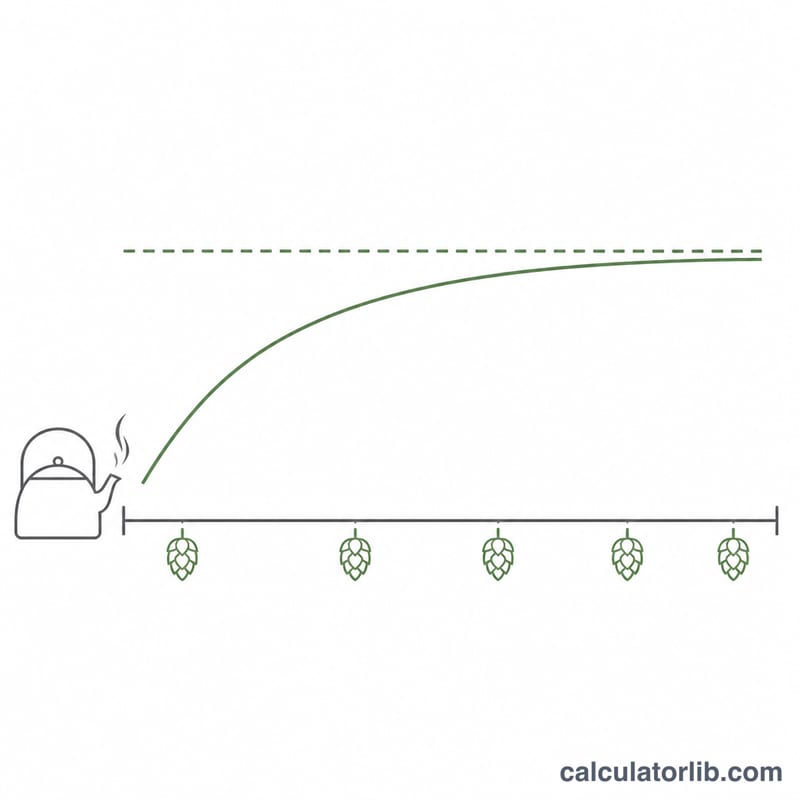
Utilization \(U\) falls as wort gravity rises and grows as boil time increases:
$$U = 1.65 \times 0.000125^{\,G-1} \times \frac{1 - e^{-0.04t}}{4.15}$$where \(G\) = average boil specific gravity and \(t\) = boil time in minutes. The bitterness is then
$$\text{IBU} = U \times \frac{\text{AA} \times W \times 1000}{V}$$with \(\text{AA}\) = alpha acid as a decimal fraction, \(W\) = hop weight in grams and \(V\) = batch volume in liters.
Worked example
Add 28 g of 10% alpha hops for 60 minutes to a 20 L batch boiled at 1.050:
$$U = 1.65 \times 0.000125^{0.05} \times \frac{1 - e^{-2.4}}{4.15} = 0.2307$$$$\text{IBU} = 0.2307 \times \frac{0.10 \times 28 \times 1000}{20} = 0.2307 \times 140 = 32.3$$So the addition contributes about 32 IBU.
Typical IBU Ranges by Beer Style
The IBU figure your recipe targets only makes sense next to the beer's gravity and malt character. The table below lists published ranges from the BJCP 2021 Style Guidelines (a US-based competition style system used internationally; the Brewers Association guidelines give similar but not identical numbers). Original gravity (OG) is shown alongside, because the same 35 IBU reads as sharply bitter in a 1.035 bitter and mild in a 1.080 barleywine.
| Style | IBU range | Typical OG range | Approx. BU:GU at mid-range |
|---|---|---|---|
| American Light Lager | 8–12 | 1.028–1.040 | 0.29 |
| Munich Helles | 16–22 | 1.044–1.048 | 0.41 |
| Czech Premium Pale Lager | 30–45 | 1.048–1.060 | 0.69 |
| Weissbier | 8–15 | 1.044–1.052 | 0.24 |
| Belgian Witbier | 8–20 | 1.044–1.052 | 0.29 |
| English (Ordinary) Bitter | 25–35 | 1.030–1.039 | 0.87 |
| Irish Stout | 25–45 | 1.036–1.044 | 0.88 |
| American Pale Ale | 30–50 | 1.045–1.060 | 0.76 |
| American IPA | 40–70 | 1.056–1.070 | 0.87 |
| Double IPA | 60–120 | 1.065–1.085 | 1.20 |
| American Barleywine | 50–100 | 1.080–1.120 | 0.75 |
Reading the BU:GU ratio
BU:GU compares bitterness units to gravity units, where gravity units are the last two digits of the OG (1.050 → 50 GU):
$$\text{BU:GU} = \frac{\text{IBU}}{ {1000 \times (\text{OG} - 1)}}$$
For example, 45 IBU at OG 1.060 gives \(45 \div 60 = 0.75\). As a rough balance guide used by many brewers:
- ≈ 0.3–0.5 — malt-forward and sweet-leaning (helles, Scottish ales, doppelbock).
- ≈ 0.6–0.8 — balanced, with bitterness supporting the malt (pale ale, amber ale).
- ≈ 1.0 — clearly balanced toward bitterness; the malt is a backbone, not the focus.
- > 1.5 — aggressively hoppy and dry-tasting; common only in deliberately bracing session IPAs and some West Coast styles.
Style ranges are descriptive, not prescriptive: a calculated IBU 5–10 points outside a range is rarely detectable, whereas whirlpool and dry hopping change perceived bitterness without moving the Tinseth number at all.
Alpha Acid Percentages of Common Hop Varieties
Alpha acid (AA) percentage is the single input the IBU result scales with linearly — double the AA and you double the IBU. The table gives commonly published typical ranges for widely grown varieties. These varieties are grown in several countries (chiefly the USA, Germany, the Czech Republic, the UK, Australia and New Zealand), and the same variety grown in different regions can sit at different points in its range.
| Variety | Typical alpha acid | Usual origin / common use |
|---|---|---|
| Saaz | 3–4.5% | Czech; noble aroma, Czech pale lager |
| Hallertau Mittelfrüh | 3–5.5% | German; noble aroma, helles and pils |
| Tettnang | 3.5–5.5% | German; noble aroma, lagers and wheat beers |
| Fuggle | 4–5.5% | English; earthy, bitters and milds |
| Willamette | 4–6% | US; mild, English-style and amber ales |
| Cascade | 4.5–7% | US; grapefruit/citrus, American pale ale |
| East Kent Goldings | 4.5–6.5% | English; floral/honey, bitters |
| Amarillo | 8–11% | US; orange citrus, dual purpose |
| Centennial | 9–11.5% | US; citrus/floral, dual purpose |
| Nelson Sauvin | 10–13% | New Zealand; white-wine character |
| Citra | 11–13% | US; tropical/citrus, late and dry hop |
| Mosaic | 11.5–13.5% | US; berry/tropical, late and dry hop |
| Simcoe | 12–14% | US; pine/passionfruit, dual purpose |
| Chinook | 12–14% | US; pine/resin, bittering and aroma |
| Magnum | 12–14% | German; clean bittering |
| Galaxy | 13–15% | Australian; peach/passionfruit |
| Columbus / CTZ | 14–17% | US; pungent, high-alpha bittering |
| Warrior | 15–17% | US; clean, high-alpha bittering |
Always prefer the lot analysis
These are harvest-dependent ranges, not fixed constants. Alpha acid content varies year to year with weather, and between farms and regions within a single harvest. Every commercial hop package carries a printed lot analysis with the measured alpha acid for that specific lot — that number always overrides this table. Entering the table midpoint when the packet says 6.2% can shift your calculated IBU by 20% or more.
Alpha acid loss in storage
Alpha acids degrade over time through oxidation. Vacuum-sealed pellets kept in a freezer lose very little per year, but hops stored warm, in air, or in leaf form can lose roughly 5–10% of their alpha acid per year (and considerably more at room temperature in a permeable bag). Hop analyses are usually quoted with a hop storage index (HSI) that describes this rate. If you are brewing with hops of unknown age and poor storage, reduce the alpha acid figure you enter accordingly:
$$\text{AA}_{\text{effective}} \approx \text{AA}_{\text{printed}} \times (1 - r)^{y}$$
where \(r\) is the annual fractional loss and \(y\) the age in years. A 12% hop stored two years at \(r = 0.08\) is about \(12 \times 0.92^{2} = 10.2\%\).
How Boil Time and Gravity Change the Result
The Tinseth model splits into a concentration term \(C\) — which is pure arithmetic on weight, alpha acid and volume — and a utilization term \(U\), which is where boil time and boil gravity act. Both tables below hold the hop charge fixed at 28 g of 10% alpha acid in a 20 L batch, so \(C\) is constant throughout:
$$C = \frac{10}{100} \times \frac{28 \times 1000}{20} = 0.10 \times 1400 = 140\ \text{mg/L}$$
Every IBU below is simply \(U \times 140\), rounded to one decimal, so you can check any row by hand.
Varying boil time at boil gravity 1.050
At \(G = 1.050\) the gravity factor is \(1.65 \times 0.000125^{\,0.050} = 1.0528\), leaving \(U = 1.0528 \times \frac{1 - e^{-0.04t}}{4.15}\).
| Boil time (min) | Utilization \(U\) | IBU | Share of the 90-min result |
|---|---|---|---|
| 5 | 4.6% | 6.4 | 19% |
| 10 | 8.4% | 11.7 | 34% |
| 15 | 11.4% | 16.0 | 46% |
| 30 | 17.7% | 24.8 | 72% |
| 45 | 21.2% | 29.6 | 86% |
| 60 | 23.1% | 32.3 | 94% |
| 75 | 24.1% | 33.7 | 98% |
| 90 | 24.7% | 34.5 | 100% |
The curve flattens hard. Going from 5 to 30 minutes nearly quadruples the bitterness, but the last half hour (60 → 90 min) adds only about 2 IBU — roughly 7%. That is why extending a bittering addition past 60 minutes is an inefficient way to add bitterness, while trimming a 60-minute addition to 30 minutes costs you about a quarter of it.
Varying boil gravity at a fixed 60-minute boil
Here the time factor is fixed at \(\frac{1 - e^{-2.4}}{4.15} = 0.2191\), and only \(1.65 \times 0.000125^{\,G-1}\) changes.
| Boil gravity | Gravity factor | Utilization \(U\) | IBU |
|---|---|---|---|
| 1.040 | 1.1518 | 25.2% | 35.3 |
| 1.050 | 1.0528 | 23.1% | 32.3 |
| 1.060 | 0.9623 | 21.1% | 29.5 |
| 1.070 | 0.8796 | 19.3% | 27.0 |
| 1.080 | 0.8040 | 17.6% | 24.7 |
Denser wort extracts iso-alpha acids less efficiently: the same hop charge that gives 35.3 IBU in a 1.040 wort gives only 24.7 IBU at 1.080 — a 30% loss. This matters most for full-volume boils of strong beers and for concentrated extract boils, where the kettle gravity is far higher than the final batch gravity. Enter the gravity of the boil, not the original gravity of the finished, topped-up batch, or the calculator will overstate your bitterness.
What the model does not capture
Tinseth is an empirical fit to typical homebrew and small-scale practice, so treat single-digit differences as noise. Whirlpool and hop-stand additions below boiling, dry hops, kettle trub losses, pellet-versus-leaf form, wort pH and fermentation/filtration losses all shift real measured IBU relative to the calculated figure. Use the number for consistent recipe-to-recipe comparison rather than as a laboratory prediction.
FAQ
Why does higher gravity lower the IBU? Dense, sugary wort extracts and retains less isomerized alpha acid, so the same hops bitter a strong beer less than a small beer.
Do late and whirlpool hops count? Additions under about 10 minutes contribute very little bitterness in this model, and dry hops contribute essentially none.
How accurate is the estimate? Expect roughly plus or minus 15–20%. Boil vigor, hop age, pellet versus cone, and yeast absorption all shift the real measured value.