What is the IBU Bitterness Calculator?
The IBU Bitterness Calculator estimates the International Bitterness Units of a beer recipe. IBU is a measure of the concentration of isomerized alpha acids, the compounds from hops that give beer its bitter character. This tool uses the widely trusted Tinseth model, favored by homebrewers for its accuracy across a range of boil times and gravities.
The formula explained
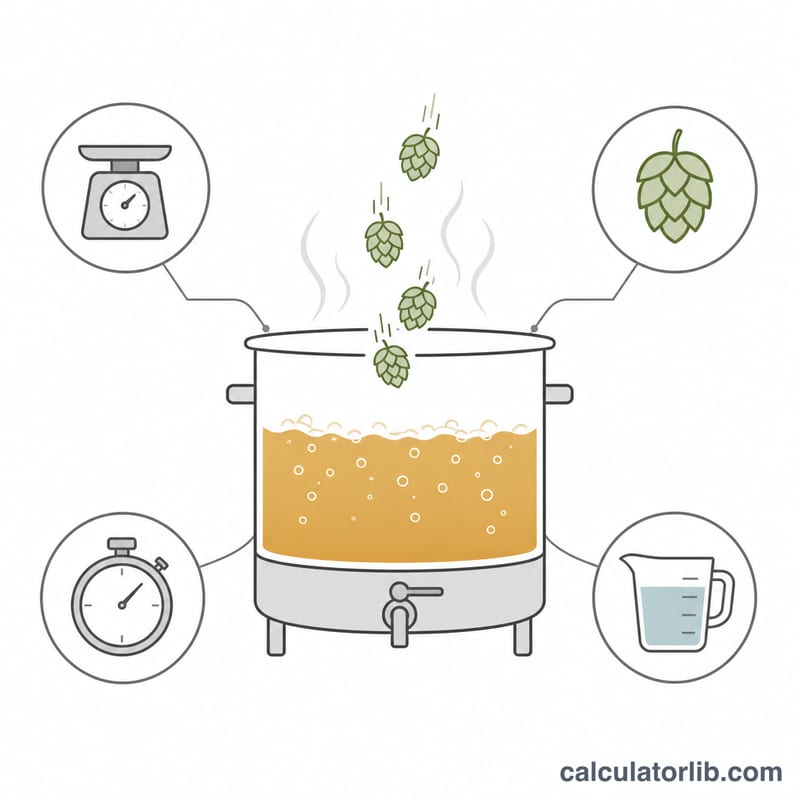
Bitterness is the concentration of alpha acids added to the wort multiplied by how efficiently those acids are isomerized, known as utilization:
$$\text{IBU} = \frac{ {\text{AA} \times W \times 1000}}{V} \times U$$Here \(\text{AA}\) = alpha acid as a decimal, \(W\) = hop weight in grams, \(V\) = batch volume in litres, and \(U\) = utilization. Utilization itself depends on original gravity \(G\) and boil time \(t\) in minutes:
$$U = 1.65 \times 0.000125^{(G-1)} \times \frac{1 - e^{-0.04t}}{4.15}$$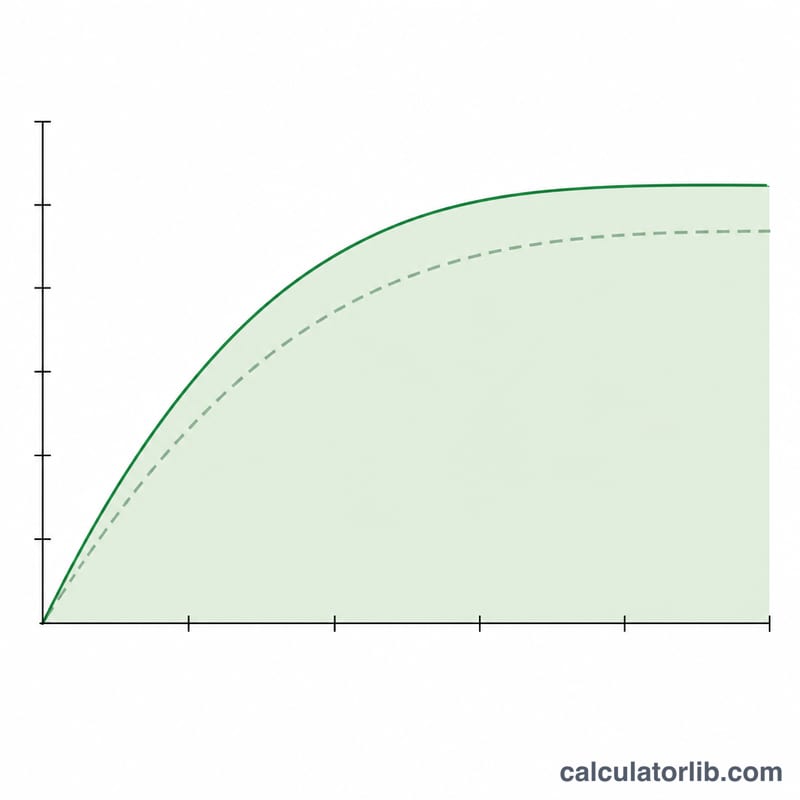
How to use it
Enter your hop weight in grams, the alpha acid percentage printed on the hop package, the boil (addition) time in minutes, the batch volume in litres, and the wort original gravity. The calculator returns the estimated IBU along with the hop utilization and the alpha acid concentration in the wort.
Worked example
For 28 g of 10% alpha hops boiled 60 minutes in 20 L at gravity 1.050, the bigness factor is \(1.65 \times 0.000125^{0.05} = 1.0528\) and the time factor is \(\tfrac{1 - e^{-2.4}}{4.15} = 0.2191\), giving \(U = 0.2307\). The alpha concentration is \(\tfrac{0.10 \times 28 \times 1000}{20} = 140\) mg/L, so:
$$\text{IBU} = 140 \times 0.2307 = 32.3$$Typical IBU Ranges by Beer Style
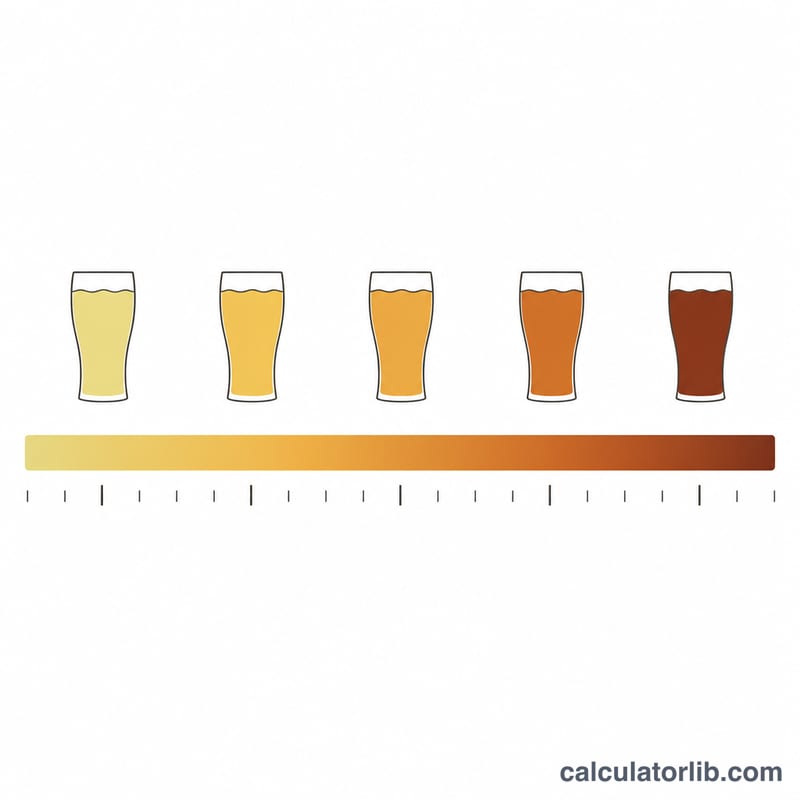
The table below lists approximate bitterness ranges for several common beer styles. These figures are drawn from published beer style guidelines and are useful as a target when you interpret the IBU your recipe produces. They are ranges, not fixed values, and they overlap between styles because perceived bitterness also depends on malt, gravity, and hop character.
| Beer style | Approx. IBU range |
|---|---|
| American Light Lager | 8–12 |
| Pilsner | 25–45 |
| Pale Ale | 30–50 |
| IPA | 40–70 |
| Double / Imperial IPA | 60–100+ |
| Stout | 35–75 |
| Barleywine | 35–100 |
Source note: These ranges are consolidated from the Beer Judge Certification Program (BJCP) style guidelines, a widely used reference maintained by a US-based organization for beer competitions and homebrewing. The BJCP defines many narrower sub-styles (for example German Pils vs. Czech Premium Pale Lager, or English vs. American Barleywine), so the values above are grouped approximations. Other guidelines, such as those from the Brewers Association (also US-based), define style boundaries slightly differently, so treat any single figure as indicative rather than definitive.
Interpreting Your IBU Result
An IBU (International Bitterness Unit) is defined as a concentration: it corresponds to the amount of isomerized alpha acids (iso-alpha-acids) dissolved in the beer, measured in milligrams per litre (mg/L). Roughly speaking, 1 IBU ≈ 1 mg/L of iso-alpha-acids. The Tinseth formula this calculator uses estimates that concentration from your hop weight, alpha-acid percentage, boil time, batch volume, and gravity:
$$\text{IBU} = \frac{\text{AA} \times W \times 1000}{V} \times U$$
where \(U\) is the hop utilization factor, which the Tinseth model derives from boil time and wort gravity (higher gravity and shorter boils reduce utilization).
IBU is an estimated concentration, not a taste score. A laboratory IBU is a measured chemical value, and a calculated IBU is a model-based estimate of that same value. Neither is a direct scale of how bitter the beer tastes. Two beers with an identical IBU can taste very different in bitterness because sweetness, residual malt, alcohol, carbonation, and water chemistry all modify perception.
A common way to gauge perceived balance is the BU:GU ratio (bitterness units to gravity units), which compares IBU to the wort's gravity points (the digits after the decimal in the original gravity, so 1.050 = 50 points):
$$\text{BU:GU} = \frac{\text{IBU}}{\text{gravity points}}$$
For example, a hop addition of 28 g at 10% alpha acid, boiled 60 minutes in 20 L at gravity 1.050, gives approximately \( \frac{0.10 \times 28 \times 1000}{20} \times 0.231 \approx \) 32 IBU. Against 50 gravity points that is a BU:GU of about 0.65, which reads as moderately balanced toward malt. Ratios well below 0.5 tend to taste malt-forward, while ratios above 0.8–1.0 taste distinctly bitter.
In practical terms, brewed beers span roughly 0 to just over 100 IBU. Very low values (under about 10) are near the threshold of detectable bitterness, mid-range values (20–45) cover most everyday styles, and values above 70–100+ are found in heavily hopped styles such as Double IPAs. Extremely high calculated IBUs are also somewhat theoretical, because there is a practical ceiling to how much iso-alpha-acid actually stays dissolved in beer.
FAQ
Does gravity really matter? Yes. Higher-gravity wort reduces utilization, so a bigger beer needs more hops for the same bitterness.
Which alpha acid value should I use? Use the percentage on your specific hop lot, since it varies by harvest.
Why Tinseth? The Tinseth model reflects real-world isomerization better than simple linear estimates, especially for typical 15-90 minute additions.