What this calculator does
The Cessna 172 Weight and Balance Calculator estimates your airplane's total loaded weight and its center of gravity (CG) so you can compare the loading with the weight and CG limits in your aircraft's POH before departure. Loading an airplane outside its approved weight or CG envelope can make it difficult or impossible to control, so this check is a required part of preflight planning.
The formula explained
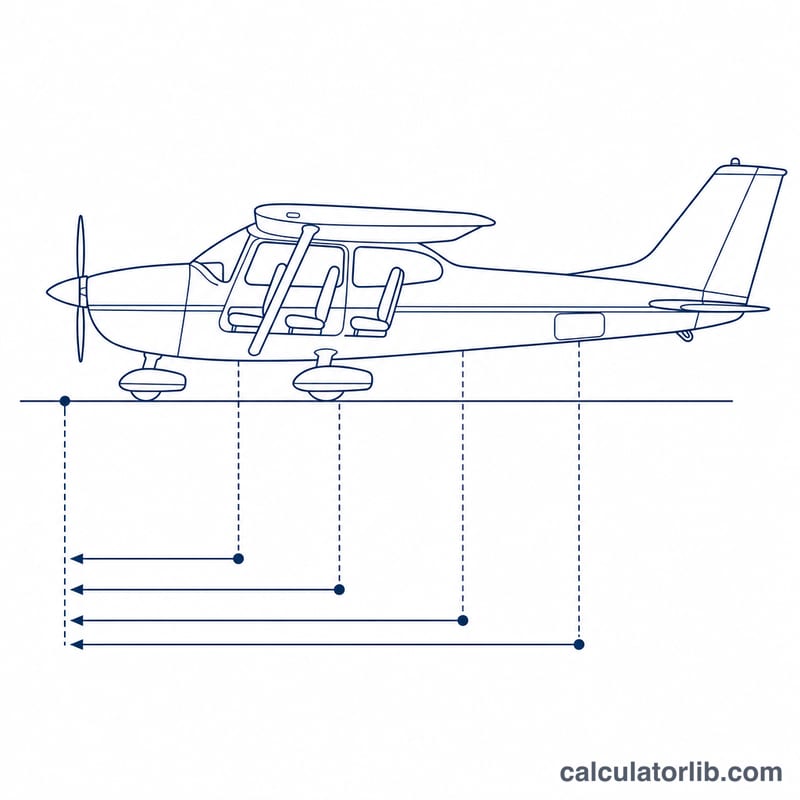
Weight and balance uses moments. A moment is a weight multiplied by its arm, the horizontal distance from the datum to that item. Summing all moments and dividing by total weight gives the CG:
$$\text{CG} = \frac{\sum (w_i \times \text{arm}_i)}{\sum w_i}$$
Here \(w_i\) is the weight at each station (empty aircraft, front seats, rear seats, fuel, baggage) and \(\text{arm}_i\) is that station's arm in inches. Typical arms used are 37 in front seats, 73 in rear seats, 48 in fuel, and 95 in baggage. Fuel weight is gallons times 6 lb/gal.
How to use it
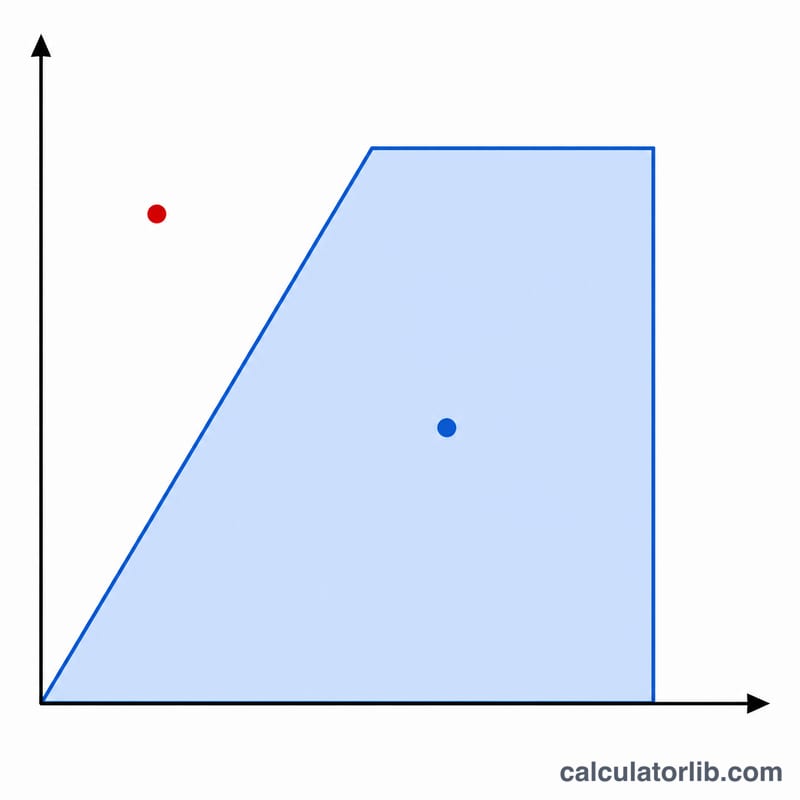
Enter your aircraft's empty weight and empty-weight arm from its current weight and balance sheet, then add the front and rear occupant weights, fuel in gallons, and baggage. The tool returns gross weight, total moment and CG, and shows whether both fall inside the simplified range (max 2,450 lb; CG 35.0 to 47.3 in).
Worked example
With empty weight 1,500 lb at arm 39 in, 340 lb up front, 40 gal fuel (240 lb) and 20 lb baggage, total weight is 2,100 lb and total moment is 84,500 lb-in:
$$\text{CG} = \frac{84500}{2100} = 40.24\ \text{in}$$
Both 2,100 lb and 40.24 in fall inside the simplified range used here (max 2,450 lb; CG 35.0–47.3 in). Check the same point against the envelope in your aircraft's POH.
Station Arms and Loading Limits
The Cessna 172 is a US, FAA-certificated aircraft, and its weight and balance data are published in US customary units — pounds (lb) and inches (in) measured aft of the reference datum, with fuel quantity in US gallons. Each loading station acts at a fixed distance (its arm) from the datum; the station weight multiplied by that arm gives the station moment. This calculator uses the standard arms below and sums the moments to find the total moment \(M_{\text{total}}\) and total weight \(W_{\text{total}}\), then divides to obtain the center of gravity:
$$\text{CG} = \frac{M_{\text{total}}}{W_{\text{total}}}$$
The values shown are typical published figures for common 172 models. They are not universal: the empty weight, the empty-weight arm, the certificated maximum gross weight, and the CG limits vary by model, serial number, and installed equipment. Always verify them against the specific aircraft's Pilot's Operating Handbook (POH) and its individual weight-and-balance record before flight.
| Loading station | Standard arm (in aft of datum) | Weight used in this tool |
|---|---|---|
| Empty aircraft | From the individual POH / weight-and-balance record | empty_weight × empty_arm |
| Front seats (pilot + front passenger) | 37 | front_weight |
| Rear seats | 73 | rear_weight |
| Fuel (usable) | 48 | fuel_gal × 6 lb/gal |
| Baggage area | 95 | baggage_weight |
Fuel is entered in gallons and converted to weight and moment using the standard aviation gasoline (avgas, 100LL) figure of about 6 lb per US gallon, at an arm of 48 in — so each gallon contributes 6 lb of weight and \(6 \times 48 = 288\) lb·in of moment.
| Certificated limit | Typical value |
|---|---|
| Fuel weight conversion | 6 lb/gal (avgas) |
| Maximum gross weight | 2,450 lb |
| Forward CG limit | 35.0 in aft of datum |
| Aft CG limit | 47.3 in aft of datum |
The 2,450 lb maximum gross weight and the 35.0-47.3 in CG range are representative of several popular 172 variants, but earlier and later models differ. Treat this table as a template and replace every value with the numbers from your own aircraft's POH and Type Certificate Data Sheet (TCDS).
FAQ
Which arms should I use? Use the arms from your specific aircraft's POH; the defaults here reflect common 172 values but individual airplanes vary.
What if I am over gross weight? Remove baggage or reduce fuel and recompute until weight and CG are both inside limits.
Is this a substitute for the POH? No. Always confirm results against your airplane's official weight and balance documentation.