What This Calculator Does
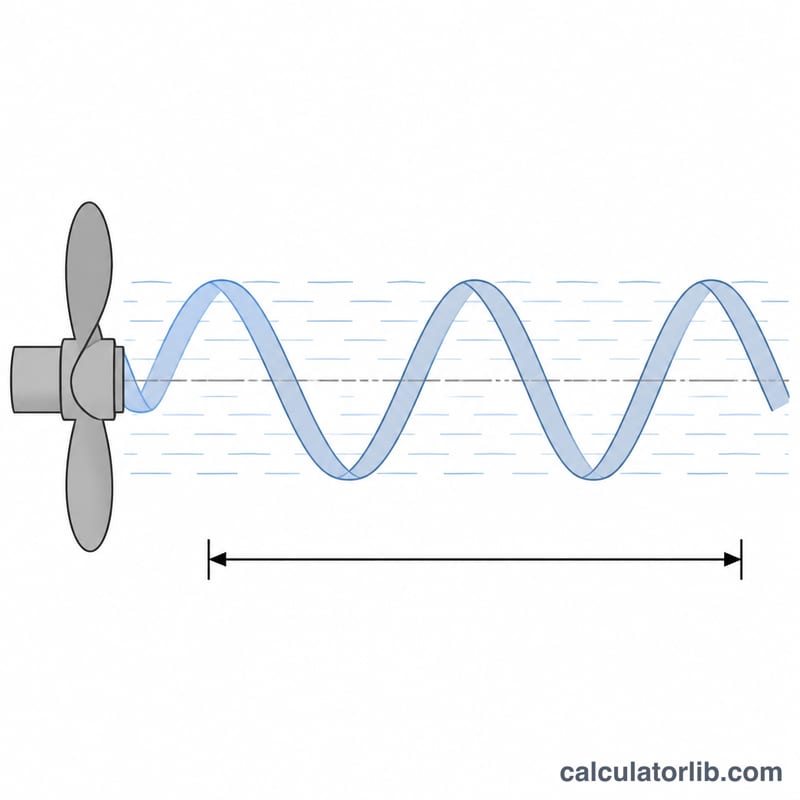
The Outboard Propeller Pitch Calculator estimates the propeller pitch (in inches) your outboard needs to reach a target boat speed at a chosen wide-open-throttle engine RPM. Pitch is the theoretical distance a prop travels forward in one full turn, so choosing the right pitch keeps the engine spinning in its ideal RPM band while delivering the speed you want.
The Formula Explained
Because one nautical relationship links speed, RPM and pitch, we can solve directly for pitch. Starting from theoretical speed and correcting for slip, the working equation is:
$$P = \frac{V \times 1056 \times R}{N \times (1 - S)}$$Here \(P\) = pitch in inches, \(V\) = target speed in mph, \(N\) = engine RPM, \(R\) = gearcase ratio, and \(S\) = prop slip as a decimal fraction. The constant \(1056\) comes from \(\frac{63360}{60}\), converting inches per mile and minutes per hour. Propeller RPM itself is \(N_{p} = \frac{N}{R}\).
How To Use It
Enter your target speed, the engine RPM you want to turn at full throttle, your gearcase ratio (printed on the gearcase or in the manual), and an estimated slip. Typical slip runs 10-15% for planing hulls. The result is the pitch to shop for; round to the nearest available propeller size.
Worked Example
Suppose you want \(30\) mph at \(5000\) RPM with a \(2.0\) gear ratio and \(10\%\) slip \((S = 0.10)\):
$$P = \frac{30 \times 1056 \times 2.0}{5000 \times (1 - 0.10)} = \frac{63360}{4500} = 14.08\,\text{in}$$So a 14-inch pitch propeller is the closest practical choice.
Pitch Across Common Scenarios
Every row below is the pitch produced by this tool's formula,
$$P = \frac{ S \times 1056 \times G}{\text{RPM} \times \left(1 - \frac{ \text{slip}}{100}\right)}$$where \(S\) is target speed in mph and \(G\) is the gearcase ratio. The table holds one input at a time constant so you can see how strongly each factor moves the required pitch. Note how raising WOT RPM or slip lowers the pitch, while a higher target speed or numerically larger gear ratio raises it.
| Target speed (mph) | WOT RPM | Gear ratio | Slip (%) | Pitch (in) |
|---|---|---|---|---|
| 25 | 5000 | 1.85 | 10 | 10.85 |
| 30 | 5000 | 1.85 | 10 | 13.02 |
| 35 | 5000 | 1.85 | 10 | 15.19 |
| 30 | 5000 | 2.00 | 10 | 14.08 |
| 30 | 5800 | 1.85 | 10 | 11.23 |
| 30 | 5000 | 1.85 | 15 | 13.79 |
| 35 | 5800 | 2.00 | 15 | 15.00 |
Worked check on the first row: \(P = \dfrac{ 25 \times 1056 \times 1.85}{5000 \times (1 - 0.10)} = \dfrac{ 48840}{4500} = 10.85\) in. Because the result is a continuous number, treat it as a target to round toward the nearest pitch a real propeller is actually sold in (see below).
Choosing and Verifying Your Prop
The calculated pitch is a starting point, not a part number. Use these general rules of thumb to turn it into a prop you can actually buy and confirm on the water.
- Round to an available size. Aluminum and stainless outboard props are typically sold in 2-inch pitch increments (for example 13, 15, 17, 19 in); many smaller props use odd pitches, while some larger diameters step in even numbers. Round your computed pitch to the nearest size the manufacturer lists for your model rather than expecting an exact match.
- Know the pitch-versus-RPM trade. As a widely used rule of thumb, dropping about 1 inch of pitch raises wide-open-throttle (WOT) RPM by roughly 150–200 RPM, and adding 1 inch lowers it by about the same. So if two available pitches straddle your target, you can predict which way each will push your RPM.
- Verify WOT RPM on the water. Run the boat at full throttle, trimmed and lightly loaded, and read actual WOT RPM. Compare it against your engine's rated WOT range printed in the owner's manual (rated ranges vary by engine, so use your own model's figure). If RPM lands above the range, add pitch; if below, drop pitch — then re-compute here with the corrected numbers.
- Re-check slip after a test run. If measured speed differs from the calculator, back out your real slip from that run and feed it back into the formula for a more accurate second estimate; hull type, load, and trim all change slip.
This is general guidance for sizing outboard props and not a substitute for your engine and propeller manufacturer's specifications. Always keep WOT RPM within the engine's rated range to avoid lugging or over-revving.
FAQ
Does more pitch mean more speed? A higher pitch can raise top speed but lowers engine RPM and acceleration; too much pitch lugs the engine below its rated range.
What slip should I use? Light, fast boats slip around 10%; heavier or high-bow-lift boats slip 15% or more. Adjust and recompare.
Is the result exact? No. It is a sizing estimate. Hull load, trim, and prop design shift real results, so treat it as a strong starting point.