
What Is Pitch Diameter?
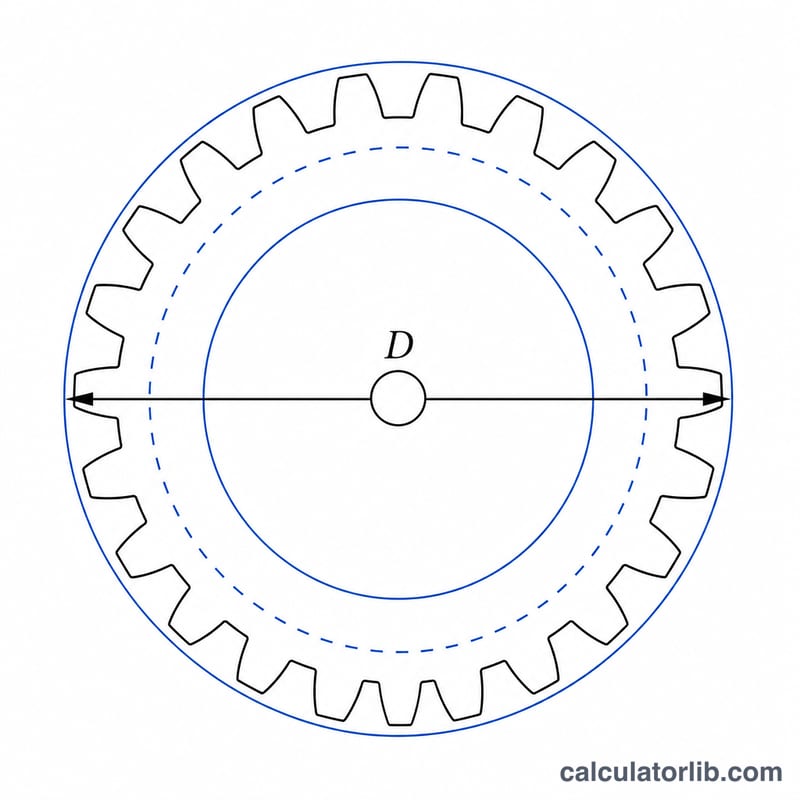
The pitch diameter (PD) of a gear is the diameter of the imaginary pitch circle on which two meshing gears effectively roll against each other without slipping. It is one of the most important dimensions in gear design because center distances, gear ratios, and tooth proportions are all referenced to it. This calculator finds the pitch diameter of a spur gear from its number of teeth and its diametral pitch.
How to Use This Calculator
Enter the number of teeth (N) on the gear and its diametral pitch (P), expressed in teeth per inch. The calculator instantly returns the pitch diameter in inches, along with the circular pitch. Diametral pitch is a common imperial measure of tooth size — a larger P means smaller, finer teeth.
The Formula Explained
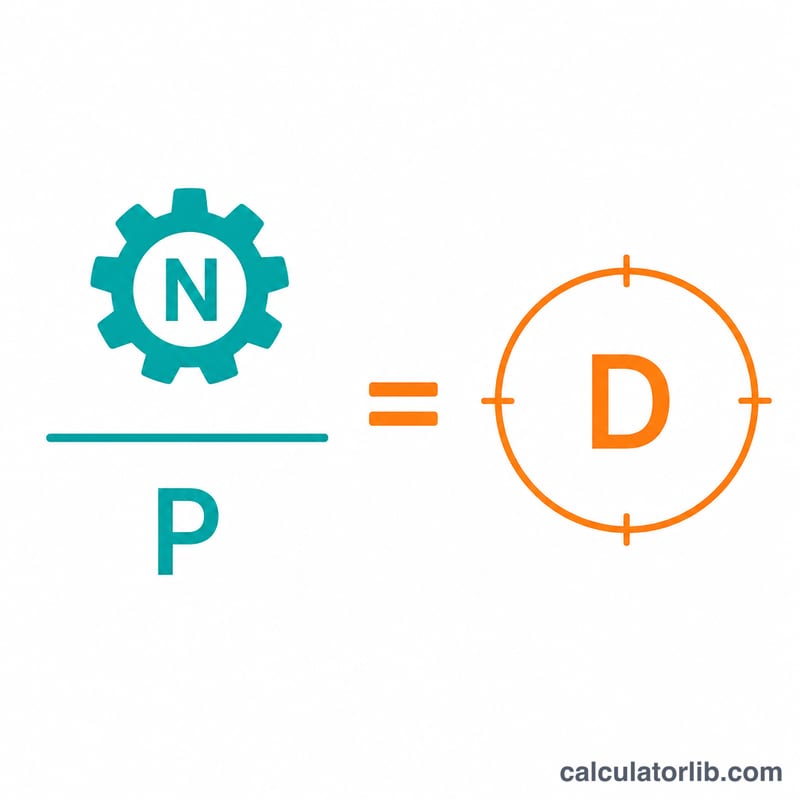
The relationship is simple: $$D = \frac{N}{P}$$ where \(D\) is the pitch diameter, \(N\) is the number of teeth, and \(P\) is the diametral pitch. Because diametral pitch describes how many teeth fit per inch of pitch diameter, dividing the total tooth count by \(P\) directly yields the diameter the teeth occupy.
Worked Example
Suppose a spur gear has 40 teeth and a diametral pitch of 10 teeth/inch. Then $$D = \frac{40}{10} = 4 \text{ inches}$$ The circular pitch is $$p = \frac{\pi}{P} = \frac{3.14159}{10} \approx 0.3142 \text{ inches}$$ the arc distance between adjacent teeth measured along the pitch circle.
FAQ
What is diametral pitch? It is the number of teeth per inch of pitch diameter — a standardized way to express gear tooth size in imperial units.
How does this relate to module? In metric design, module \(m = \frac{D}{N}\). Diametral pitch and module are reciprocally related (\(P \approx \frac{25.4}{m}\)).
Does this work for any gear type? The formula \(D = \frac{N}{P}\) applies to standard spur and helical gears using the diametral pitch convention.